Common eastern firefly
Photinus pyralis (Linnaeus, 1767) · also called firefly, Big Dipper Firefly
The common eastern firefly, also called the North American firefly, is a beetle rather than a fly, found across the United States east of the Rocky Mountains, whose males flash yellow-green lights to court females on summer evenings.

Quick facts
| Kingdom | Animalia[4] |
|---|---|
| Phylum | Arthropoda[4] |
| Class | Insecta[4] |
| Order | Coleoptera[4] |
| Family | Lampyridae[4] |
| Genus | Photinus[4] |
| Species | Photinus pyralis[1] |
| Authority | (Linnaeus, 1767)[1] |
| ITIS TSN | 1269201[4] |
| Synonyms | Lampyris pyralis Linnaeus, 1767; Cantharis pyralis[2] |
| Other common names | firefly, Big Dipper Firefly[3] |
| Length | 10–14 mm (0.39–0.55 in)[6] |
| Lifespan (max. recorded / range) | 5–30 days[6] |
| Eggs per season (average) | 500[6] |
| Weight | Not available from our sources |
| Diet type | carnivore[6] |
| Habitat | Meadows, woodland edges, stream banks, suburbs and farmland; larvae on moist ground and under bark · ADW biomes: savanna or grassland savanna or grassland forest forest[6] |
| IUCN Red List | Least Concern (LC)[5] IUCN page Population trend: not available through GBIF; see the IUCN assessment. |
Where it lives
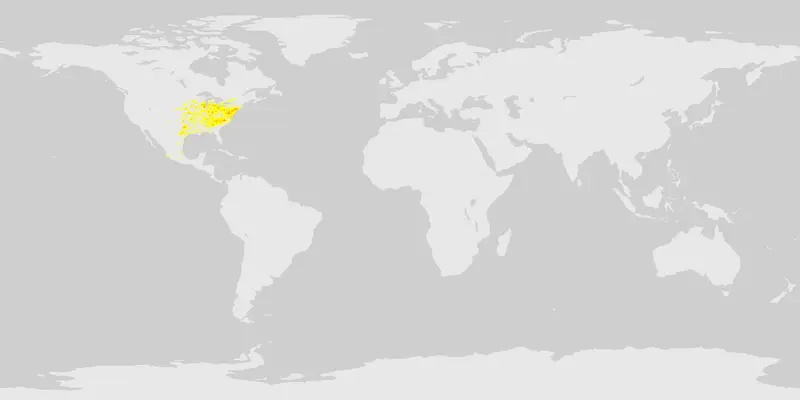
This is the most common of the world's roughly nineteen hundred firefly species, and very likely the one you chased as a child if you grew up in the East. It ranges throughout the United States east of the Rocky Mountains, and GBIF records come mostly from North Carolina, Pennsylvania, Ohio, New York and Texas. Adults appear from late spring into early fall in meadows, along woodland edges and near streams, and they also do well in suburbs and farm country. Records show a sharp peak in June and July, with far fewer sightings in May and August. Flashing begins at dusk, when males take to the air while females wait on the ground or perched in bushes. A male gives a quick flash, lasting only a fraction of a second, roughly every five or six seconds as he flies. Adults are dark brown and about half an inch long. Look for wing covers with thin yellow side edges and a rounded shield over the head outlined in yellow with two orange spots. The light comes from the last segment of the abdomen and glows a bright yellow-green. Watching from a darkened yard or a field away from streetlights gives the best view, since bright lights interfere with the signals fireflies send each other.
When & where in the US
GBIF holds 14,403 occurrence records of this species from the United States. States with the most records:
- North Carolina 1,681
- Pennsylvania 1,220
- Ohio 1,151
- New York 1,147
- Texas 956
Occurrence records reflect where and when people look and report (observer effort), not just where the animal is common. Busy birding states and summer months are over-represented; zoo and museum records can appear for non-native species.
Source: GBIF occurrence search for country US.[8]
What it eats
Both the larvae and the adults of this firefly are meat eaters. They hunt other insects, including other fireflies, along with earthworms and snails. A hunter injects a poison that paralyzes the prey and turns its insides to liquid, and the firefly then sucks up the meal. The larvae do most of this hunting, since the larval stage is the longest part of the life cycle and lasts one to two years. They live in moist places, on the ground, under bark and near streams, and on damp nights you may see them glowing there. They spend the winter and early spring burrowed in the soil, then come out in late spring to feed. Adults, by contrast, live only five days to about a month, and their brief time above ground is mostly about finding mates. That long hidden childhood is why the ground matters so much to fireflies. Snails and earthworms need damp soil, and so do the young hunters that chase them, so a soggy corner of a yard or a stream bank can be a firefly nursery for years before you ever see a single flash there.
Reproduction and life cycle
Firefly courtship is a conversation in light. Each firefly species has its own signal, and for this one a flying male sends a brief flash at a steady interval. A female waiting on the ground or in low bushes answers with her own flash about two seconds later, and that exact delay is how the male knows he has found a female of his own kind. He then drops down to her, and mating takes place on the ground. Females usually have short wings and do not fly at all. The light comes from a chemical reaction: an enzyme called luciferase uses oxygen and the cell's energy molecule to oxidize a compound called luciferin. It is often called cold light, since nearly all of the energy becomes light and very little becomes heat. Courtship runs through summer and early fall, and a female lays roughly five hundred eggs on damp soil. Even the eggs give off a faint glow. They hatch after about four weeks into flightless larvae, which also glow and are often called glowworms. After one to two years, a full-grown larva moves into a chamber in moist soil, pupates and emerges as an adult. Adults breed in a single season and then die. A darker twist: females of a predatory firefly copy the answer flash of this species, luring hopeful males in and eating them.
Threats and conservation
The common eastern firefly has no special conservation status, and the IUCN lists it as Least Concern. Its own chemistry protects it from many enemies: it contains a poisonous steroid that discourages predators such as birds and frogs, so its glow does not make it an easy meal. The biggest risk to a firefly display comes from our own lights. Bright light disrupts the signals that males and females trade, which is why Great Smoky Mountains National Park asks night visitors to cover flashlights with red cellophane, point them at the ground and switch them off once they reach a viewing spot. At home, turn off outdoor lights on summer evenings or use shielded fixtures that point downward, and draw the curtains on bright windows. Leave some damp, shady ground with leaf litter or loose bark where larvae can hunt, and go easy on garden chemicals that soak into the soil. The park also asks visitors not to catch fireflies and to stay on trails, because females rest on the ground where careless feet can crush them. If a firefly lands on you, stay still and let it fly off. Fireflies matter to science as well: researchers splice the gene behind their light into other plants and animals as a glowing tag for tracing inherited traits.
How to tell it apart
- Convergent lady beetle: A lady beetle is small, round and hard-shelled with red-orange covers and black spots, and it never glows. A firefly is longer, with dark brown wing covers edged in narrow yellow stripes.
- Western honey bee: A honey bee is reddish brown and hairy with clear wings and a barbed stinger, and it visits flowers by day. A firefly is a dark brown beetle that flies at dusk and hunts small animals.
- Monarch butterfly: Both are classic backyard insects in summer, but a monarch is a big orange daytime butterfly. A firefly is a small, dark brown beetle you notice mostly by its flashing light.
Photo: (c) Katja Schulz, some rights reserved (CC BY) — CC BY 4.0, source[9]. See all image credits.
Sources
- GBIF Backbone Taxonomy — Photinus pyralis (species 1162763), via GBIF API — retrieved 2026-11-21
- GBIF — synonyms of Photinus pyralis — retrieved 2026-11-21
- GBIF — vernacular names of Photinus pyralis — retrieved 2026-11-21
- ITIS — full hierarchy for TSN 1269201 — retrieved 2026-11-21
- IUCN Red List category via GBIF (Photinus pyralis) — retrieved 2026-11-21
- Animal Diversity Web (University of Michigan) — Photinus pyralis account — retrieved 2026-11-21
- GBIF occurrence density map tile for Photinus pyralis — retrieved 2026-11-21
- GBIF occurrence search — Photinus pyralis, country US, month and state facets — retrieved 2026-11-21
- iNaturalist taxon 129350 — Photinus pyralis (photo source) — retrieved 2026-11-21
- National Park Service — Yellowstone: Common eastern firefly — retrieved 2026-11-21

Written under the pen name Maya Reynolds with AI-assisted drafting, then checked against the sources cited on each page. Last reviewed 2026-11-21. Numbers in the fact table come only from the linked sources; all prose is original. See our editorial policy.