Western honey bee
Apis mellifera Linnaeus, 1758 · also called honey bee, Africanized honey bee, Domestic Honey Bee, Drone-bee, European Honey Bee, Killer Bee
The western honey bee is a social insect native to Europe, western Asia and Africa that people have carried to nearly every continent, including the Americas, for its honey, its wax and the pollination it gives to crops.

Quick facts
| Kingdom | Animalia[4] |
|---|---|
| Phylum | Arthropoda[4] |
| Class | Insecta[4] |
| Order | Hymenoptera[4] |
| Family | Apidae[4] |
| Genus | Apis[4] |
| Species | Apis mellifera[1] |
| Authority | Linnaeus, 1758[1] |
| ITIS TSN | 154396[4] |
| Synonyms | Apis adansonii Latreille, 1804; Apis aenigmaticus Rayment, 1925; Apis australis Kiesenwetter, 1860; Apis caffra Lepeletier, 1836; Apis cerifera Gerstäcker, 1862; Apis cerifera Scopoli, 1770; Apis daurica Fischer von Waldheim, 1843; Apis fasciata Latreille, 1804[2] |
| Other common names | honey bee, Africanized honey bee, Domestic Honey Bee, Drone-bee, European Honey Bee, Killer Bee[3] |
| Length | 10–20 mm (0.39–0.79 in)[6] |
| Lifespan (max. recorded / range) | 2–3 years[6] |
| Eggs per season | 60,000 to 80,000[6] |
| Gestation (average) | 3 days[6] |
| Weight | Not available from our sources |
| Diet type | herbivore[6] |
| Habitat | Meadows, gardens, open woods, farmland and towns; also grassland, desert and wetland where flowers, water and nest cavities exist · ADW biomes: desert or dune desert or dune savanna or grassland savanna or grassland chaparral chaparral forest forest[6] |
| IUCN Red List | Not Evaluated (NE)[5] Population trend: not available through GBIF; see the IUCN assessment. |
Where it lives
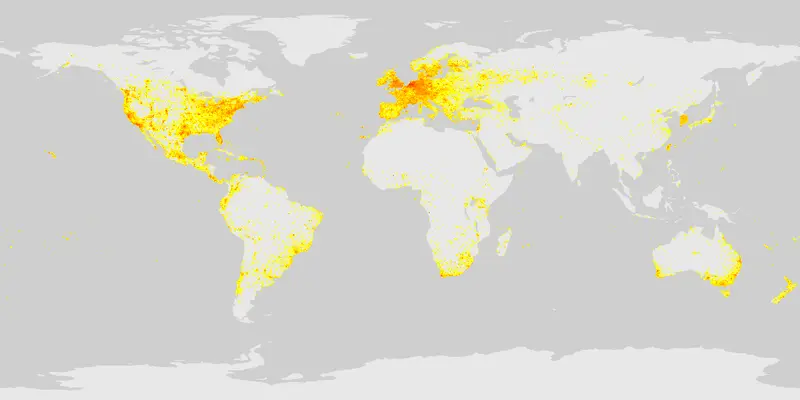
It surprises many Americans to learn that the honey bee is not a native insect here. Its homeland is Europe, western Asia and Africa, and people started shipping colonies to other continents during the seventeenth century. It now turns up around the globe, from eastern Asia and Australia to both Americas. In the United States, records gathered by GBIF come from coast to coast, with California and Texas logging the most, followed by Pennsylvania, Florida and New York. Most of these bees belong to managed hives, from backyard boxes to large commercial apiaries. In the wild, a colony needs a sheltered cavity such as a hollow tree for its nest. Untended, feral colonies once lived across North America, but parasitic mites are believed to have wiped out nearly all of them. In the southern United States, some bees now carry genes from an African subspecies that escaped in South America and spread north; these bees answer any disturbance with far more defenders and chase intruders much farther. Honey bees forage only in daylight and stay home in heavy rain, strong wind or chilly weather, since workers cannot fly once they cool below about fifty degrees Fahrenheit. US sightings climb from March, stay high through summer and peak in September before tapering off in late fall. In cold months the colony huddles in a tight ball inside the hive and shivers its flight muscles to stay warm.
When & where in the US
GBIF holds 362,132 occurrence records of this species from the United States. States with the most records:
- California 86,050
- Texas 50,233
- Pennsylvania 16,714
- Florida 16,169
- New York 13,109
Occurrence records reflect where and when people look and report (observer effort), not just where the animal is common. Busy birding states and summer months are over-represented; zoo and museum records can appear for non-native species.
Source: GBIF occurrence search for country US.[8]
What it eats
Honey bees live on what flowers provide. Nectar supplies energy, and a forager sips it with her tongue and holds it in a front chamber of her gut called the crop. Back at the hive she hands it off to younger workers, who either share it around the colony or turn it into honey: they mix in enzymes and leave it in open cells so extra water can evaporate and the sugars grow concentrated. Pollen is the protein side of the menu. A forager brushes the grains off her fuzzy body and packs them into baskets on her hind legs, and the colony stores the surplus in the comb. Young workers eat pollen and nectar and make a rich jelly in glands in their heads, which they feed to the larvae. Workers also fly out for water, gather plant resins that they blend with wax into a sealant called propolis, and sometimes lap up honeydew, the sugary waste that aphids leave on leaves. They can be thieves, too, raiding weak hives when flowers run short. A forager that discovers a rich patch dances on the comb when she returns. A simple round dance means food is close by, while the famous waggle dance tells her sisters both the direction and distance of a farther patch, using the sun as a reference. Most foraging happens within roughly two miles of home, but bees will travel five to eight miles if they must. Gardeners who want to help can plant a mix of flowers that bloom one after another from spring through fall.
Reproduction and life cycle
A honey bee colony works almost like a single organism. One queen lays the eggs, as many as a thousand in a single day, while the sterile female workers handle every other job. A worker's duties change as she ages. Newly emerged bees clean cells, then tend larvae and the queen, process nectar and fan their wings to move air through the hive; in their second week they start making wax and building comb, later they take turns guarding the entrance, and after about three weeks they become foragers. The queen decides whether each egg is fertilized. Unfertilized eggs become male drones, whose only role is mating, while fertilized eggs become workers or new queens depending on the food the larvae receive. Healthy colonies reproduce by swarming, usually once or twice a year as the main nectar season begins. Workers raise several new queens, and just before they emerge the old queen departs with as many as half the workers. The swarm hangs in a temporary cluster on a branch while scouts hunt for a new cavity. Back home, the young queens battle until only one is left. She flies to spots where drones gather, mates with several males in flight, from her own colony or others nearby, and then returns to lay eggs without ever mating again. A queen usually lives two or three years, while summer workers last only a few weeks.
Threats and conservation
The species as a whole remains extremely numerous and has no special conservation status, but beekeepers have serious worries. The worst enemy is the varroa mite, which jumped from an Asian honey bee, spread around the world and also carries viruses; heavy infestations often destroy whole colonies. A tiny mite that lives in the breathing tubes, several bacterial and fungal brood diseases, and the small hive beetle add to the burden. Large commercial operations in North America have also faced colony collapse disorder, in which hives suddenly lose nearly all their workers, and no single cause has been pinned down. In Europe, there is concern that commercial beekeeping is crowding out locally adapted kinds of honey bee. Honey bees can also put pressure on native pollinators in North America, where no native bee forms such big colonies and solitary bees may lose out at the flowers. A yard full of native flowers and flowering shrubs helps both groups. Avoid spraying insecticides on open blooms, and set out a shallow water dish with pebbles for landing. If a swarm settles on your property, do not spray it; a local beekeeping club can often collect it. A single sting hurts but is not dangerous unless someone is allergic to the venom, so people with allergies should carry the medication their doctor recommends.
How to tell it apart
- Monarch butterfly: A monarch also visits garden flowers, but it is a large orange and black butterfly with broad wings that it holds open. A honey bee is small and reddish brown, with dark and yellowish bands on the abdomen and a hairy thorax.
- Convergent lady beetle: A lady beetle is round and shiny red-orange with black spots, and its hard wing covers hide the flying wings. A bee has a hairy thorax, a banded abdomen and pollen baskets on its hind legs.
- Common eastern firefly: A firefly is a dark brown beetle with yellow-edged wing covers and a rounded shield over its head, and its tail lights up at dusk. It has no pollen baskets and hunts small animals instead of visiting flowers.
- Ruby-throated hummingbird: Both hover at the same flowers, but a hummingbird is a feathered bird with a needle bill and a humming blur of wings, several times the size of any bee.
Photo: no rights reserved — CC0 1.0, source[9]. See all image credits.
Sources
- GBIF Backbone Taxonomy — Apis mellifera (species 1341976), via GBIF API — retrieved 2026-11-21
- GBIF — synonyms of Apis mellifera — retrieved 2026-11-21
- GBIF — vernacular names of Apis mellifera — retrieved 2026-11-21
- ITIS — full hierarchy for TSN 154396 — retrieved 2026-11-21
- IUCN Red List category via GBIF (Apis mellifera) — retrieved 2026-11-21
- Animal Diversity Web (University of Michigan) — Apis mellifera account — retrieved 2026-11-21
- GBIF occurrence density map tile for Apis mellifera — retrieved 2026-11-21
- GBIF occurrence search — Apis mellifera, country US, month and state facets — retrieved 2026-11-21
- iNaturalist taxon 47219 — Apis mellifera (photo source) — retrieved 2026-11-21

Written under the pen name Maya Reynolds with AI-assisted drafting, then checked against the sources cited on each page. Last reviewed 2026-11-21. Numbers in the fact table come only from the linked sources; all prose is original. See our editorial policy.