Ruby-throated hummingbird
Archilochus colubris (Linnaeus, 1758) · also called Ruby Throat, Ruby-throated/Black-chinned Hummingbird
The ruby-throated hummingbird is the only hummingbird that regularly nests in the eastern United States, a tiny emerald bird whose males carry a glittering red throat patch.

Quick facts
| Kingdom | Animalia[4] |
|---|---|
| Phylum | Chordata[4] |
| Class | Aves[4] |
| Order | Apodiformes[4] |
| Family | Trochilidae[4] |
| Genus | Archilochus[4] |
| Species | Archilochus colubris[1] |
| Authority | (Linnaeus, 1758)[1] |
| ITIS TSN | 178032[4] |
| Synonyms | Trochilus colubris Linnaeus, 1758; Trochilus colubris[2] |
| Other common names | Ruby Throat, Ruby-throated/Black-chinned Hummingbird[3] |
| Length | 7.5–9 cm (2.95–3.54 in)[6] |
| Weight | 3.4–3.8 g (0.12–0.13 oz)[6] |
| Lifespan (max. recorded / range) | 5–9.1 years[6] |
| Eggs per season | 1 to 3[6] |
| Incubation (time to hatching) | 10 to 14 days[6] |
| Diet type | herbivore[6] |
| Habitat | Deciduous and mixed woods, woodland edges, gardens and orchards · ADW biomes: forest forest rainforest rainforest scrub forest scrub forest[6] |
| IUCN Red List | Least Concern (LC)[5] IUCN page Population trend: not available through GBIF; see the IUCN assessment. |
Where it lives
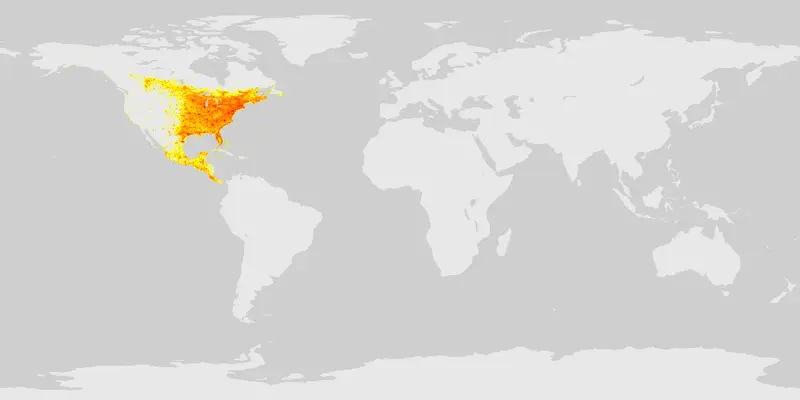
Ruby-throats breed across the eastern half of the continent, from the Gulf Coast to southern Canada and west to the Great Plains. In fall nearly all of them leave for southern Mexico and Central America, and many cross the Gulf of Mexico in a single nonstop flight, an extraordinary feat for a bird that weighs less than a coin. Others follow the coastline through Texas. In spring males usually arrive a little before females, and the first sightings at feeders move northward through the season like a wave. The monthly GBIF chart for the United States shows that pattern sharply, with records near zero in winter.
Where and when to look
Most of eastern North America sees ruby-throated hummingbirds only from spring until early fall, so timing matters. Males arrive first, often just as early flowers and the first sugar-water feeders appear, and adult males are also the first to leave in late summer, with females and young lingering a little longer. Late summer is the busiest season, when fresh juveniles join the adults and the birds feed heavily before migrating across or around the Gulf of Mexico. Plant tubular red and orange flowers such as bee balm, cardinal flower, trumpet honeysuckle and salvias, and keep a feeder of plain sugar water with no dye, changing it every few days in hot weather. Watch for the male's dramatic pendulum dive, a wide U-shaped swoop above a perched female, and listen for the sharp chips and squeaky chatter of birds chasing each other off a feeder. Only the adult male shows the gleaming red throat, which can look black when the light is wrong; females and immature birds have pale throats and white tips on the outer tail feathers. Young males may show a few dark streaks or spots on the throat by late summer. Tiny walnut-sized nests sit on top of a branch and look like knots of lichen, so a long look with binoculars from a respectful distance is better than a close check.
When & where in the US
GBIF holds 3,939,651 occurrence records of this species from the United States. States with the most records:
- Texas 314,191
- New York 257,325
- Pennsylvania 226,096
- North Carolina 215,537
- Florida 189,909
Occurrence records reflect where and when people look and report (observer effort), not just where the animal is common. Busy birding states and summer months are over-represented; zoo and museum records can appear for non-native species.
Source: GBIF occurrence search for country US.[7]
What it eats
Hummingbirds live on nectar and tiny insects. They favor tubular red and orange flowers such as trumpet honeysuckle, cardinal flower, bee balm and jewelweed, licking nectar with a fringed tongue many times per second. Sugar fuels their extreme metabolism, but protein comes from gnats, small flies, mosquitoes and spiders, which they catch in the air or pluck from webs. They also visit sap wells drilled by sapsuckers. A feeder filled with a simple solution of white sugar and water is plenty; red dye is not needed and is best avoided. Changing the solution often in hot weather keeps it from spoiling.
Reproduction and life cycle
Males and females meet only briefly. The male performs a dramatic pendulum display, swinging back and forth in a wide U in front of the female, and then plays no further role. She builds a walnut-sized cup of plant down bound with spider silk and camouflaged with flakes of lichen, usually saddled on a downsloping branch. The silk lets the nest stretch as the chicks grow. She incubates alone and feeds the young a slurry of nectar and insects. The fledglings soon learn to feed themselves and gain fat for the long autumn journey south.
Threats and conservation
The species is common and assessed as least concern. Habitat loss on both breeding and wintering grounds, pesticide use that reduces insect prey, and window strikes all take a toll. Because migration timing is tied to flower bloom, shifts in climate that change when flowers open could cause mismatches. Planting native nectar flowers that bloom from spring through fall, avoiding insecticides and keeping feeders clean are the most useful ways to help.
How to tell it apart
- Northern cardinal: The only other common bird with bright red in an eastern yard, but a cardinal is thick-billed, crested, red or brown all over and many times heavier.
- American goldfinch: Similar size at flowers, yet a goldfinch perches to feed, is yellow or olive rather than metallic green, and has a short cone bill.
- Monarch butterfly: Moves from flower to flower like a hummingbird, but it is an insect with orange wings; a hummingbird hums, hovers motionless and darts backward.
Photo: no rights reserved — CC0 1.0, source[8]. See all image credits.
Sources
- GBIF Backbone Taxonomy — Archilochus colubris (species 5228514), via GBIF API — retrieved 2026-11-21
- GBIF — synonyms of Archilochus colubris — retrieved 2026-11-21
- GBIF — vernacular names of Archilochus colubris — retrieved 2026-11-21
- ITIS — full hierarchy for TSN 178032 — retrieved 2026-11-21
- IUCN Red List category via GBIF (Archilochus colubris) — retrieved 2026-11-21
- Animal Diversity Web (University of Michigan) — Archilochus colubris account — retrieved 2026-11-21
- GBIF occurrence search — Archilochus colubris, country US, month and state facets — retrieved 2026-11-21
- iNaturalist taxon 6432 — Archilochus colubris (photo source) — retrieved 2026-11-21
Written under the pen name Maya Reynolds with AI-assisted drafting, then checked against the sources cited on each page. Last reviewed 2026-11-21. Numbers in the fact table come only from the linked sources; all prose is original. See our editorial policy.