Northern cardinal
Cardinalis cardinalis (Linnaeus, 1758) · also called Cardinal, Cardinal Grosbeak, Cardinal Redbird, Cardinal-bird, Common Cardinal, Crested Redbird
The northern cardinal is a stout, crested songbird of eastern and southern North America whose males glow scarlet all year and whose thick red bill is built for cracking seeds.

Quick facts
| Kingdom | Animalia[4] |
|---|---|
| Phylum | Chordata[4] |
| Class | Aves[4] |
| Order | Passeriformes[4] |
| Family | Cardinalidae[4] |
| Genus | Cardinalis[4] |
| Species | Cardinalis cardinalis[1] |
| Authority | (Linnaeus, 1758)[1] |
| ITIS TSN | 179124[4] |
| Synonyms | Loxia cardinalis Linnaeus, 1758; Richmondena cardinalis (Linnaeus, 1758)[2] |
| Other common names | Cardinal, Cardinal Grosbeak, Cardinal Redbird, Cardinal-bird, Common Cardinal, Crested Redbird[3] |
| Length | 20.9–23.5 cm (8.23–9.25 in)[6] |
| Weight | 42–48 g (1.48–1.69 oz)[6] |
| Lifespan (max. recorded / range) | 15.75 years[6] |
| Eggs per season | 1 to 5[6] |
| Incubation (time to hatching) | 11 to 13 days[6] |
| Diet type | herbivore[6] |
| Habitat | Forest edges, thickets, gardens and suburban yards · ADW biomes: forest[6] |
| IUCN Red List | Least Concern (LC)[5] IUCN page Population trend: not available through GBIF; see the IUCN assessment. |
Where it lives
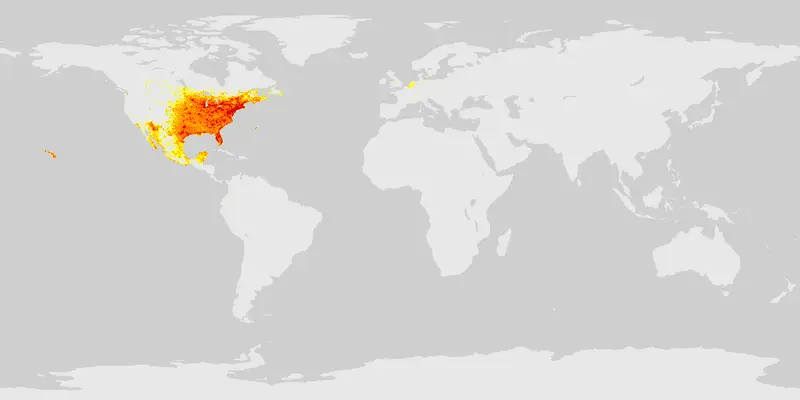
Cardinals are birds of brushy edges rather than deep forest. They live year-round across the eastern half of the United States, through the Gulf states and into the desert Southwest, and they keep pushing north into New England and southern Canada. Much of that northward spread happened as towns grew, hedges were planted and bird feeders became common, which gave the species reliable winter food at the cold edge of its range. Cardinals do not migrate, so a pair you see in July is very likely the same pair on your feeder in January. That loyalty to one patch is also why the GBIF chart below stays fairly flat across the year compared with a migrant like the robin. Away from people, look for them in tangled shrubs along streams, overgrown fields and the margins of woodlots, where dense cover sits close to open ground for feeding.
Where and when to look
The easiest time to find a cardinal is the first and last half hour of daylight, when pairs feed on the ground under feeders and shrubs before most other birds arrive and after they leave. Listen before you look. The male's song is a loud, clear series of slurred whistles, often written as cheer, cheer, cheer or birdie, birdie, birdie, and the call note is a sharp metallic chip that sounds like a pebble tapped on glass; once you learn that chip, you will notice cardinals in nearly every hedge. In winter they join loose flocks, so one sighting often means several more birds nearby. Females are easy to overlook: warm buffy brown with reddish wings and tail, a crest and the same coral-red bill, so check every plain brown bird under the feeder. A good habit for families is a weekly cardinal count from the same window at the same time, which turns a common bird into a real record of how your yard changes through the year.
When & where in the US
GBIF holds 25,076,193 occurrence records of this species from the United States. States with the most records:
- Texas 2,062,180
- New York 1,905,145
- Florida 1,700,443
- Pennsylvania 1,692,926
- Ohio 1,403,689
Occurrence records reflect where and when people look and report (observer effort), not just where the animal is common. Busy birding states and summer months are over-represented; zoo and museum records can appear for non-native species.
Source: GBIF occurrence search for country US.[8]
What it eats
A cardinal is mostly a seed eater, and that heavy cone-shaped bill is the tool for the job. It rolls a seed against the edges of the bill, crushes the hull and swallows the kernel, which is why black-oil sunflower and safflower are the feeder favorites. Wild foods include the seeds of weeds and grasses, wild grapes, dogwood and sumac fruit, and buds in early spring. During the nesting season the adults switch a large share of their effort to insects such as caterpillars, beetles and grasshoppers, because nestlings need protein to grow quickly. Cardinals usually feed on or near the ground, hopping under shrubs and around the base of a feeder rather than clinging to it. Watching a pair at dawn and dusk, the busiest feeding times, is one of the easiest bits of nature study available to anyone with a window.
Reproduction and life cycle
Courtship in cardinals is unusually gentle to watch. Males feed females bill to bill, a behavior that starts in late winter and continues while she sits on eggs. Both sexes sing, and the female often answers the male from the nest, which may tell him when to bring food. She builds a loose cup of twigs, bark strips and grass, lined with fine material, wedged in a dense shrub or vine tangle at about head height. The female does most of the incubating while the male defends the territory and attacks intruders, including his own reflection in windows and car mirrors. Young cardinals leave the nest before they fly well and spend several days hiding in low cover while both parents feed them. Pairs often raise more than one brood in a season, with the male taking over the fledglings while the female starts the next nest.
Threats and conservation
The species is common and widespread, and its population has done well alongside people. The hazards it faces are the everyday ones of a backyard bird. Collisions with windows kill many songbirds each year, and cardinals are at extra risk because territorial males fight their reflections. Free-roaming pet cats take adults and especially recently fledged young that sit on low branches. Nests in shrubs are raided by snakes, jays, squirrels and raccoons, and brown-headed cowbirds sometimes lay eggs in cardinal nests. Feeders can spread disease if they are not cleaned. Simple steps help: window decals or screens, keeping cats indoors, regular feeder cleaning and planting native shrubs that offer both cover and fruit.
How to tell it apart
- Ruby-throated hummingbird: Also flashes red in the yard, but only on the male's throat. The hummingbird is far smaller, metallic green above, with a needle bill and no crest, and it hovers instead of hopping.
- American robin: The robin's breast is brick orange rather than true red, its back is gray-brown, it has no crest, and its bill is slim and yellow. Robins run and pause on lawns, pulling worms.
- Blue jay: Shares the crest and the feeder, but is blue, white and black, larger and much louder, with a black necklace across the throat.
- Red-tailed hawk: Only the tail is rusty red, and only from above. A hawk is many times larger, perches high on poles and sails in circles, which a cardinal never does.
Photo: (c) Paul Danese, some rights reserved (CC BY-SA) — CC BY-SA 4.0, source[9]. See all image credits.
Sources
- GBIF Backbone Taxonomy — Cardinalis cardinalis (species 2490384), via GBIF API — retrieved 2026-11-21
- GBIF — synonyms of Cardinalis cardinalis — retrieved 2026-11-21
- GBIF — vernacular names of Cardinalis cardinalis — retrieved 2026-11-21
- ITIS — full hierarchy for TSN 179124 — retrieved 2026-11-21
- IUCN Red List category via GBIF (Cardinalis cardinalis) — retrieved 2026-11-21
- Animal Diversity Web (University of Michigan) — Cardinalis cardinalis account — retrieved 2026-11-21
- GBIF occurrence density map tile for Cardinalis cardinalis — retrieved 2026-11-21
- GBIF occurrence search — Cardinalis cardinalis, country US, month and state facets — retrieved 2026-11-21
- iNaturalist taxon 9083 — Cardinalis cardinalis (photo source) — retrieved 2026-11-21

Written under the pen name Maya Reynolds with AI-assisted drafting, then checked against the sources cited on each page. Last reviewed 2026-11-21. Numbers in the fact table come only from the linked sources; all prose is original. See our editorial policy.