Blue jay
Cyanocitta cristata (Linnaeus, 1758) · also called Jay-bird
The blue jay is a bold, crested member of the crow family from eastern North America, patterned in bright blue, white and black and famous for its loud calls and acorn caching.

Quick facts
| Kingdom | Animalia[4] |
|---|---|
| Phylum | Chordata[4] |
| Class | Aves[4] |
| Order | Passeriformes[4] |
| Family | Corvidae[4] |
| Genus | Cyanocitta[4] |
| Species | Cyanocitta cristata[1] |
| Authority | (Linnaeus, 1758)[1] |
| ITIS TSN | 179680[4] |
| Synonyms | Corvus cristatus Linnaeus, 1758; Corvus cristatus[2] |
| Other common names | Jay-bird[3] |
| Length | 22–30 cm (8.66–11.8 in)[6] |
| Weight | 65–109 g (2.29–3.84 oz)[6] |
| Lifespan (max. recorded / range) | 17.5 years[6] |
| Eggs per season | 3 to 6[6] |
| Incubation (time to hatching) (average) | 17 days[6] |
| Diet type | omnivore[6] |
| Habitat | Oak and mixed woods, suburbs, parks and towns · ADW biomes: forest[6] |
| IUCN Red List | Least Concern (LC)[5] IUCN page Population trend: not available through GBIF; see the IUCN assessment. |
Where it lives
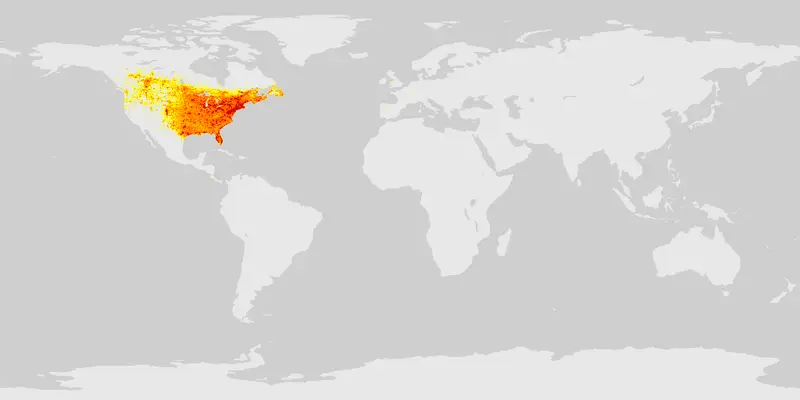
Blue jays live from the Atlantic coast west to the Great Plains, and from southern Canada to Florida and eastern Texas. In recent decades they have spread somewhat farther west into the Rockies' foothills, where they occasionally meet and even hybridize with the related Steller's jay. Some blue jays migrate, moving in loose flocks along lakeshores and ridges in fall, while others stay put all winter. Which individuals migrate in a given year seems to vary, and researchers still do not fully understand the pattern. The species is most at home where oaks grow, because acorns are central to its life, but it adapts well to towns with large shade trees and feeders.
Where and when to look
Blue jays are often heard before they are seen. The classic jay call is a harsh, descending jeer, but jays also make a liquid, bell-like pumphandle call and an uncanny imitation of a red-shouldered or red-tailed hawk, which may warn other jays or scare competitors from food. On fall mornings, watch the sky over ridges and lakeshores for loose, silent flocks moving in one direction; that is migration. In September and October, jays are busy shuttling acorns from oaks to hiding places, so a single oak in a quiet yard can host a steady procession. At feeders they prefer platform trays with whole peanuts. If you hear a sudden chorus of jays scolding in one tree, look carefully into the branches; mobbing jays often lead you to a roosting owl or a hawk.
When & where in the US
GBIF holds 20,731,677 occurrence records of this species from the United States. States with the most records:
- New York 1,932,403
- Pennsylvania 1,489,055
- Florida 1,293,582
- Massachusetts 1,199,151
- Ohio 1,164,619
Occurrence records reflect where and when people look and report (observer effort), not just where the animal is common. Busy birding states and summer months are over-represented; zoo and museum records can appear for non-native species.
Source: GBIF occurrence search for country US.[7]
What it eats
Jays are true omnivores. Acorns, beechnuts and other nuts make up a large part of the year's food, and a jay can carry several acorns at once in a throat pouch and its bill. It buries them one by one in the ground for later, and the nuts it never recovers grow into new trees. Many ecologists credit jays with helping oak forests spread north after the last ice age. They also eat insects, fruit, grains, and occasionally eggs or nestlings of other birds, which gives them a fierce reputation that is somewhat exaggerated; studies of stomach contents show bird prey is a small fraction of the diet. At feeders, jays favor peanuts and sunflower seeds and often arrive in noisy groups.
Reproduction and life cycle
Blue jays are believed to form long-term pair bonds. Before nesting, small groups of males follow a female in courtship flights. The pair builds a nest of twigs, often snapping living twigs from trees, held together with mud or grass and lined with rootlets, set in the crotch of a tree. During nesting the normally raucous jay becomes quiet and secretive near the nest. The female does most of the incubating while the male feeds her. Young jays stay with their parents for some time after leaving the nest and travel with family groups into the fall.
Threats and conservation
The species is common and assessed as least concern. It faces the same suburban hazards as other songbirds, including window collisions and cats, and it was hit hard by West Nile virus when the disease arrived in North America. Because jays depend on oaks, the long-term health of oak woodlands matters for them. Planting oaks and other nut trees is a long-term gift to jays and to many other species.
How to tell it apart
- Northern cardinal: The other common crested feeder bird, but red (male) or warm brown (female) with a red bill, smaller and with sweet whistled songs instead of harsh screams.
- Black-capped chickadee: Gray, black and white rather than blue, much smaller, and without a crest.
- American robin: Close in size and shape on a lawn, but the robin shows an orange breast and no blue at all.
Photo: (c) Judy Gallagher, some rights reserved (CC BY) — CC BY 4.0, source[8]. See all image credits.
Sources
- GBIF Backbone Taxonomy — Cyanocitta cristata (species 2482593), via GBIF API — retrieved 2026-11-21
- GBIF — synonyms of Cyanocitta cristata — retrieved 2026-11-21
- GBIF — vernacular names of Cyanocitta cristata — retrieved 2026-11-21
- ITIS — full hierarchy for TSN 179680 — retrieved 2026-11-21
- IUCN Red List category via GBIF (Cyanocitta cristata) — retrieved 2026-11-21
- Animal Diversity Web (University of Michigan) — Cyanocitta cristata account — retrieved 2026-11-21
- GBIF occurrence search — Cyanocitta cristata, country US, month and state facets — retrieved 2026-11-21
- iNaturalist taxon 8229 — Cyanocitta cristata (photo source) — retrieved 2026-11-21
Written under the pen name Maya Reynolds with AI-assisted drafting, then checked against the sources cited on each page. Last reviewed 2026-11-21. Numbers in the fact table come only from the linked sources; all prose is original. See our editorial policy.