Black-capped chickadee
Poecile atricapillus (Linnaeus, 1766) · also called Black-capped Titmouse, Black-capped/Mountain Chickadee, Black-capt Titmouse, Northern Chickadee
The black-capped chickadee is a tiny, round-headed songbird of northern and western North America with a black cap and bib, white cheeks and a famously cheerful chick-a-dee call.

Quick facts
| Kingdom | Animalia[4] |
|---|---|
| Phylum | Chordata[4] |
| Class | Aves[4] |
| Order | Passeriformes[4] |
| Family | Paridae[4] |
| Genus | Poecile[4] |
| Species | Poecile atricapillus[1] |
| Authority | (Linnaeus, 1766)[1] |
| ITIS TSN | 554382[4] |
| Synonyms | Parus atricapillus Linnaeus, 1766; Parus atricapillus[2] |
| Other common names | Black-capped Titmouse, Black-capped/Mountain Chickadee, Black-capt Titmouse, Northern Chickadee[3] |
| Length | 13.3 cm (5.24 in)[6] |
| Weight | 11 g (0.39 oz)[6] |
| Lifespan (max. recorded / range) | 12.5 years[6] |
| Eggs per season | 5 to 10[6] |
| Incubation (time to hatching) | 12 to 13 days[6] |
| Diet type | carnivore[6] |
| Habitat | Deciduous and mixed forest, woodland edges, parks and backyards · ADW biomes: taiga taiga forest forest[6] |
| IUCN Red List | Least Concern (LC)[5] IUCN page Population trend: not available through GBIF; see the IUCN assessment. |
Where it lives
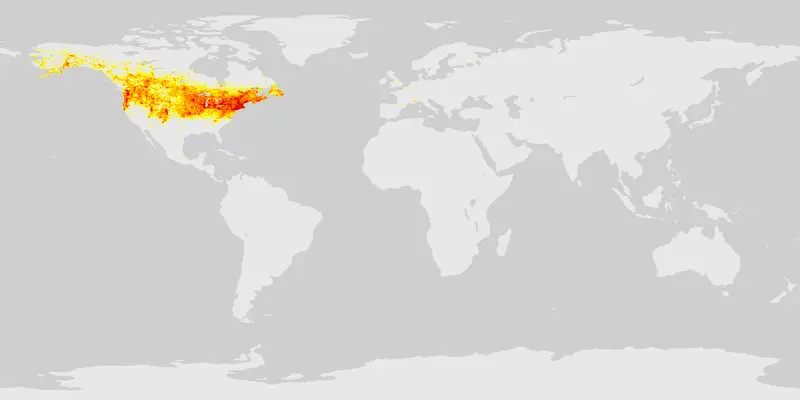
This chickadee lives across the northern United States and most of Canada, from Alaska to the Atlantic, and southward in the West through the Rockies. Along a line through the middle of the eastern states it meets the very similar Carolina chickadee, and the two sometimes interbreed in the contact zone. Black-capped chickadees stay on their home range year-round. In winter they move in small flocks that often include nuthatches, kinglets, downy woodpeckers and titmice, and other birds seem to rely on the chickadees' sharp alarm calls to detect predators. In some winters, when seed crops fail in the north, larger numbers show up south of the usual range.
Where and when to look
Chickadees are the rare backyard bird that seems to come looking for you. Cold, still mornings from late fall through early spring are the best time, because the birds travel in small, chattering bands that sweep through a yard every hour or so and often pull nuthatches, titmice, kinglets and downy woodpeckers along with them. Stand near a feeder with black oil sunflower seed and watch the routine: a bird darts in, grabs one seed, and flies to a branch to hammer it open against the bark, or tucks it into a crevice to eat later. The familiar chick-a-dee-dee-dee call grows longer when the flock is agitated, so extra dee notes are a good hint that an owl or a cat is close. The sweet, two-note whistle that drops in pitch, often written fee-bee, is the song, and you can hear it on sunny days even in January. Males and females look alike, so watch behavior instead: in spring, pairs split off from the winter flock and excavate a cavity in soft, rotting wood. Leave dead snags standing where it is safe, and keep feeders clean so disease does not spread through a flock that visits every day.
When & where in the US
GBIF holds 13,179,653 occurrence records of this species from the United States. States with the most records:
- New York 1,625,672
- Massachusetts 1,192,278
- Michigan 1,111,759
- Wisconsin 1,040,685
- Washington 890,149
Occurrence records reflect where and when people look and report (observer effort), not just where the animal is common. Busy birding states and summer months are over-represented; zoo and museum records can appear for non-native species.
Source: GBIF occurrence search for country US.[7]
What it eats
In summer chickadees eat mostly insects and spiders, gleaning caterpillars, aphids and insect eggs from twigs and the undersides of leaves while hanging upside down. In winter seeds and berries become a larger share of the diet. Chickadees are expert hoarders: a single bird hides thousands of seeds in bark crevices and clusters of needles each fall and remembers where many of them are. Remarkably, the part of the chickadee brain linked to spatial memory grows in autumn when caching is most intense. At feeders they take a sunflower seed, fly off to a branch, hold it with their feet and hammer it open, then come back for another.
Reproduction and life cycle
Chickadees nest in cavities. A pair often excavates its own hole in soft, rotting wood such as a dead birch or alder stub, or uses an old woodpecker hole or a nest box. The female builds a cup of moss lined with fur and soft plant down inside the cavity. If disturbed on the nest she may hiss and sway like a snake, a surprising defense from such a small bird. Both parents feed the nestlings, and the family stays together for a short time before young disperse to join winter flocks elsewhere.
Threats and conservation
The species is common and not considered threatened. Winter survival depends on enough food and shelter on the coldest nights, when chickadees can lower their body temperature to save energy. Loss of dead snags removes nest sites, so leaving standing dead wood where it is safe helps. Like other feeder birds, they can be harmed by window strikes and cats. A nest box with the right size hole, put up before spring, is an easy way to give them a home.
How to tell it apart
- Blue jay: Much larger and blue, with a crest; jays travel in loud groups rather than tiny flitting flocks.
- American goldfinch: Similar size and also acrobatic at feeders, but winter goldfinches are buffy-olive with black wings and white wing bars and lack the chickadee's black bib.
- Northern cardinal: Females can look plain at a glance, but they show a crest, a red bill and warm brown tones the chickadee never has.
Photo: (c) Blake Ross, some rights reserved (CC BY), uploaded by Blake Ross — CC BY 4.0, source[8]. See all image credits.
Sources
- GBIF Backbone Taxonomy — Poecile atricapillus (species 2487805), via GBIF API — retrieved 2026-11-21
- GBIF — synonyms of Poecile atricapillus — retrieved 2026-11-21
- GBIF — vernacular names of Poecile atricapillus — retrieved 2026-11-21
- ITIS — full hierarchy for TSN 554382 — retrieved 2026-11-21
- IUCN Red List category via GBIF (Poecile atricapillus) — retrieved 2026-11-21
- Animal Diversity Web (University of Michigan) — Poecile atricapillus account — retrieved 2026-11-21
- GBIF occurrence search — Poecile atricapillus, country US, month and state facets — retrieved 2026-11-21
- iNaturalist taxon 144815 — Poecile atricapillus (photo source) — retrieved 2026-11-21
Written under the pen name Maya Reynolds with AI-assisted drafting, then checked against the sources cited on each page. Last reviewed 2026-11-21. Numbers in the fact table come only from the linked sources; all prose is original. See our editorial policy.