American goldfinch
Spinus tristis (Linnaeus, 1758) · also called Golden Finch
The American goldfinch is a small finch whose breeding males turn lemon yellow with a black cap and wings, a seed specialist that brightens fields and feeders across the United States.

Quick facts
| Kingdom | Animalia[4] |
|---|---|
| Phylum | Chordata[4] |
| Class | Aves[4] |
| Order | Passeriformes[4] |
| Family | Fringillidae[4] |
| Genus | Spinus[4] |
| Species | Spinus tristis[1] |
| Authority | (Linnaeus, 1758)[1] |
| ITIS TSN | 179249[4] |
| Synonyms | Carduelis tristis (Linnaeus, 1758); Fringilla tristis Linnaeus, 1758; Carduelis tristis[2] |
| Other common names | Golden Finch[3] |
| Length | 11–13 cm (4.33–5.12 in)[6] |
| Weight | 11–20 g (0.39–0.71 oz)[6] |
| Lifespan (max. recorded / range) | 3–10.4 years[6] |
| Eggs per season | 2 to 7[6] |
| Incubation (time to hatching) (average) | 15 days[6] |
| Diet type | herbivore[6] |
| Habitat | Weedy fields, floodplains, roadsides, orchards and gardens · ADW biomes: savanna or grassland savanna or grassland chaparral chaparral forest forest scrub forest scrub forest[6] |
| IUCN Red List | Least Concern (LC)[5] IUCN page Population trend: not available through GBIF; see the IUCN assessment. |
Where it lives
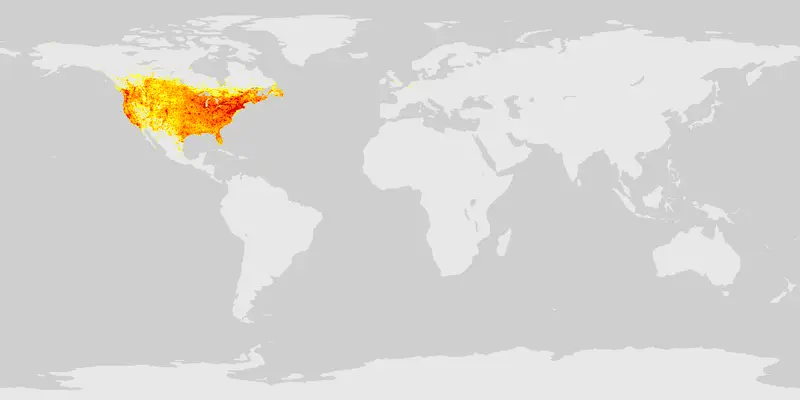
Goldfinches breed across the northern two-thirds of the United States and southern Canada and spend the winter across most of the country, reaching the Gulf Coast and northern Mexico. Many birds shift southward in fall, but in much of the middle of the country they are present all year; what changes is their color, so people often think they have left. Goldfinches are birds of open country with scattered shrubs and plenty of flowering weeds rather than of forest interiors. Roadsides, old fields and gardens full of coneflowers and sunflowers are prime spots.
Where and when to look
If you want an easy summer project, plant coneflowers, sunflowers, thistles or zinnias and let some of them go to seed; goldfinches will find them within weeks. These finches nest later than almost any other songbird in the country, waiting until midsummer when thistle down is available to line their tight, cup-shaped nests, so July and August are prime months to see adults carrying seeds to young. Listen for the flight call as birds pass overhead in a deeply bouncing path; it sounds a little like po-ta-to-chip, given at the top of each rise. In spring and summer the breeding male is unmistakable, lemon yellow with a black cap and black wings with white bars, while the female is a softer olive yellow with no cap. In fall both sexes molt into a dull brownish winter plumage, and many people think their goldfinches have left when in fact they are still at the feeder in disguise. Look for that strong white wing barring and the small conical pink bill to confirm them. By late winter, males start showing patchy yellow feathers, an early sign that spring is near. Tube feeders with nyjer seed attract flocks, but those fine seeds mold easily, so offer small amounts and shake out wet clumps after storms. Watching from a window keeps the birds relaxed and gives the best looks at feeding behavior.
When & where in the US
GBIF holds 16,468,770 occurrence records of this species from the United States. States with the most records:
- New York 1,453,005
- Pennsylvania 1,158,961
- Ohio 943,879
- Massachusetts 931,447
- Michigan 909,383
Occurrence records reflect where and when people look and report (observer effort), not just where the animal is common. Busy birding states and summer months are over-represented; zoo and museum records can appear for non-native species.
Source: GBIF occurrence search for country US.[7]
What it eats
Few North American birds are as devoted to seeds as the goldfinch. It eats seeds of thistles, sunflowers, asters, coneflowers, dandelions, ragweed and grasses, plus tree seeds such as birch and alder in winter. Its light, sharp bill is suited to picking small seeds out of seedheads, and the bird often clings to a swaying stem to do it. Even the young are fed mostly regurgitated seeds rather than insects, which is unusual among songbirds. At feeders, goldfinches prefer nyjer and hulled sunflower in hanging tube feeders. Leaving garden flowers standing into fall gives them natural food.
Reproduction and life cycle
Goldfinches are among the latest nesters in North America, waiting until mid to late summer when thistles and milkweed produce their silky down. The female weaves a cup so tight it can hold water, often lined with that plant down, placed in the fork of a shrub or small tree. Late nesting matches the peak seed season, giving the young a steady seed supply. The male feeds the female while she incubates and helps feed the chicks. Because goldfinches feed their young mostly on seeds, cowbird chicks raised in their nests rarely survive, which makes them poor hosts for that parasite.
Threats and conservation
The American goldfinch is common and widespread. Its biggest needs are open habitat with seed-bearing plants, which are sometimes lost when roadsides and fields are mowed often or sprayed. Clean feeders matter because seed-eating birds that crowd around feeders can pass on eye infections and other diseases. Native wildflower patches that are allowed to go to seed are one of the most effective ways to support them.
How to tell it apart
- Black-capped chickadee: Also small and acrobatic, but black-capped and black-bibbed with white cheeks and gray body, never bright yellow.
- Monarch butterfly: Children sometimes call a bright flitting monarch a "yellow bird," but monarchs are orange with black veins and fly with flapping glides.
- Ruby-throated hummingbird: Similar size at a flower bed, but metallic green, hovering, and with a long needle bill rather than a short cone.
Photo: no rights reserved, uploaded by Glenn Berry — CC0 1.0, source[8]. See all image credits.
Sources
- GBIF Backbone Taxonomy — Spinus tristis (species 5231640), via GBIF API — retrieved 2026-11-21
- GBIF — synonyms of Spinus tristis — retrieved 2026-11-21
- GBIF — vernacular names of Spinus tristis — retrieved 2026-11-21
- ITIS — full hierarchy for TSN 179249 — retrieved 2026-11-21
- IUCN Red List category via GBIF (Spinus tristis) — retrieved 2026-11-21
- Animal Diversity Web (University of Michigan) — Spinus tristis account — retrieved 2026-11-21
- GBIF occurrence search — Spinus tristis, country US, month and state facets — retrieved 2026-11-21
- iNaturalist taxon 145310 — Spinus tristis (photo source) — retrieved 2026-11-21
Written under the pen name Maya Reynolds with AI-assisted drafting, then checked against the sources cited on each page. Last reviewed 2026-11-21. Numbers in the fact table come only from the linked sources; all prose is original. See our editorial policy.