Monarch butterfly
Danaus plexippus (Linnaeus, 1758) · also called Milkweed, Milkweed Butterfly, Milkweed [butterfly], Monarch, Monarch or Milkweed, The Milkweed
The monarch is a large orange-and-black butterfly that depends on milkweed and makes one of the longest insect migrations on Earth, from Canada to the mountains of central Mexico.

Quick facts
| Kingdom | Animalia[4] |
|---|---|
| Phylum | Arthropoda[4] |
| Class | Insecta[4] |
| Order | Lepidoptera[4] |
| Family | Nymphalidae[4] |
| Genus | Danaus[4] |
| Species | Danaus plexippus[1] |
| Authority | (Linnaeus, 1758)[1] |
| ITIS TSN | 117273[4] |
| Synonyms | Danaida plexippus (Linnaeus); Danais archippus fumosus Hulst, 1886; Danaus americanus Gunder, 1927; Danaus archippus (Fabricius, 1793); Danaus curassavicae Fabricius, 1807; Danaus fumosus Hulst, 1886; Danaus leucogyne Butler, 1884; Danaus megalippe Hübner, 1826[2] |
| Other common names | Milkweed, Milkweed Butterfly, Milkweed [butterfly], Monarch, Monarch or Milkweed, The Milkweed[3] |
| Wingspan | 8.6 to 12.4 cm (3.4 to 4.9 in)[8] |
| Weight, Lifespan | Not available from our sources |
| Habitat | Meadows, prairies, roadsides, gardens and any open place with milkweed |
| IUCN Red List | Least Concern (LC)[5] IUCN page Population trend: not available through GBIF; see the IUCN assessment. |
Where it lives
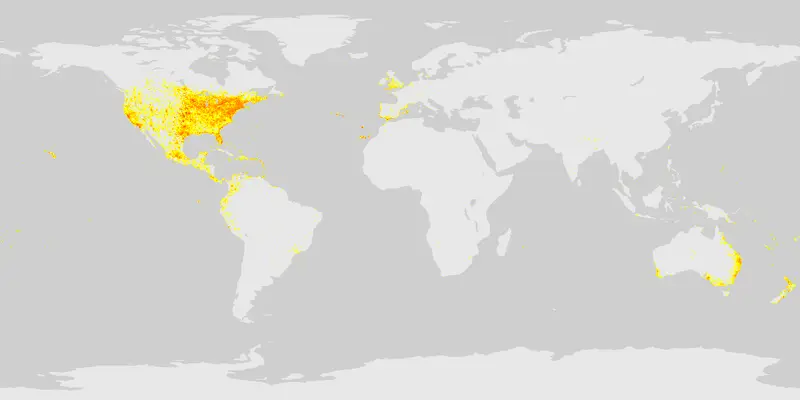
Monarchs live across North America, with smaller populations in Central and South America, Australia, Pacific islands and parts of Europe. East of the Rocky Mountains, monarchs drift north each spring and summer over several generations, then a special late-summer generation flies south to overwinter in fir forests high in the mountains of central Mexico. Western monarchs traditionally winter in groves along the California coast. The GBIF US chart for monarchs rises through summer and peaks in late summer and early fall, when migrants are most visible on flowers and at coastal gathering points.
Where and when to look
Monarchs follow the seasons in a way few other insects do, so knowing the calendar is the key to seeing them. In spring, the first adults return north from Mexico and from coastal California, laying eggs on milkweed as they go, and over the summer several shorter-lived generations spread across much of North America. Late summer and early fall bring the most visible spectacle: migrating monarchs drift south along coastlines, lakeshores and ridges, and on cool evenings they gather by the hundreds or more in roosting clusters on trees, especially near the Great Lakes, along the Gulf Coast and on the Atlantic barrier islands. Western monarchs spend winter in groves of trees along the California coast, where public sites invite visitors to watch from marked paths, and the eastern population winters in mountain fir forests in central Mexico. In your own yard, check the undersides of milkweed leaves for tiny cream-colored eggs and for striped caterpillars in yellow, black and white, and look for chewed leaf edges and small dark droppings on lower leaves. A jade green chrysalis with gold dots often hangs from a fence rail or the edge of a nearby plant. Males have a small black spot on a vein of each hind wing and slightly thinner veins overall, while females have thicker black veins and no spot. Plant native milkweeds and late-blooming nectar flowers such as asters and goldenrod, and skip pesticides in the garden. Rearing large numbers indoors is discouraged by many researchers because it can spread disease, so it is usually better to protect caterpillars where they are and simply visit them every day.
When & where in the US
GBIF holds 690,514 occurrence records of this species from the United States. States with the most records:
- Kansas 111,018
- Texas 63,109
- California 50,924
- Minnesota 39,195
- Iowa 34,922
Occurrence records reflect where and when people look and report (observer effort), not just where the animal is common. Busy birding states and summer months are over-represented; zoo and museum records can appear for non-native species.
Source: GBIF occurrence search for country US.[6]
What it eats
Monarch caterpillars eat only milkweed. Milkweed contains bitter toxins, and the caterpillars store them in their bodies, which makes both larvae and adults distasteful to many birds. The bright orange warning colors advertise that defense. Adult monarchs drink nectar from a wide range of flowers, including milkweeds, asters, goldenrods, coneflowers, blazing stars and zinnias. Fall-blooming flowers are especially important for migrating butterflies building fat for the trip and the winter.
Reproduction and life cycle
Females lay single tiny eggs on the undersides of milkweed leaves. The striped caterpillar eats and grows quickly, then forms a jade-green chrysalis dotted with gold. A new butterfly emerges after the chrysalis turns clear. Summer monarchs live only a short time as adults, but the migrating fall generation delays breeding and lives many months, through the winter in Mexico or California, before heading north to start the cycle again.
Threats and conservation
Monarch numbers at the overwintering sites have fallen dramatically compared with the late twentieth century. Causes include loss of milkweed across farmland and roadsides, herbicide use, insecticides, degradation of the forests in Mexico, extreme weather and climate change. The migratory monarch was reassessed on the IUCN Red List in recent years, and its status is checked here through GBIF. Planting native milkweed and fall nectar flowers, avoiding pesticides and joining tagging or counting projects are concrete ways to help.
How to tell it apart
- American goldfinch: A yellow-and-black bird can flash like a butterfly, but goldfinches fly in deep bounding loops and perch on seed heads.
- Ruby-throated hummingbird: Visits the same flowers and hovers; the hummingbird is green, fast and hums, while the monarch flaps and glides with orange wings.
- Eastern chipmunk: Kids often lump orange-and-black things together; this one is a furry rodent on the ground.
Photo: no rights reserved — CC0 1.0, source[7]. See all image credits.
Sources
- GBIF Backbone Taxonomy — Danaus plexippus (species 5133088), via GBIF API — retrieved 2026-11-21
- GBIF — synonyms of Danaus plexippus — retrieved 2026-11-21
- GBIF — vernacular names of Danaus plexippus — retrieved 2026-11-21
- ITIS — full hierarchy for TSN 117273 — retrieved 2026-11-21
- IUCN Red List category via GBIF (Danaus plexippus) — retrieved 2026-11-21
- GBIF occurrence search — Danaus plexippus, country US, month and state facets — retrieved 2026-11-21
- iNaturalist taxon 48662 — Danaus plexippus (photo source) — retrieved 2026-11-21
- Animal Diversity Web (University of Michigan) — Danaus plexippus account — retrieved 2026-11-21
Written under the pen name Maya Reynolds with AI-assisted drafting, then checked against the sources cited on each page. Last reviewed 2026-11-21. Numbers in the fact table come only from the linked sources; all prose is original. See our editorial policy.