Eastern chipmunk
Tamias striatus (Linnaeus, 1758) · also called Ardilla Listada Oriental, Chippie, Chipping Squirrel, Ground Squirrel, Streifen-Backenhornchen
The eastern chipmunk is a small striped ground squirrel of eastern North American woods and yards that carries seeds in stretchy cheek pouches to a burrow pantry.

Quick facts
| Kingdom | Animalia[4] |
|---|---|
| Phylum | Chordata[4] |
| Class | Mammalia[4] |
| Order | Rodentia[4] |
| Family | Sciuridae[4] |
| Genus | Tamias[4] |
| Species | Tamias striatus[1] |
| Authority | (Linnaeus, 1758)[1] |
| ITIS TSN | 180207[4] |
| Synonyms | Sciurus striatus Linnaeus, 1758[2] |
| Other common names | Ardilla Listada Oriental, Chippie, Chipping Squirrel, Ground Squirrel, Streifen-Backenhornchen[3] |
| Length | 255–266 mm (10–10.5 in)[6] |
| Weight | 66–115 g (2.33–4.06 oz)[6] |
| Lifespan (max. recorded / range) | 2–8 years[6] |
| Young per litter or brood | 2 to 5[6] |
| Gestation (average) | 35 days[6] |
| Diet type | herbivore[6] |
| Habitat | Deciduous forest, woodland edges, stone walls, rock piles and gardens · ADW biomes: forest[6] |
| IUCN Red List | Least Concern (LC)[5] IUCN page Population trend: not available through GBIF; see the IUCN assessment. |
Where it lives
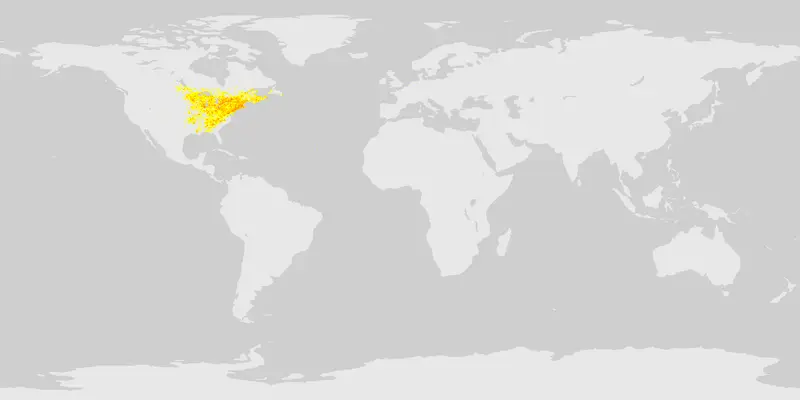
Eastern chipmunks live from southern Canada through the eastern United States, reaching south to the northern parts of the Gulf states and west to the eastern Great Plains. They are a woodland species that favors places with lots of cover near the ground: logs, stumps, rock walls, woodpiles and foundation plantings. In the West, a long list of smaller chipmunk species replaces them. Chipmunks become scarce above ground in the coldest months, so sightings fall off sharply in winter and pick up in early spring, which you can see in the GBIF monthly chart.
Where and when to look
The best way to meet a chipmunk is to sit quietly near an old stone wall, a woodpile or a rocky slope in a deciduous forest on a warm, sunny morning. Chipmunks are active by day and spend much of their time on the ground, so you will usually spot one dashing between cover with its tail held straight up like a little flag. Listen for the sound that gives them away: a sharp chip repeated over and over, sometimes for many minutes, or a lower, hollow chuck-chuck that drifts out of the leaf litter and is easy to mistake for a bird or a frog. A quick, trilling chip is often given right before the animal dives into its burrow. Late summer and early fall are the busiest months, when chipmunks race back and forth with cheek pouches stretched so full of seeds and acorns that their heads look twice as wide. Look for small, neat burrow openings, about the width of a coin, with no pile of dirt around them, because chipmunks carry the soil away and hide the entrance under leaves or a root. In the coldest part of winter they stay mostly underground, waking now and then to eat from their stored food, so sightings drop sharply, but on a mild day in late winter you may see one pop out early. Spring brings the first litters, and by early summer young chipmunks appear at burrow entrances, smaller and clumsier than the adults, often sunning themselves on a log. Males and females look alike, so focus on behavior instead. Chipmunks are easy to tame with food, but resist the urge: hand-fed animals lose some of their caution and become easy targets for hawks, snakes, foxes and house cats. Keeping cats indoors is one of the most helpful things a family can do for chipmunks and for the birds that share the same yards.
When & where in the US
GBIF holds 79,544 occurrence records of this species from the United States. States with the most records:
- New York 10,576
- Massachusetts 6,483
- Pennsylvania 5,568
- Michigan 5,418
- Ohio 5,358
Occurrence records reflect where and when people look and report (observer effort), not just where the animal is common. Busy birding states and summer months are over-represented; zoo and museum records can appear for non-native species.
Source: GBIF occurrence search for country US.[7]
What it eats
Chipmunks gather seeds, nuts, acorns, berries, mushrooms and bulbs, plus insects, snails and occasionally eggs or small vertebrates. The hallmark behavior is pouching: a chipmunk fills its cheeks until its head looks twice as wide, scurries home and unloads. Each animal builds a large underground store and lives off it through winter. During cold spells they enter a light torpor but wake often to eat from the stash. Birdseed spilled beneath feeders is a favorite and helps explain why chipmunks are so common around houses.
Reproduction and life cycle
Chipmunks are solitary and defend the area around their burrow. Breeding occurs in early spring and sometimes again in summer. The burrow is a network of tunnels with a nest chamber and food storage rooms, and its main entrance is often hard to spot because the chipmunk carries away the dirt. Young are born underground and appear at the entrance after several weeks, looking like miniature adults. They soon disperse to dig homes of their own.
Threats and conservation
Eastern chipmunks are common and listed as least concern. They are prey for hawks, foxes, weasels, snakes and especially outdoor cats, which kill large numbers. Their burrows occasionally undermine patios or walls, but they rarely cause serious damage. Leaving brush piles and native ground cover gives chipmunks and other small animals shelter.
How to tell it apart
- Eastern gray squirrel: Larger, unstriped and gray, with a big bushy tail; it spends far more time in trees and builds leaf nests.
- Eastern cottontail: Shares the edge of the lawn but is larger, with long ears and no stripes.
- Monarch butterfly: Kids sometimes link the orange colors, but in the hand a chipmunk is clearly a furry, striped rodent.
Photo: (c) Cephas, some rights reserved (CC BY-SA) — CC BY-SA 4.0, source[8]. See all image credits.
Sources
- GBIF Backbone Taxonomy — Tamias striatus (species 2437438), via GBIF API — retrieved 2026-11-21
- GBIF — synonyms of Tamias striatus — retrieved 2026-11-21
- GBIF — vernacular names of Tamias striatus — retrieved 2026-11-21
- ITIS — full hierarchy for TSN 180207 — retrieved 2026-11-21
- IUCN Red List category via GBIF (Tamias striatus) — retrieved 2026-11-21
- Animal Diversity Web (University of Michigan) — Tamias striatus account — retrieved 2026-11-21
- GBIF occurrence search — Tamias striatus, country US, month and state facets — retrieved 2026-11-21
- iNaturalist taxon 46217 — Tamias striatus (photo source) — retrieved 2026-11-21
Written under the pen name Maya Reynolds with AI-assisted drafting, then checked against the sources cited on each page. Last reviewed 2026-11-21. Numbers in the fact table come only from the linked sources; all prose is original. See our editorial policy.