Eastern cottontail
Sylvilagus floridanus (J.A.Allen, 1890) · also called Andean Rabbit, Conejo, Conejo De Florida, Cottontail Rabbit, Eastern Cottontail Rabbit, Florida Cottontail
The eastern cottontail is the common wild rabbit of eastern and central North America, a brown, big-eared grazer named for its fluffy white tail.

Quick facts
| Kingdom | Animalia[4] |
|---|---|
| Phylum | Chordata[4] |
| Class | Mammalia[4] |
| Order | Lagomorpha[4] |
| Family | Leporidae[4] |
| Genus | Sylvilagus[4] |
| Species | Sylvilagus floridanus[1] |
| Authority | (J.A.Allen, 1890)[1] |
| ITIS TSN | 180124[4] |
| Synonyms | Lepus floridanus Allen, 1890; Lepus floridanus chapmani J.A.Allen, 1899; Lepus floridanus connectens Nelson, 1904; Lepus floridanus subcinctus Miller, 1899; Lepus floridanus yucatanicus Miller, 1899; Lepus nuttalli mallurus Thomas, 1898; Lepus orizabae Merriam, 1893; Lepus russatus J.A.Allen, 1904[2] |
| Other common names | Andean Rabbit, Conejo, Conejo De Florida, Cottontail Rabbit, Eastern Cottontail Rabbit, Florida Cottontail[3] |
| Length | 395–477 mm (15.6–18.8 in)[6] |
| Weight | 0.8–1.53 kg (1.76–3.37 lb)[6] |
| Lifespan (max. recorded / range) | 3 years[6] |
| Young per litter or brood | 1 to 12[6] |
| Gestation | 25 to 28 days[6] |
| Diet type | herbivore[6] |
| Habitat | Meadows, brushy edges, farmland, parks and suburban lawns · ADW biomes: forest[6] |
| IUCN Red List | Least Concern (LC)[5] IUCN page Population trend: not available through GBIF; see the IUCN assessment. |
Where it lives
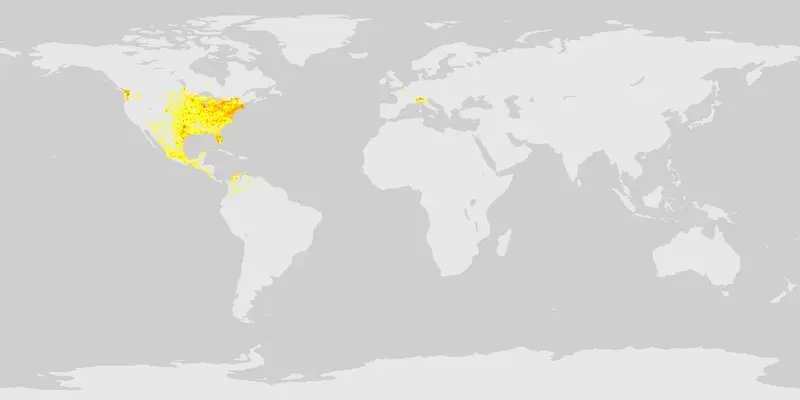
Cottontails range from southern Canada through the eastern and central United States to the Southwest, Mexico, Central America and northern South America. Introductions for hunting have expanded the range in New England and parts of the West, where they compete with native rabbits such as the New England cottontail. The species thrives where open grazing meets dense shrubs or brush piles to hide in, so suburbs with lawns and hedges suit it well. Cottontails are active year-round and most visible at dawn and dusk.
Where and when to look
Cottontails are creatures of the edges, and the trick to seeing them is to watch the places where short grass meets thick cover: the border of a lawn and a hedge, a mowed path beside brambles, the shoulder of a quiet country road, or the margin of a park meadow. They feed most in the early morning and at dusk, and on a calm summer evening a single suburban block may hold several rabbits nibbling clover and dandelions. Sit still and let them come to you, because a cottontail relies first on freezing, ears flat and body pressed low, and only bolts in a zigzag sprint when it thinks it has been seen; the white underside of the tail flashes as it runs, which is where the name comes from. In winter, look for the clues they leave behind: neat, angled cuts on low twigs and shrubs, gnawed bark at the base of young trees, small round droppings in clusters, and in fresh snow a repeating track pattern of two long hind prints side by side ahead of two smaller front prints, one behind the other. Rabbits spend the day in a shallow resting hollow in grass or under brush called a form, so a quick dash from your feet on a walk often reveals one. Spring and summer are the breeding months, and females may raise several litters in a single season. A nest is a shallow scrape in the lawn lined with grass and fur, and the mother visits only briefly around dawn and dusk to nurse, so finding babies alone does not mean they are orphaned. If you uncover a nest while mowing, put the cover back, keep pets away and leave it alone; a crisscross of string over the top will show you the next day whether the mother has returned. Young rabbits that are fully furred, eyes open and hopping on their own are already independent. Males and females look alike in the field, and adults and well-grown young are hard to separate except by size early in summer.
When & where in the US
GBIF holds 126,579 occurrence records of this species from the United States. States with the most records:
- Texas 15,057
- Massachusetts 12,754
- New York 7,981
- Illinois 7,890
- Pennsylvania 6,832
Occurrence records reflect where and when people look and report (observer effort), not just where the animal is common. Busy birding states and summer months are over-represented; zoo and museum records can appear for non-native species.
Source: GBIF occurrence search for country US.[7]
What it eats
In the growing season cottontails eat grasses, clover, dandelions, plantain and many garden plants, which can frustrate vegetable growers. In winter they switch to woody food: twigs, buds and the bark of young trees and shrubs. Like other rabbits they eat some of their own soft droppings to pass food through the gut twice and absorb more nutrients. A low fence around a garden bed is usually more effective than repellents.
Reproduction and life cycle
Cottontails breed prolifically. A female digs a shallow hollow in the ground, often in the middle of a lawn, lines it with grass and fur pulled from her own chest, and covers the young with more of the same. She visits only briefly at dawn and dusk to nurse, which keeps predators from finding the nest. People often mistake these nests for abandoned babies; they almost never are. The young leave the nest soon after their eyes open, and females can have several litters in a season.
Threats and conservation
The eastern cottontail is common and listed as least concern. It is prey for nearly every predator, from hawks and owls to foxes, coyotes, snakes and pet cats, and most rabbits live short lives. Lawn mowing destroys many nests; checking for them before mowing in spring helps. It is a popular small game animal in many states.
How to tell it apart
- Eastern gray squirrel: Gray and climbs trees, with a bushy tail and short ears.
- Eastern chipmunk: Much smaller, striped, and quick to dash into a burrow with full cheeks.
- White-tailed deer: Shares the white tail flag and the edges of lawns at dusk, but a deer is many times larger with hooves and slender legs.
Photo: (c) Andrew Murray, some rights reserved (CC BY), uploaded by Andrew Murray — CC BY 4.0, source[8]. See all image credits.
Sources
- GBIF Backbone Taxonomy — Sylvilagus floridanus (species 2436886), via GBIF API — retrieved 2026-11-21
- GBIF — synonyms of Sylvilagus floridanus — retrieved 2026-11-21
- GBIF — vernacular names of Sylvilagus floridanus — retrieved 2026-11-21
- ITIS — full hierarchy for TSN 180124 — retrieved 2026-11-21
- IUCN Red List category via GBIF (Sylvilagus floridanus) — retrieved 2026-11-21
- Animal Diversity Web (University of Michigan) — Sylvilagus floridanus account — retrieved 2026-11-21
- GBIF occurrence search — Sylvilagus floridanus, country US, month and state facets — retrieved 2026-11-21
- iNaturalist taxon 43111 — Sylvilagus floridanus (photo source) — retrieved 2026-11-21
Written under the pen name Maya Reynolds with AI-assisted drafting, then checked against the sources cited on each page. Last reviewed 2026-11-21. Numbers in the fact table come only from the linked sources; all prose is original. See our editorial policy.