White-tailed deer
Odocoileus virginianus (Zimmermann, 1780) · also called American Deer, Cerf De Virginie, Ciervo, Ciervo De Cola Blanca, Clavium, Common American Deer
The white-tailed deer is the most widespread large wild mammal in the Americas, a reddish-to-gray deer that flashes the white underside of its tail when alarmed.

Quick facts
| Kingdom | Animalia[4] |
|---|---|
| Phylum | Chordata[4] |
| Class | Mammalia[4] |
| Order | Artiodactyla[4] |
| Family | Cervidae[4] |
| Genus | Odocoileus[4] |
| Species | Odocoileus virginianus[1] |
| Authority | (Zimmermann, 1780)[1] |
| ITIS TSN | 180699[4] |
| Synonyms | Cervus virginianus (Zimmermann, 1780); Dama virginiana Zimmermann, 1780; Odocoileus cooki Frick, 1937; Odocoileus sheridanus Frick, 1937; Dama virginianus; Dama virginiana[2] |
| Other common names | American Deer, Cerf De Virginie, Ciervo, Ciervo De Cola Blanca, Clavium, Common American Deer[3] |
| Length | 160–220 cm (5.25–7.22 ft)[6] |
| Weight | 57–137 kg (126–302 lb)[6] |
| Lifespan (max. recorded / range) | 2 years[6] |
| Young per litter or brood | 1.0 to 3.0[6] |
| Gestation (average) | 6.5 months[6] |
| Diet type | herbivore[6] |
| Habitat | Forest edges, farmland, river bottoms, suburbs and parks · ADW biomes: chaparral chaparral forest forest rainforest rainforest scrub forest scrub forest[6] |
| IUCN Red List | Least Concern (LC)[5] IUCN page Population trend: not available through GBIF; see the IUCN assessment. |
Where it lives
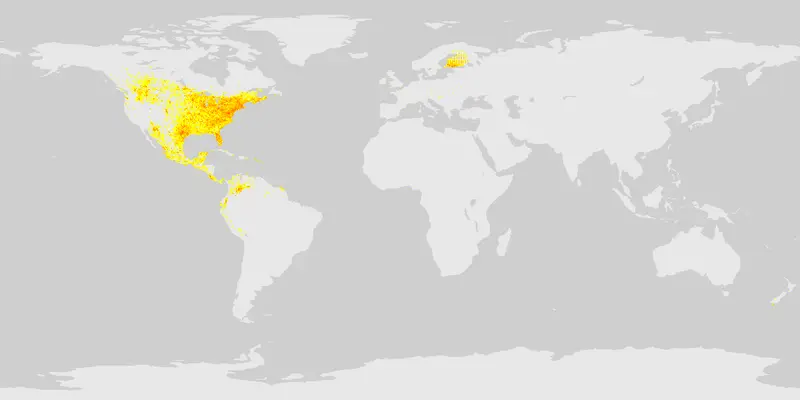
White-tails range from southern Canada through most of the United States and Mexico into Central America and northern South America. In the United States they are absent mainly from parts of the far West, where mule deer take over. After severe declines from overhunting by the early twentieth century, deer rebounded under hunting regulations and the loss of large predators, and today they are abundant in much of the East and Midwest. Suburbs with lawns, gardens and woodlots have some of the highest densities. Small subspecies include the endangered Key deer of the Florida Keys.
Where and when to look
Deer are most visible in the hour around sunrise and sunset, when they leave cover to feed along field edges, roadsides and lawns. In fall, look for signs of the rut: scrapes, which are pawed patches of bare earth under an overhanging branch, and rubs, where bucks have stripped the bark from saplings with their antlers. Those are also the weeks when deer are most often on roads, so dusk drives call for extra care. In winter, deer gather in sheltered areas called yards, often in conifer stands, and their trails become clearly worn paths through the snow. In early summer, a doe repeatedly returning to the same patch of tall grass may be visiting a hidden fawn; watch from a distance and resist the urge to check on it. A tail held up and flagged white means a deer has spotted you and is about to bound away. In suburbs, deer often follow the same routes night after night, so a muddy trail through a hedge or a gap in a fence usually marks a regular crossing. Planting deer-resistant natives near the house and saving favorite plants for fenced beds is easier than trying to keep deer out of the whole yard.
When & where in the US
GBIF holds 286,885 occurrence records of this species from the United States. States with the most records:
- Texas 45,965
- Virginia 17,992
- New York 17,597
- Florida 17,217
- Pennsylvania 16,911
Occurrence records reflect where and when people look and report (observer effort), not just where the animal is common. Busy birding states and summer months are over-represented; zoo and museum records can appear for non-native species.
Source: GBIF occurrence search for country US.[7]
What it eats
Deer are browsers. They eat leaves, twigs and buds of shrubs and young trees, along with acorns, fruit, mushrooms, farm crops and garden plants. In winter they rely on woody browse and stored fat. Where deer are dense, they can strip a forest of its young trees and wildflowers, leaving a park-like understory with little cover for birds and other wildlife. That is why many land managers count deer as one of the major forces shaping eastern forests.
Reproduction and life cycle
The breeding season, called the rut, runs mainly in fall. Bucks grow antlers each year, rub them on saplings and spar with rivals, and then shed them in winter. Fawns are born in late spring, spotted reddish-brown for camouflage. A mother leaves her fawn hidden alone in grass for long stretches and returns to nurse, so a fawn lying quietly by itself is almost always fine and should be left where it is.
Threats and conservation
White-tailed deer are listed as least concern. Collisions with vehicles cause human injuries and many deer deaths, especially during the fall rut. Chronic wasting disease, a fatal prion disease of deer and elk, has spread across many states and is closely monitored by wildlife agencies. Overabundance is a bigger ecological problem than scarcity in many regions, and regulated hunting is the main management tool.
How to tell it apart
- Elk: Far larger and heavier, with a pale rump patch, a dark shaggy neck and huge sweeping antlers on bulls.
- Pronghorn: Tan and white like a deer in summer, but with bold white bands on the throat, black horns rather than branching antlers, and a home on the open plains.
- Moose: Much bigger and dark brown with a long face, a hanging dewlap and palm-shaped antlers.
- Eastern cottontail: Both raise a white tail as they bolt, but only a rabbit fits under a hedge.
Photo: (c) James St. John, some rights reserved (CC BY) — CC BY 4.0, source[8]. See all image credits.
Sources
- GBIF Backbone Taxonomy — Odocoileus virginianus (species 2440965), via GBIF API — retrieved 2026-11-21
- GBIF — synonyms of Odocoileus virginianus — retrieved 2026-11-21
- GBIF — vernacular names of Odocoileus virginianus — retrieved 2026-11-21
- ITIS — full hierarchy for TSN 180699 — retrieved 2026-11-21
- IUCN Red List category via GBIF (Odocoileus virginianus) — retrieved 2026-11-21
- Animal Diversity Web (University of Michigan) — Odocoileus virginianus account — retrieved 2026-11-21
- GBIF occurrence search — Odocoileus virginianus, country US, month and state facets — retrieved 2026-11-21
- iNaturalist taxon 42223 — Odocoileus virginianus (photo source) — retrieved 2026-11-21
Written under the pen name Maya Reynolds with AI-assisted drafting, then checked against the sources cited on each page. Last reviewed 2026-11-21. Numbers in the fact table come only from the linked sources; all prose is original. See our editorial policy.