Elk
Cervus canadensis Erxleben, 1777 · also called Roosevelt elk
The elk is a large North American deer with a dark shaggy neck and a pale rump, whose bulls carry sweeping antlers and fill autumn evenings with high, whistling bugles.

Quick facts
| Kingdom | Animalia[4] |
|---|---|
| Phylum | Chordata[4] |
| Class | Mammalia[4] |
| Order | Artiodactyla[4] |
| Family | Cervidae[4] |
| Genus | Cervus[4] |
| Species | Cervus canadensis[1] |
| Authority | Erxleben, 1777[4] |
| ITIS TSN | 898259[4] |
| Synonyms | None listed[2] · Also treated as Cervus elaphus canadensis (GBIF) · Also treated as Cervus elaphus (GBIF, which lumps elk with red deer) |
| Other common names | Roosevelt elk[3] |
| Weight (NPS, Yellowstone) | about 500 lb (cows) to about 700 lb (bulls)[7] |
| Shoulder height (NPS, Yellowstone) | about 5 ft (bulls)[7] |
| Lifespan | Not available from our sources |
| Habitat | Mountain meadows, forest edges, valleys and foothills |
| IUCN Red List | Not available via GBIF |
Where it lives
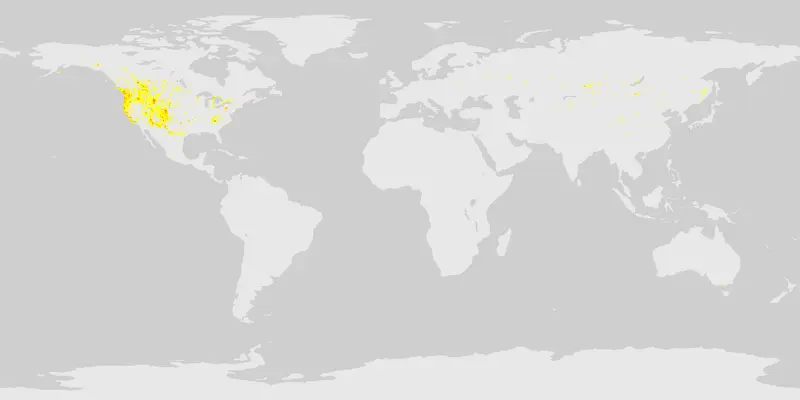
Elk once lived across most of the United States, but by the early twentieth century they survived mainly in the Rocky Mountain West. Yellowstone sheltered many of those survivors and served as a source for restocking herds elsewhere. Today elk are common in the Rockies, the Pacific Northwest and parts of the Great Plains, with reintroduced herds in Kentucky, Tennessee, North Carolina, Pennsylvania, Arkansas and Michigan. In Yellowstone, large herds summer at high elevations and migrate to lower valleys and the northern range in winter. Elk also live in Asia, where related forms are sometimes called wapiti or maral.
Where and when to look
Fall is the season most people remember. During the autumn rut, bull elk gather groups of cows and challenge rivals with bugling, a call that starts as a low growl, climbs to an eerie, high-pitched whistle and ends with a series of grunts. The sound carries for a long way on cold, clear mornings, and hearing it echo across a valley is one of the great wildlife experiences in North America. Dawn and dusk are prime time, when elk move out of the timber to feed in open meadows, along river bottoms and on grassy hillsides. Many western parks and some eastern restoration areas have well-known meadows where crowds gather each evening to watch. Sorting the sexes is straightforward for much of the year. Mature bulls carry large, branching antlers from late summer into winter, along with a darker, shaggier neck mane. Cows lack antlers and are lighter in build. Young bulls show smaller antlers, sometimes just single spikes. In late spring, look for spotted calves hidden in tall grass while their mothers feed nearby. Antlers drop in late winter, and new ones grow over the summer covered in soft, fuzzy velvet. Signs include bark stripped from aspen trees, muddy wallows that smell strongly during the rut, rubbed saplings, oval split-hoof tracks larger than a deer's, and piles of pellets. Elk can look calm, but bulls in the rut and cows guarding young calves can charge without much warning. Stay well back, use binoculars or a long lens, never stand between a bull and his cows, and follow the distance rules posted by the park. If an elk changes what it is doing because of you, you are too close.
When & where in the US
GBIF holds 38,395 occurrence records of this species from the United States. States with the most records:
- California 6,708
- Colorado 6,671
- Wyoming 5,566
- Oregon 3,820
- New Mexico 3,214
Occurrence records reflect where and when people look and report (observer effort), not just where the animal is common. Busy birding states and summer months are over-represented; zoo and museum records can appear for non-native species.
Source: GBIF occurrence search for country US.[5]
NPS, number in Yellowstone: Summer: 10,000–20,000 elk in six to seven different herds[7]
What it eats
Elk are mixed feeders, both grazing and browsing. They eat grasses and flowering plants in summer, and in winter shift to shrubs, tree bark, twigs and dried grasses. They feed mostly at dawn and dusk. Large elk herds can heavily browse willows and aspen, which is one reason the arrival of wolves in Yellowstone, and changes in elk numbers and behavior, became a focus of research into how predators shape landscapes.
Reproduction and life cycle
The rut runs through early fall. Bulls bugle, wallow in mud, thrash small trees and gather groups of cows, defending them from rivals in sometimes violent antler clashes. Calves are born in late spring, spotted for camouflage, and spend their first weeks lying hidden while the mother feeds nearby. Bulls shed their antlers in late winter and immediately start growing new ones covered in velvet.
Threats and conservation
The elk is listed as least concern. Chronic wasting disease, a fatal prion disease, is spreading through many elk herds and is a growing worry, including near Yellowstone. Elk are hunted under state regulations, and herds that winter near towns can damage crops and fences. During the rut, bull elk in parks can be dangerous to people who get too close.
How to tell it apart
- White-tailed deer: Much smaller, uniformly tan or gray, and raises a big white tail when it bolts; antlers curve forward.
- Moose: Larger and much darker, with a long drooping nose, bell under the chin and flat palm-shaped antlers.
- American bison: A dark, heavy grazer with horns, hump and beard.
- Pronghorn: Small and tan with white bands and short pronged horns, on open sagebrush flats.
Photo: no rights reserved — CC0 1.0, source[6]. See all image credits.
Sources
- GBIF Backbone Taxonomy — Cervus elaphus canadensis (species 4262380), via GBIF API — retrieved 2026-11-21
- GBIF — synonyms of Cervus elaphus canadensis — retrieved 2026-11-21
- GBIF — vernacular names of Cervus elaphus canadensis — retrieved 2026-11-21
- ITIS — full hierarchy for TSN 898259 — retrieved 2026-11-21
- GBIF occurrence search — Cervus elaphus canadensis, country US, month and state facets — retrieved 2026-11-21
- iNaturalist taxon 204114 — Cervus canadensis (photo source) — retrieved 2026-11-21
- National Park Service — Yellowstone: Elk — retrieved 2026-11-21
Written under the pen name Maya Reynolds with AI-assisted drafting, then checked against the sources cited on each page. Last reviewed 2026-11-21. Numbers in the fact table come only from the linked sources; all prose is original. See our editorial policy.