Pronghorn
Antilocapra americana (Ord, 1815) · also called American Antelope, American Pronghorn, Antelope, Antelope; Sonoran Pronghorn (sonoriensis), Mexican Pronghorn, Prairie Antelope
The pronghorn is a tan-and-white hoofed mammal of the western plains, the last survivor of an ancient North American family and the fastest land animal on the continent.

Quick facts
| Kingdom | Animalia[4] |
|---|---|
| Phylum | Chordata[4] |
| Class | Mammalia[4] |
| Order | Artiodactyla[4] |
| Family | Antilocapridae[4] |
| Genus | Antilocapra[4] |
| Species | Antilocapra americana[1] |
| Authority | (Ord, 1815)[1] |
| ITIS TSN | 180717[4] |
| Synonyms | Antilocapra anteflexa Gray, 1855; Antilope americana Ord, 1815; Capra americana (Ord, 1815); Neomeryx finni Parks, 1925; Antilocapra anteflexa; Antilope americana[2] |
| Other common names | American Antelope, American Pronghorn, Antelope, Antelope; Sonoran Pronghorn (sonoriensis), Mexican Pronghorn, Prairie Antelope[3] |
| Length | 1.75 m (5.74 ft)[6] |
| Weight | 47–70 kg (104–154 lb)[6] |
| Lifespan (max. recorded / range) | 11 years[6] |
| Top speed (ADW) | sprints up to 86 km/h (53 mph); sustained 59 to 65 km/h[6] |
| Young per litter or brood | 1 to 2[6] |
| Gestation (average) | 252 days[6] |
| Diet type | herbivore[6] |
| Habitat | Open grasslands, sagebrush steppe and desert basins · ADW biomes: desert or dune desert or dune savanna or grassland savanna or grassland chaparral chaparral[6] |
| IUCN Red List | Least Concern (LC)[5] IUCN page Population trend: not available through GBIF; see the IUCN assessment. |
Where it lives
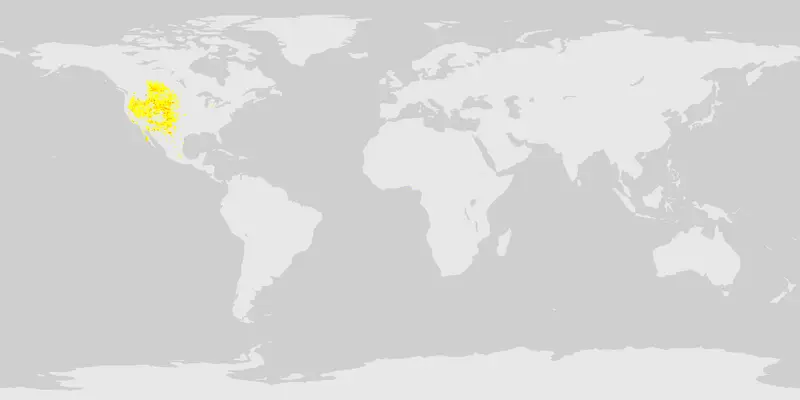
Pronghorn live from southern Canada through the western Great Plains and intermountain West into northern Mexico. Wyoming holds the largest share of the population. In Greater Yellowstone, pronghorn summer in the park's northern valleys and Grand Teton, and some make one of the longest land migrations in the lower forty-eight states, the Path of the Pronghorn, between Grand Teton and the Upper Green River basin. Fences, highways and energy development across that route pose challenges, and wildlife crossings have been built to help. Small endangered populations, such as the Sonoran pronghorn, live in the desert Southwest.
Where and when to look
Pronghorn belong to wide-open country, so the best way to find them is to drive slowly through sagebrush flats and short-grass prairie and scan the horizon with binoculars. Their bold white rump patch and the white bands on the throat stand out against tan grass even at a great distance. Early morning and late afternoon are the most active times, when small groups graze and move toward water. In parts of the northern Rockies and Great Plains, they can be seen along highways and ranch roads, often standing near fence lines. Pronghorn are famous for their speed. They are the fastest land mammals in the Americas, and a spooked herd running flat out across a basin is an unforgettable sight. When alarmed, they flare the long white hairs on their rumps, which acts as a signal to other pronghorn that something is wrong. You may also hear a sharp, snorting whistle as an alarm. In some areas, pronghorn make long seasonal migrations between summer and winter ranges, and spring and fall are good times to see herds on the move. Telling the sexes apart is easy once you know what to look for. Males have larger horns with a forward-pointing prong and a black patch on the face and neck. Females may have short horns or none at all, and they lack the black face patch. Unlike true antlers, the black outer sheath of the horn is shed and regrown each year, a feature found in no other living animal. In late spring and early summer, look for fawns lying flat in the grass, often in pairs, while their mother feeds some distance away. Tracks are pointed and heart-shaped, and you may see scrapes and droppings along ridges where males mark their territories. Pronghorn usually crawl under fences rather than jumping them, so smooth bottom wires help them move freely. Watch from your vehicle or at a respectful distance, never chase a herd, and do not approach a fawn that seems alone. The mother is usually nearby.
When & where in the US
GBIF holds 20,517 occurrence records of this species from the United States. States with the most records:
- Wyoming 4,508
- Colorado 2,389
- New Mexico 1,933
- Utah 1,851
- Montana 1,547
Occurrence records reflect where and when people look and report (observer effort), not just where the animal is common. Busy birding states and summer months are over-represented; zoo and museum records can appear for non-native species.
Source: GBIF occurrence search for country US.[7]
What it eats
Pronghorn eat sagebrush, forbs, cactus, shrubs and grasses, depending on the season. Sagebrush is especially important in winter, when other food is buried. Like cattle and deer, pronghorn are ruminants that chew cud. They get much of their water from plants and can go long periods without drinking in dry country.
Reproduction and life cycle
Both sexes have horns, though the male's are larger. Unlike true antelopes, pronghorn shed the outer horn sheath every year. Males defend territories or harems during the fall rut. Females usually have twins in late spring, and the fawns lie hidden in the grass for their first weeks, coming out to nurse. Within days the young can outrun most predators, but coyotes still take many fawns.
Threats and conservation
The species is listed as least concern overall. Barriers to migration are the main issue: woven-wire and low barbed-wire fences, highways and development can block pronghorn movement. Pronghorn rarely jump fences and instead crawl underneath, so wildlife-friendly fencing with a smooth bottom wire raised off the ground helps. Severe winters can cause heavy losses where herds cannot move to better ground.
How to tell it apart
- White-tailed deer: Deer have branching antlers only on males, no white throat bands, and live near woods rather than open plains.
- Bighorn sheep: Also tan with a white rump, but stockier, with heavy curled horns on rams and a love of steep rocky terrain.
- Cheetah: The cheetah is fastest over a short sprint; the pronghorn is built to sustain high speed over longer distances.
- Elk: Much larger, with a dark shaggy neck and branching antlers on bulls.
Photo: no rights reserved — CC0 1.0, source[8]. See all image credits.
Sources
- GBIF Backbone Taxonomy — Antilocapra americana (species 2440902), via GBIF API — retrieved 2026-11-21
- GBIF — synonyms of Antilocapra americana — retrieved 2026-11-21
- GBIF — vernacular names of Antilocapra americana — retrieved 2026-11-21
- ITIS — full hierarchy for TSN 180717 — retrieved 2026-11-21
- IUCN Red List category via GBIF (Antilocapra americana) — retrieved 2026-11-21
- Animal Diversity Web (University of Michigan) — Antilocapra americana account — retrieved 2026-11-21
- GBIF occurrence search — Antilocapra americana, country US, month and state facets — retrieved 2026-11-21
- iNaturalist taxon 42429 — Antilocapra americana (photo source) — retrieved 2026-11-21
- National Park Service — Yellowstone: Pronghorn — retrieved 2026-11-21
Written under the pen name Maya Reynolds with AI-assisted drafting, then checked against the sources cited on each page. Last reviewed 2026-11-21. Numbers in the fact table come only from the linked sources; all prose is original. See our editorial policy.