Cheetah
Acinonyx jubatus (Schreber, 1775) · also called Hunting Leopard, Hunting Pard, King Cheetah
The cheetah is a slender, long-legged cat of African grasslands, with a small remnant in Iran, built for explosive sprints and marked by black tear lines on its face.

Quick facts
| Kingdom | Animalia[4] |
|---|---|
| Phylum | Chordata[4] |
| Class | Mammalia[4] |
| Order | Carnivora[4] |
| Family | Felidae[4] |
| Genus | Acinonyx[4] |
| Species | Acinonyx jubatus[1] |
| Authority | (Schreber, 1775)[1] |
| ITIS TSN | 183813[4] |
| Synonyms | Cynaelurus jubatus (Schreber, 1775); Felis jubata Schreber, 1775; Felis jubata[2] |
| Other common names | Hunting Leopard, Hunting Pard, King Cheetah[3] |
| Length | 112–150 cm (3.67–4.92 ft)[6] |
| Weight | 21–72 kg (46.3–159 lb)[6] |
| Lifespan (max. recorded / range) | 8 years[6] |
| Young per litter or brood | 1 to 6[6] |
| Gestation | 90 to 95 days[6] |
| Diet type | carnivore[6] |
| Habitat | Savanna, grassland, open woodland and semi-desert · ADW biomes: desert or dune desert or dune savanna or grassland savanna or grassland[6] |
| IUCN Red List | Vulnerable (VU)[5] IUCN page Population trend: not available through GBIF; see the IUCN assessment. |
Where it lives
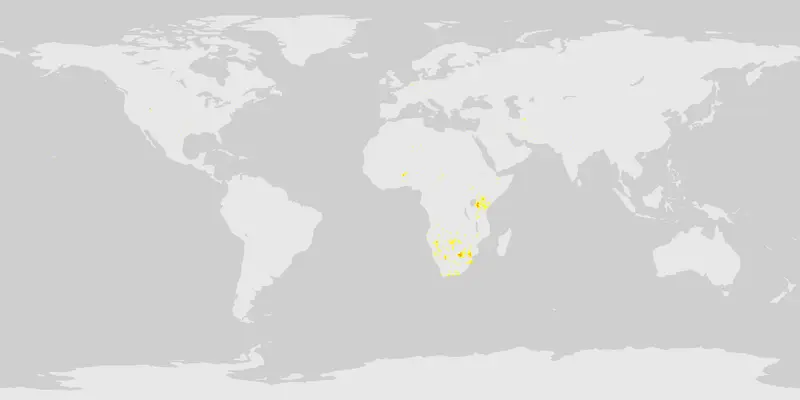
Cheetahs once lived across most of Africa and from the Middle East to India. Today they survive mainly in eastern and southern Africa, with strongholds in Namibia, Botswana, Kenya and Tanzania, plus small populations in North and West Africa and a critically small group in Iran. India has reintroduced African cheetahs in recent years. Cheetahs range widely at low density, and many live outside protected areas on farmland. As with lions, GBIF records inside the United States come from zoos.
Where and when to look
Cheetahs live in the open grasslands, savannas and semi-desert areas of eastern and southern Africa, with a tiny population of Asiatic cheetahs in Iran. The best places to see them in the wild include the Serengeti and Ngorongoro in Tanzania, the Maasai Mara in Kenya, and parks and reserves in Botswana, Namibia and South Africa. Plains with short grass give the clearest views, so many travelers time trips for the drier months or for the period when gazelle herds have young. Unlike most big cats, cheetahs are mainly active during the day, especially in the early morning and late afternoon when it is cooler. They often perch on termite mounds, fallen trees or small rises to scan for prey such as gazelles and impalas. Guides look for them by watching for alarm calls from antelope, following vultures, or checking favorite lookout spots. Cheetahs rely on speed rather than strength, sprinting in short bursts to catch their prey, then resting to catch their breath before eating. Cheetahs have a slender body, long legs, a small head and distinctive black tear marks running from the eyes to the mouth. Males are slightly larger than females, and some males form small coalitions, often brothers, that hunt and defend territories together. Females live alone, except when raising cubs. Young cheetahs have a fluffy, silvery-gray mantle along their backs, which may help them blend into grass and look like honey badgers to predators. Watching cheetahs ethically means giving them space to hunt without interference, since they are easily disturbed and can lose their kills to lions and hyenas. Choose safari operators who limit vehicle numbers at sightings, keep a respectful distance, and never chase or crowd animals. Avoid places that offer cheetah petting or walks, as these animals are often taken from the wild or bred for commercial purposes. Reputable field projects and accredited zoos with breeding programs are far better places to spend your money and attention.
When & where in the US
GBIF holds 85 occurrence records of this species from the United States. States with the most records:
- New Mexico 44
- Nebraska 8
- Colorado 5
- Texas 5
- California 3
Occurrence records reflect where and when people look and report (observer effort), not just where the animal is common. Busy birding states and summer months are over-represented; zoo and museum records can appear for non-native species.
Source: GBIF occurrence search for country US.[8]
What it eats
Cheetahs hunt by day, mostly gazelles, impalas and other small to medium antelope, plus hares and young of larger animals. They stalk close and then launch into a short, extremely fast sprint, using the long tail as a rudder and semi-retractable claws for grip. After a chase the cat must rest before eating, and lions and hyenas often steal its catch. That pressure is one reason cheetahs do poorly where larger predators are dense.
Reproduction and life cycle
Females live alone except when raising cubs, while males often live in small coalitions, usually brothers. Cubs are born in hidden lairs and have a long, fluffy mantle of gray fur along the back that may help them look like the fierce honey badger. Cub mortality from predators is high. Mothers move the lair often and teach cubs to hunt over many months.
Threats and conservation
The cheetah is listed as vulnerable on the IUCN Red List, as checked through GBIF, and the Asiatic population is critically endangered. Habitat loss, conflict with livestock farmers, loss of prey and illegal trade in cubs as pets are major threats. Programs using livestock guardian dogs in Namibia and elsewhere have reduced conflict with farmers.
How to tell it apart
- African lion: Much heavier and plain tawny, with no spots on adults and a mane on males.
- Tiger: Massive, striped rather than spotted, and lives in Asian forests.
- Pronghorn: The cheetah wins the sprint; the pronghorn is the long-distance speed champion in North America.
- Giraffe: Shares the savanna and a patterned coat, but towers over everything with its neck.
Photo: (c) Bernard DUPONT, some rights reserved (CC BY-SA) — CC BY-SA 4.0, source[9]. See all image credits.
Sources
- GBIF Backbone Taxonomy — Acinonyx jubatus (species 2435270), via GBIF API — retrieved 2026-11-21
- GBIF — synonyms of Acinonyx jubatus — retrieved 2026-11-21
- GBIF — vernacular names of Acinonyx jubatus — retrieved 2026-11-21
- ITIS — full hierarchy for TSN 183813 — retrieved 2026-11-21
- IUCN Red List category via GBIF (Acinonyx jubatus) — retrieved 2026-11-21
- Animal Diversity Web (University of Michigan) — Acinonyx jubatus account — retrieved 2026-11-21
- GBIF occurrence density map tile for Acinonyx jubatus — retrieved 2026-11-21
- GBIF occurrence search — Acinonyx jubatus, country US, month and state facets — retrieved 2026-11-21
- iNaturalist taxon 41955 — Acinonyx jubatus (photo source) — retrieved 2026-11-21

Written under the pen name Maya Reynolds with AI-assisted drafting, then checked against the sources cited on each page. Last reviewed 2026-11-21. Numbers in the fact table come only from the linked sources; all prose is original. See our editorial policy.