African lion
Panthera leo (Linnaeus, 1758) · also called Lion, Lioness
The lion is a large social cat of African savannas, with a small population in India, whose males wear a shaggy mane and whose prides hunt together.

Quick facts
| Kingdom | Animalia[4] |
|---|---|
| Phylum | Chordata[4] |
| Class | Mammalia[4] |
| Order | Carnivora[4] |
| Family | Felidae[4] |
| Genus | Panthera[4] |
| Species | Panthera leo[1] |
| Authority | (Linnaeus, 1758)[1] |
| ITIS TSN | 183803[4] |
| Synonyms | Felis imperialis Leidy, 1873; Felis leo Linnaeus, 1758; Felis leo[2] |
| Other common names | Lion, Lioness[3] |
| Length | 2.4–3.3 m (7.87–10.8 ft)[6] |
| Weight | 126–272 kg (278–600 lb)[6] |
| Lifespan (max. recorded / range) | 18 years[6] |
| Young per litter or brood | 1 to 6[6] |
| Gestation (average) | 3.5 months[6] |
| Diet type | carnivore[6] |
| Habitat | Savanna, open woodland, scrub and grassland · ADW biomes: savanna or grassland savanna or grassland forest forest scrub forest scrub forest mountains mountains[6] |
| IUCN Red List | Vulnerable (VU)[5] IUCN page Population trend: not available through GBIF; see the IUCN assessment. |
Where it lives
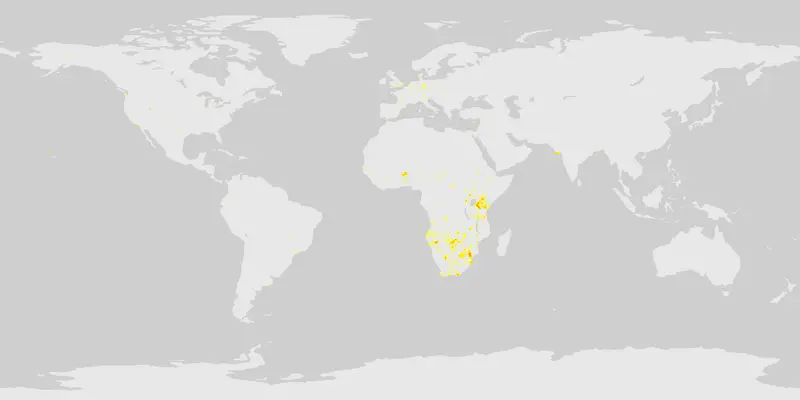
Lions once ranged across most of Africa, southern Europe, the Middle East and India. Today they survive mainly in eastern and southern Africa, in scattered populations in West and Central Africa, and in a single group of Asiatic lions in the Gir Forest of India. Strongholds include the Serengeti and Mara, the Okavango Delta, Kruger and the Zambezi region. Lions live in nearly every habitat except deep rainforest and true desert, but they need large areas with enough prey and some protection from people. The US records in the GBIF chart are from zoos and are not wild sightings, which is why we treat this map as a world map.
Where and when to look
Most wild lions live in the savannas of eastern and southern Africa, with a small population of Asiatic lions in the Gir Forest of western India. Classic places to see them include the great national parks and reserves of Kenya, Tanzania, Botswana, Zambia, Zimbabwe and South Africa. The dry season is usually best, when grass is short and animals gather near rivers and waterholes, making lions easier to spot. In many areas, the great wildebeest and zebra migrations bring lions together with huge herds of prey. Lions are most active at dawn, dusk and through the night. By midmorning, a pride is likely to be stretched out in the shade of an acacia or on a rocky outcrop, sleeping for most of the day. Guides often find them by following vultures circling a kill, listening for alarm calls from antelope and monkeys, or reading fresh tracks on dirt roads. At night, the deep, rolling roars of males and females can carry for miles and often end in a series of grunts. Males are easy to tell apart by their manes, which range from blond to almost black and grow fuller with age. Females are smaller, sleeker and do most of the hunting. Young lions have faint spots on their coats, which fade as they grow. A pride is usually a group of related females, their cubs and one or a few adult males. Look for cubs playing near their mothers, males marking territory, or pride members greeting each other by rubbing heads. On a game drive, keep inside the vehicle, talk quietly and leave decisions about positioning to your guide. Choose operators who keep a respectful distance, limit how many vehicles gather at a sighting, and never bait or call animals. Avoid places that offer cub petting or walking with lions, since those animals are often bred for commercial purposes rather than conservation.
When & where in the US
GBIF holds 206 occurrence records of this species from the United States. States with the most records:
- California 58
- New Mexico 42
- Texas 12
- Alaska 11
- Ohio 10
Occurrence records reflect where and when people look and report (observer effort), not just where the animal is common. Busy birding states and summer months are over-represented; zoo and museum records can appear for non-native species.
Source: GBIF occurrence search for country US.[7]
What it eats
Lions hunt medium to large hoofed mammals such as wildebeest, zebra, buffalo, antelope and warthog. Lionesses do much of the hunting, often working together to stalk and ambush prey, though males hunt too, especially large or dangerous prey like buffalo. Lions also steal kills from hyenas, leopards and cheetahs. They tend to rest much of the day and become active in the cooler hours, eating very large meals and then fasting.
Reproduction and life cycle
A pride is built around related females and their cubs, with one or a few males that defend it. When new males take over a pride, they often kill young cubs, after which the females come back into breeding condition. Females in a pride tend to give birth around the same time and may nurse each other's cubs. Young males leave the pride as they mature and roam until they can win a pride of their own.
Threats and conservation
The lion is listed as vulnerable on the IUCN Red List, as checked through GBIF. Conflicts with herders after lions kill livestock, the loss of prey and habitat, and poaching for body parts are the main threats. Well-managed protected areas and community programs that compensate or protect livestock help. The isolated West African lions are especially at risk.
How to tell it apart
- Tiger: Larger on average, orange with black stripes, a solitary forest hunter of Asia; no mane.
- Cheetah: Slim and long-legged with solid black spots and black tear lines down the face.
- African bush elephant: Not a look-alike, but elephants and lions share many savannas, and young elephants are occasional lion prey in some areas.
Photo: no rights reserved — CC0 1.0, source[8]. See all image credits.
Sources
- GBIF Backbone Taxonomy — Panthera leo (species 5219404), via GBIF API — retrieved 2026-11-21
- GBIF — synonyms of Panthera leo — retrieved 2026-11-21
- GBIF — vernacular names of Panthera leo — retrieved 2026-11-21
- ITIS — full hierarchy for TSN 183803 — retrieved 2026-11-21
- IUCN Red List category via GBIF (Panthera leo) — retrieved 2026-11-21
- Animal Diversity Web (University of Michigan) — Panthera leo account — retrieved 2026-11-21
- GBIF occurrence search — Panthera leo, country US, month and state facets — retrieved 2026-11-21
- iNaturalist taxon 41964 — Panthera leo (photo source) — retrieved 2026-11-21
Written under the pen name Maya Reynolds with AI-assisted drafting, then checked against the sources cited on each page. Last reviewed 2026-11-21. Numbers in the fact table come only from the linked sources; all prose is original. See our editorial policy.