Tiger
Panthera tigris (Linnaeus, 1758) · also called Bagh, Sher
The tiger is the largest living cat, a solitary striped hunter of Asian forests, grasslands and mangroves, from the Russian Far East to India and Sumatra.

Quick facts
| Kingdom | Animalia[4] |
|---|---|
| Phylum | Chordata[4] |
| Class | Mammalia[4] |
| Order | Carnivora[4] |
| Family | Felidae[4] |
| Genus | Panthera[4] |
| Species | Panthera tigris[1] |
| Authority | (Linnaeus, 1758)[1] |
| ITIS TSN | 183805[4] |
| Synonyms | Felis tigris Linnaeus, 1758; Felis tigris[2] |
| Other common names | Bagh, Sher[3] |
| Length | 1.98–3.7 m (6.5–12.1 ft)[6] |
| Weight | 91–423 kg (201–933 lb)[6] |
| Lifespan (max. recorded / range) | 26 years[6] |
| Young per litter or brood | 1 to 7[6] |
| Gestation | 96 to 111 days[6] |
| Diet type | carnivore[6] |
| Habitat | Tropical and temperate forest, grassland, swamp and mangrove · ADW biomes: tundra tundra taiga taiga savanna or grassland savanna or grassland forest forest rainforest rainforest scrub forest scrub forest mountains mountains[6] |
| IUCN Red List | Endangered (EN)[5] IUCN page Population trend: not available through GBIF; see the IUCN assessment. |
Where it lives
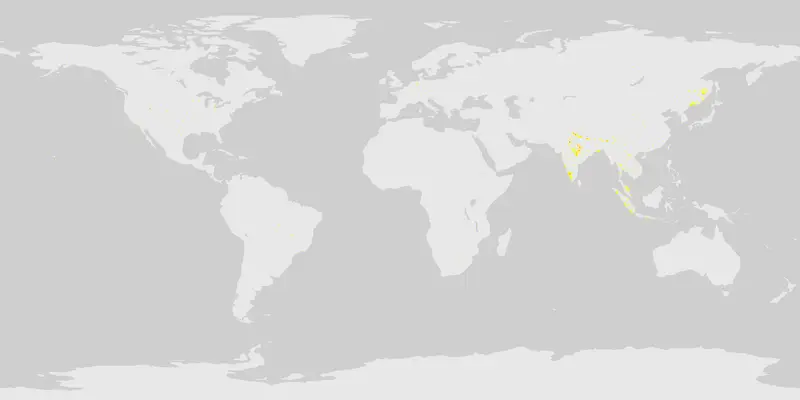
Tigers once ranged from eastern Turkey across Central Asia to the Pacific coast of Russia and south through Southeast Asia to Bali. They have since lost the great majority of that range. Today wild tigers live in India, which holds the largest share, plus Nepal, Bhutan, Bangladesh, Russia, China, Thailand, Malaysia, Indonesia (Sumatra) and a few other countries. Scientists currently recognize two subspecies groups, the continental tigers, including Bengal and Amur tigers, and the Sunda tigers of Sumatra. GBIF records from the United States reflect captive animals; the country holds many captive tigers, a topic of ongoing regulation.
Where and when to look
Seeing a wild tiger takes patience and a bit of luck, but India offers the best odds anywhere. Reserves in the central highlands, such as Kanha, Bandhavgarh, Tadoba and Pench, along with Ranthambore in the drier northwest, are well known for sightings. Further east, the mangrove forests of the Sundarbans hold tigers too, though dense cover makes them very hard to see. Nepal and Bhutan also protect tiger country, and small, scattered populations survive in Southeast Asia and the Russian Far East. Most Indian parks close during the monsoon and reopen in autumn. The hot months before the rains are often the most productive, because waterholes shrink and tigers come to drink or lie in pools to cool off. Morning and late afternoon drives are standard, and the first hour after the gates open is often magic. Experienced guides rarely search for the cat itself. Instead they listen. A sharp, repeated bark from a sambar or spotted deer, or the shrill alarm of langur monkeys overhead, usually means a tiger is walking nearby. Fresh pugmarks pressed into the dust of a forest track, scrapes on the ground and a strong musky scent on tree trunks are other giveaways. Every tiger wears a unique pattern of stripes, and park researchers use camera traps to identify individuals by their markings. Males are noticeably larger, with broader heads and a ruff of longer fur on the cheeks, while females are smaller and slimmer. A tigress with cubs keeps them hidden for their first weeks and later leads them on hunting lessons, so a sighting of a family group is a rare treat. Travel with licensed naturalists who stick to permitted routes and respect vehicle limits, stay seated and quiet, and never ask a driver to cut off a tiger's path. Avoid any venue that sells photos with cubs or walks with big cats. Accredited zoos that take part in managed breeding programs are the right place for close views.
When & where in the US
GBIF holds 146 occurrence records of this species from the United States. States with the most records:
- New Mexico 35
- California 12
- Wisconsin 12
- Minnesota 11
- Nebraska 11
Occurrence records reflect where and when people look and report (observer effort), not just where the animal is common. Busy birding states and summer months are over-represented; zoo and museum records can appear for non-native species.
Source: GBIF occurrence search for country US.[8]
What it eats
Tigers hunt large prey, mostly deer such as sambar and chital, wild pigs and wild cattle like gaur, plus smaller animals when needed. They stalk using cover and ambush from close range, usually at dusk or night, killing with a bite to the throat or neck. A tiger may drag a kill into cover and return to feed over several days. Unlike many cats, tigers are strong swimmers and often lie in water to stay cool.
Reproduction and life cycle
Adult tigers live alone in large territories marked with scent and scratches, and a male's territory overlaps those of several females. A female raises her cubs alone, keeping them hidden while she hunts. Cubs stay with her for around two years, learning to hunt, before dispersing. Many young tigers die while trying to establish territories, often in conflict with other tigers or people.
Threats and conservation
The tiger is listed as endangered on the IUCN Red List, as checked through GBIF. Poaching for skins and for use in traditional medicine, loss of prey, and habitat destruction have driven its decline. In some countries, strict protection, anti-poaching work and corridors between reserves have helped numbers grow again, especially in India and Nepal. Conflicts with villagers living near tiger reserves remain a hard problem.
How to tell it apart
- African lion: Similar size, but plain tawny without stripes, social, and living on African savannas.
- Cheetah: Slender and spotted, with tear-line markings on the face and a sprinting build.
- Red fox: Kids sometimes mix up orange animals with dark markings; a fox is a small dog relative with a white-tipped tail.
Photo: (c) Morten Ross, some rights reserved (CC BY) — CC BY 4.0, source[9]. See all image credits.
Sources
- GBIF Backbone Taxonomy — Panthera tigris (species 5219416), via GBIF API — retrieved 2026-11-21
- GBIF — synonyms of Panthera tigris — retrieved 2026-11-21
- GBIF — vernacular names of Panthera tigris — retrieved 2026-11-21
- ITIS — full hierarchy for TSN 183805 — retrieved 2026-11-21
- IUCN Red List category via GBIF (Panthera tigris) — retrieved 2026-11-21
- Animal Diversity Web (University of Michigan) — Panthera tigris account — retrieved 2026-11-21
- GBIF occurrence density map tile for Panthera tigris — retrieved 2026-11-21
- GBIF occurrence search — Panthera tigris, country US, month and state facets — retrieved 2026-11-21
- iNaturalist taxon 41967 — Panthera tigris (photo source) — retrieved 2026-11-21

Written under the pen name Maya Reynolds with AI-assisted drafting, then checked against the sources cited on each page. Last reviewed 2026-11-21. Numbers in the fact table come only from the linked sources; all prose is original. See our editorial policy.