Red fox
Vulpes vulpes (Linnaeus, 1758) · also called American Cross Fox, Arctic Marble Fox, Cross Fox, Domestic Fox, Domesticated Fox, Fox
The red fox is a slender, rusty-orange wild canid with black legs and a white-tipped bushy tail, the most widespread wild carnivore on Earth.

Quick facts
| Kingdom | Animalia[4] |
|---|---|
| Phylum | Chordata[4] |
| Class | Mammalia[4] |
| Order | Carnivora[4] |
| Family | Canidae[4] |
| Genus | Vulpes[4] |
| Species | Vulpes vulpes[1] |
| Authority | (Linnaeus, 1758)[1] |
| ITIS TSN | 180604[4] |
| Synonyms | Canis vulpes Linnaeus, 1758; Vulpes palmaria Hay, 1917; Canis vulpes[2] |
| Other common names | American Cross Fox, Arctic Marble Fox, Cross Fox, Domestic Fox, Domesticated Fox, Fox[3] |
| Length | 455–900 mm (17.9–35.4 in)[6] |
| Weight | 3–14 kg (6.61–30.9 lb)[6] |
| Lifespan (max. recorded / range) | 12 years[6] |
| Young per litter or brood | 1 to 9[6] |
| Gestation | 49 to 55 days[6] |
| Diet type | omnivore[6] |
| Habitat | Mixed farmland, forest edges, tundra, grasslands, suburbs and cities · ADW biomes: desert or dune desert or dune savanna or grassland savanna or grassland chaparral chaparral forest forest scrub forest scrub forest mountains mountains[6] |
| IUCN Red List | Least Concern (LC)[5] IUCN page Population trend: not available through GBIF; see the IUCN assessment. |
Where it lives
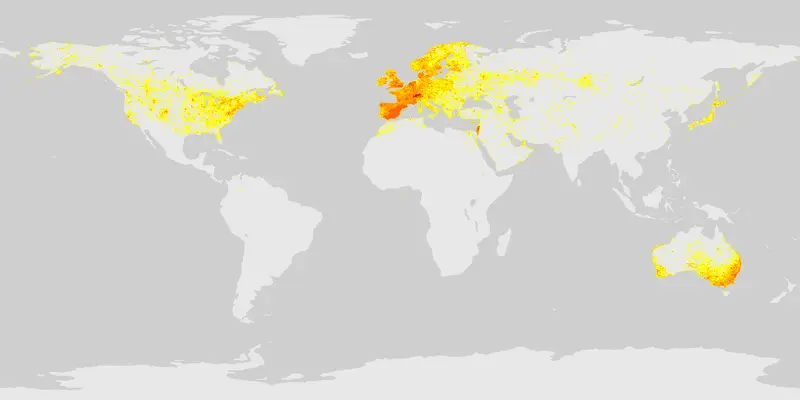
Red foxes range across most of the Northern Hemisphere, from the Arctic to North Africa and from Europe across Asia, and they were introduced to Australia, where they are a serious invasive predator. In North America they occur across Canada, Alaska and most of the lower forty-eight states, absent mainly from parts of the arid Southwest. Native North American foxes and those brought over from Europe for hunting in colonial times have mixed in the East. Foxes increasingly live in cities and suburbs, raising cubs under sheds and in quiet corners of golf courses and cemeteries.
Where and when to look
Foxes are often seen at dawn and dusk crossing quiet roads, field edges and golf courses, trotting with a light, almost floating gait and the long bushy tail held straight out behind. In winter, open snowy fields are the place to watch for the classic mousing pounce, where a fox listens, rises up on its hind legs and dives headfirst into the snow. Late winter nights bring the eerie scream of the breeding season, which can startle people who have never heard it. In spring, active dens are revealed by fresh dirt at the entrance, scattered bones and feathers, and a strong musky smell; kits play outside the entrance in the evenings. Watch from far away, since disturbance can cause a family to move. Fox tracks form a neat, straight line, each print small and oval, with a chevron-shaped pad that separates it from a domestic dog print. Urban foxes are often bold enough to cross a lawn in daylight, which is normal behavior and not a sign of illness on its own. Keep pet food indoors and the fox will usually move on after a brief look around.
When & where in the US
GBIF holds 46,929 occurrence records of this species from the United States. States with the most records:
- Maryland 5,685
- Virginia 4,590
- Alaska 2,879
- Pennsylvania 2,789
- New York 2,758
Occurrence records reflect where and when people look and report (observer effort), not just where the animal is common. Busy birding states and summer months are over-represented; zoo and museum records can appear for non-native species.
Source: GBIF occurrence search for country US.[7]
What it eats
Foxes are opportunistic hunters and foragers. Voles and mice are staples, and the fox's signature hunting move is the high pounce, in which it leaps upward and dives nose first onto prey hidden under grass or snow. Rabbits, birds, eggs, insects, earthworms, fruit, berries and carrion fill out the diet, and urban foxes take scraps and pet food. Foxes cache extra food in shallow holes and come back to it later. Their large ears pick up the faint rustling of rodents moving beneath the snow.
Reproduction and life cycle
Foxes pair up in winter, when their eerie screaming calls carry across the night. The female gives birth in an underground den, often an enlarged woodchuck burrow, under a shed or in a bank. Both parents bring food to the kits, and older offspring sometimes help. Kits play outside the den entrance in late spring, a wonderful sight from a respectful distance. By fall the young disperse, sometimes traveling far to find a territory.
Threats and conservation
The red fox is listed as least concern and remains abundant. Coyotes kill and displace foxes, and in many areas foxes have shifted toward towns where coyotes are fewer. Mange, a skin disease caused by mites, can devastate local populations, and road traffic kills many. Foxes are trapped and hunted in many states. As introduced predators in Australia and some islands, they have caused declines of native animals.
How to tell it apart
- Coyote: Larger and leggier, gray-brown rather than orange, with a black-tipped tail held low and a broader muzzle.
- Gray wolf: Much larger, with a massive head and long legs; wolves in Yellowstone are gray or black, never fox red.
- Raccoon: Similar size in headlights, but a raccoon hunches and waddles and has a masked face and ringed tail.
- Eastern cottontail: A fox carrying a rabbit can surprise people; the color of the coat and the tail tip tell them apart quickly.
Photo: (c) Алина Урусова, some rights reserved (CC BY) — CC BY 4.0, source[8]. See all image credits.
Sources
- GBIF Backbone Taxonomy — Vulpes vulpes (species 5219243), via GBIF API — retrieved 2026-11-21
- GBIF — synonyms of Vulpes vulpes — retrieved 2026-11-21
- GBIF — vernacular names of Vulpes vulpes — retrieved 2026-11-21
- ITIS — full hierarchy for TSN 180604 — retrieved 2026-11-21
- IUCN Red List category via GBIF (Vulpes vulpes) — retrieved 2026-11-21
- Animal Diversity Web (University of Michigan) — Vulpes vulpes account — retrieved 2026-11-21
- GBIF occurrence search — Vulpes vulpes, country US, month and state facets — retrieved 2026-11-21
- iNaturalist taxon 42069 — Vulpes vulpes (photo source) — retrieved 2026-11-21
Written under the pen name Maya Reynolds with AI-assisted drafting, then checked against the sources cited on each page. Last reviewed 2026-11-21. Numbers in the fact table come only from the linked sources; all prose is original. See our editorial policy.