Coyote
Canis latrans Say, 1823 · also called American Jackal, Black Coyote, Brush Wolf, Burrowing Dog, Cased Wolf, Cayjotte
The coyote is a medium-sized wild dog native to North America, a gray-brown, yellow-eyed survivor that has spread from the western plains to nearly every corner of the continent.

Quick facts
| Kingdom | Animalia[4] |
|---|---|
| Phylum | Chordata[4] |
| Class | Mammalia[4] |
| Order | Carnivora[4] |
| Family | Canidae[4] |
| Genus | Canis[4] |
| Species | Canis latrans[1] |
| Authority | Say, 1823[1] |
| ITIS TSN | 180599[4] |
| Synonyms | Canis andersoni Merriam, 1910; Canis caneloensis Skinner, 1942; Canis clepticus Eliot, 1903; Canis estor Merriam, 1897; Canis frustror Woodhouse, 1851; Canis goldmani Merriam, 1904; Canis hondurensis Goldman, 1936; Canis impavidus Allen, 1903[2] |
| Other common names | American Jackal, Black Coyote, Brush Wolf, Burrowing Dog, Cased Wolf, Cayjotte[3] |
| Length | 75–100 cm (2.46–3.28 ft)[6] |
| Weight | 7–21 kg (15.4–46.3 lb)[6] |
| Lifespan (max. recorded / range) | 10 years[6] |
| Young per litter or brood | 1 to 19[6] |
| Gestation | 50 to 65 days[6] |
| Diet type | omnivore[6] |
| Habitat | Prairie, desert, mountains, forest edges, farmland and cities · ADW biomes: taiga taiga desert or dune desert or dune savanna or grassland savanna or grassland chaparral chaparral forest forest scrub forest scrub forest mountains mountains[6] |
| IUCN Red List | Least Concern (LC)[5] IUCN page Population trend: not available through GBIF; see the IUCN assessment. |
Where it lives
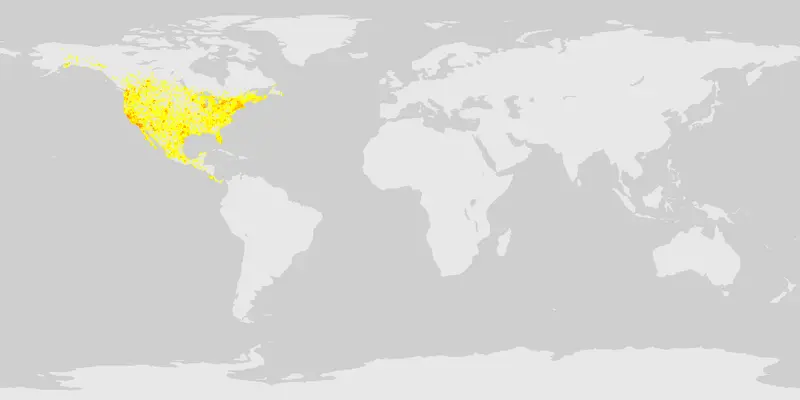
Coyotes were once mostly animals of the western plains and deserts. Over the past century and a half they have spread east to the Atlantic coast, north to Alaska and south into Central America, filling space left after wolves were eliminated and taking advantage of farmland and suburbs. Today they live in every state except Hawaii and in many big cities, including Los Angeles, Chicago and New York. Eastern coyotes tend to be larger and carry some wolf ancestry from hybridization during the eastward spread. In Yellowstone coyotes are common, and their numbers there shifted after wolves returned to the park.
Where and when to look
Coyotes now live from deserts and prairies to the edges of the biggest cities, yet many people never see one because they are cautious and mostly active at night. Your best odds come at dawn and dusk, when coyotes trot along field edges, power line cuts, golf course roughs, railroad corridors and the margins of parks, often stopping to pounce on mice in tall grass with a stiff-legged hop. Open country in the West offers daytime sightings, especially in winter, when a coyote may hunt mice across a snowy meadow in full view of the road. Listen at night for the famous chorus of yips, barks and wavering howls; a small family group can sound like a much larger pack, and the sudden burst of noise is a way for coyotes to keep in touch and mark their territory. Tracks look like a dog's but more oval and compact, with the two middle toes set ahead of the outer toes and the prints falling in a straight, efficient line. Droppings often appear in the middle of trails and are full of hair, fur, seeds and bits of berries. Late winter is mating season, and pups are born in spring in dens under brush, rock piles or banks; by summer the young may be seen playing near the den at dusk. Males are slightly larger than females, but in the field they look alike. To keep coyotes wild, never feed them, secure trash and compost, bring pet food inside, keep small pets supervised and cats indoors, and if a coyote comes close, make yourself big and loud so it learns to keep its distance from people.
When & where in the US
GBIF holds 101,150 occurrence records of this species from the United States. States with the most records:
- California 35,161
- Texas 12,419
- Arizona 4,417
- New Mexico 2,969
- Colorado 2,967
Occurrence records reflect where and when people look and report (observer effort), not just where the animal is common. Busy birding states and summer months are over-represented; zoo and museum records can appear for non-native species.
Source: GBIF occurrence search for country US.[7]
What it eats
Coyotes eat what is available. Rodents and rabbits are the core of the diet in most places, and coyotes also take deer fawns, birds, reptiles, insects, fruit such as persimmons and berries, carrion and garbage. City coyotes eat a mix of wild prey and human-linked food, and some take unattended cats and small dogs. Hunting alone or in pairs, a coyote often stalks and pounces much like a fox; in groups, coyotes can bring down larger prey.
Reproduction and life cycle
Coyotes form long-lasting pairs that defend a territory, announcing it with the yips and howls that carry at dusk. Pups are born in spring in a den dug into a bank, under rocks or in a culvert. Both parents and sometimes older offspring feed the pups by regurgitating food. Families break up in fall and winter as young disperse, which is when many coyotes are seen crossing roads in new places.
Threats and conservation
The coyote is listed as least concern and is thriving despite heavy hunting, trapping and control programs. Research suggests that removing coyotes can trigger bigger litters, which helps explain their resilience. In cities the key to coexistence is not feeding them, intentionally or through pet food and open trash, and scaring bold animals away with noise.
How to tell it apart
- Gray wolf: Much bigger with a broad blocky head, shorter rounded ears and long legs; a wolf track is far larger.
- Red fox: Smaller, bright orange with black legs and a white tail tip; coyotes are grayish with a black tail tip.
- White-tailed deer: In fields at dusk a distant coyote can blur with a fawn, but a coyote trots with its head low and tail down.
Photo: (c) Kevin Lynch, some rights reserved (CC BY) — CC BY 4.0, source[8]. See all image credits.
Sources
- GBIF Backbone Taxonomy — Canis latrans (species 5219153), via GBIF API — retrieved 2026-11-21
- GBIF — synonyms of Canis latrans — retrieved 2026-11-21
- GBIF — vernacular names of Canis latrans — retrieved 2026-11-21
- ITIS — full hierarchy for TSN 180599 — retrieved 2026-11-21
- IUCN Red List category via GBIF (Canis latrans) — retrieved 2026-11-21
- Animal Diversity Web (University of Michigan) — Canis latrans account — retrieved 2026-11-21
- GBIF occurrence search — Canis latrans, country US, month and state facets — retrieved 2026-11-21
- iNaturalist taxon 42051 — Canis latrans (photo source) — retrieved 2026-11-21
Written under the pen name Maya Reynolds with AI-assisted drafting, then checked against the sources cited on each page. Last reviewed 2026-11-21. Numbers in the fact table come only from the linked sources; all prose is original. See our editorial policy.