Gray wolf
Canis lupus Linnaeus, 1758 · also called American Wolf, Arctic Wolf, Black Wolf, Common Wolf, Grey Wolf, Large Wolf
The gray wolf is the largest wild member of the dog family, a social pack hunter whose return to Yellowstone made it one of the most studied predators in the world.

Quick facts
| Kingdom | Animalia[4] |
|---|---|
| Phylum | Chordata[4] |
| Class | Mammalia[4] |
| Order | Carnivora[4] |
| Family | Canidae[4] |
| Genus | Canis[4] |
| Species | Canis lupus[1] |
| Authority | Linnaeus, 1758[1] |
| ITIS TSN | 180596[4] |
| Synonyms | Canis furlongi Hay, 1927; Canis nubilus Say, 1823; Canis pambasileus Elliot, 1905; Canis petrolei Stock, 1938; Canis tundrarum Miller, 1912; Lupus gigas Townsend, 1850; Lupus lupus Linnaeus, 1758[2] |
| Other common names | American Wolf, Arctic Wolf, Black Wolf, Common Wolf, Grey Wolf, Large Wolf[3] |
| Length | 870–1300 mm (2.85–4.27 ft)[6] |
| Weight | 23–80 kg (50.7–176 lb)[6] |
| Lifespan (max. recorded / range) | 13 years[6] |
| Young per litter or brood | 5.0 to 14.0[6] |
| Diet type | carnivore[6] |
| Habitat | Forests, tundra, mountains, grasslands and river valleys with prey · ADW biomes: tundra tundra taiga taiga chaparral chaparral forest forest scrub forest scrub forest mountains mountains[6] |
| IUCN Red List | Least Concern (LC)[5] IUCN page Population trend: not available through GBIF; see the IUCN assessment. |
Where it lives
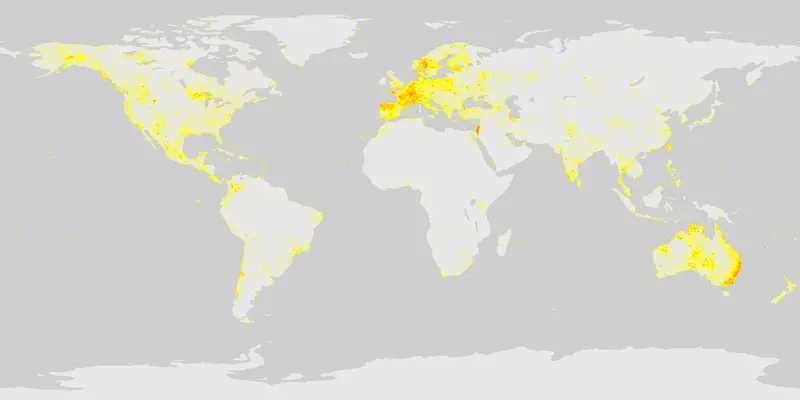
Gray wolves once ranged across most of the Northern Hemisphere. In the lower forty-eight states they were nearly eliminated by the mid twentieth century, surviving mainly in northern Minnesota. Wolves remained in Canada and Alaska. Wolves were reintroduced to Yellowstone and central Idaho in the mid nineteen nineties, and populations have since spread across the northern Rockies, into Washington, Oregon and California, and in the western Great Lakes states. Elsewhere they occur across Canada, northern Eurasia and parts of India and the Middle East.
Where and when to look
Most people who see wild wolves in the United States do so in Yellowstone's Lamar Valley, scanning distant slopes with a spotting scope in the first light of morning. Winter is usually the best season, when wolves stand out against snow and the elk herds they follow are concentrated in the northern range. Watch for ravens and magpies circling or gathering, since birds often reveal a fresh kill. Listen at dawn and dusk for a long, rising and falling howl, sometimes answered by others from across the valley. Patient watchers join the informal community of wolf spotters along the road pullouts; follow park rules, stay well back, and never use calls to attract wolves. Tracks in snow or mud are another clue: a wolf print is large and oval, with four toes and claw marks, and wolves often travel in a straight, purposeful line, each animal stepping in the tracks of the one before. Wolf watching rewards patience more than luck. Arrive before sunrise, bring warm layers and a thermos, and expect long stretches of empty snow. When a pack does appear, note the colors of each animal, the direction of travel and any elk nearby; longtime watchers trade such details, and learning to read them makes every sighting richer.
When & where in the US
GBIF holds 17,624 occurrence records of this species from the United States. States with the most records:
- Alaska 6,500
- New Mexico 1,217
- Wyoming 1,127
- Texas 847
- Minnesota 723
Occurrence records reflect where and when people look and report (observer effort), not just where the animal is common. Busy birding states and summer months are over-represented; zoo and museum records can appear for non-native species.
Source: GBIF occurrence search for country US.[7]
What it eats
In Yellowstone, elk are the primary prey for much of the year, with bison, deer, moose and smaller animals also taken. Packs test herds by chasing them, looking for animals that are young, old or weak. Wolves often eat large amounts at once and then go days without food. Their kills feed ravens, eagles, coyotes, foxes, bears and many insects, spreading benefits through the food web. The return of wolves to Yellowstone changed where and how elk feed, a topic still debated by ecologists.
Reproduction and life cycle
A pack is usually a family: a breeding pair and their offspring from recent years. The pair mates in late winter and the female gives birth in a den in spring. The whole pack helps feed the pups, carrying meat back in their stomachs. By fall the pups travel with the pack. Young wolves often leave when they mature to look for a mate and territory, sometimes traveling hundreds of miles.
Threats and conservation
Globally the gray wolf is listed as least concern. In the United States its legal status has changed repeatedly between federal protection and state management, and lethal control occurs where wolves kill livestock. Mange, disease and conflicts with other packs are major natural causes of death in Yellowstone. The species remains controversial in many rural communities, and coexistence methods such as guard animals and range riders are increasingly used.
How to tell it apart
- Coyote: Smaller and slimmer with a narrow muzzle and larger pointed ears; coyote howls are high yips, wolf howls deep and long.
- Red fox: Much smaller and orange with black stockings and a white-tipped tail.
- Grizzly bear: A competitor at kills; bulkier, with a hump and short tail.
- Elk: The wolf's main prey in Yellowstone; watching elk behavior is a good way to spot wolves nearby.
Photo: (c) James Telford, some rights reserved (CC BY) — CC BY 4.0, source[8]. See all image credits.
Sources
- GBIF Backbone Taxonomy — Canis lupus (species 5219173), via GBIF API — retrieved 2026-11-21
- GBIF — synonyms of Canis lupus — retrieved 2026-11-21
- GBIF — vernacular names of Canis lupus — retrieved 2026-11-21
- ITIS — full hierarchy for TSN 180596 — retrieved 2026-11-21
- IUCN Red List category via GBIF (Canis lupus) — retrieved 2026-11-21
- Animal Diversity Web (University of Michigan) — Canis lupus account — retrieved 2026-11-21
- GBIF occurrence search — Canis lupus, country US, month and state facets — retrieved 2026-11-21
- iNaturalist taxon 42048 — Canis lupus (photo source) — retrieved 2026-11-21
Written under the pen name Maya Reynolds with AI-assisted drafting, then checked against the sources cited on each page. Last reviewed 2026-11-21. Numbers in the fact table come only from the linked sources; all prose is original. See our editorial policy.