Grizzly bear
Ursus arctos Linnaeus, 1758 · also called brown bear, Kodiak Bear
The grizzly is the North American inland form of the brown bear, a powerful, hump-shouldered omnivore of the northern Rockies and Alaska whose fur is often tipped with silver.

Quick facts
| Kingdom | Animalia[4] |
|---|---|
| Phylum | Chordata[4] |
| Class | Mammalia[4] |
| Order | Carnivora[4] |
| Family | Ursidae[4] |
| Genus | Ursus[4] |
| Species | Ursus arctos[1] |
| Authority | Linnaeus, 1758[1] |
| ITIS TSN | 180543[4] |
| Synonyms | Ursus horribilis Ord, 1815; Ursus procerus Miller, 1899[2] |
| Other common names | brown bear, Kodiak Bear[3] |
| Length | 1–2.8 m (3.28–9.19 ft)[6] |
| Weight | 80–600 kg (176–1323 lb)[6] |
| Lifespan (max. recorded / range) | 50 years[6] |
| Young per litter or brood | 3[6] |
| Gestation | 180 to 266 days[6] |
| Diet type | omnivore[6] |
| Habitat | Mountain forests, alpine meadows, river valleys, tundra and coastal salmon streams · ADW biomes: tundra tundra taiga taiga desert or dune desert or dune savanna or grassland savanna or grassland chaparral chaparral forest forest scrub forest scrub forest mountains mountains[6] |
| IUCN Red List | Least Concern (LC)[5] IUCN page Population trend: not available through GBIF; see the IUCN assessment. |
Where it lives
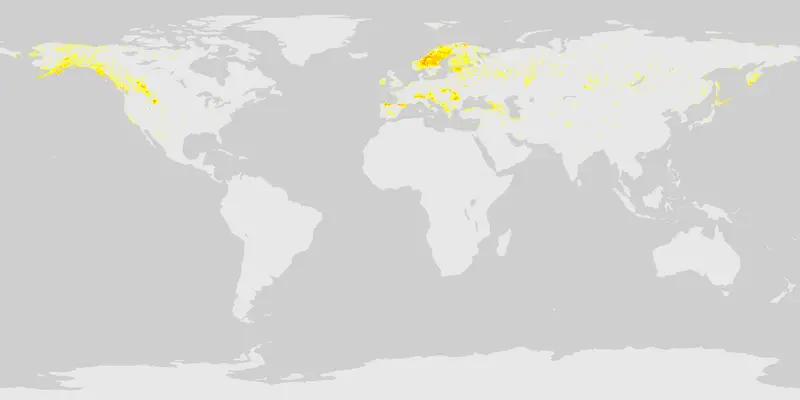
Brown bears live across northern North America, Europe and Asia, making them one of the most widespread bears. In the lower forty-eight states grizzlies once ranged from the Great Plains to California, but by the early twentieth century they had been reduced to a handful of mountain strongholds. Today the main populations are in the Greater Yellowstone Ecosystem and the Northern Continental Divide around Glacier National Park, with smaller groups in Idaho, Montana and Washington. Alaska and western Canada hold most North American brown bears, including the huge coastal bears that feed on salmon. Yellowstone grizzlies have expanded outward from the park as their numbers recovered.
Where and when to look
In Yellowstone, grizzlies are most visible in spring, when they leave dens and search open slopes and valley bottoms for winter-killed carcasses and newborn elk. Hayden Valley, Dunraven Pass and the slopes around Swan Lake Flat are well-known spots. Scan open hillsides early and late in the day with binoculars; a grizzly digging for roots often looks like a slowly moving brown boulder. In summer, bears move to higher meadows, and in fall they feed intensely to build fat, a period called hyperphagia when they can be bold. On trails, make noise, travel in groups, carry bear spray where you can reach it, and never run from a bear. Tracks show long claw marks well ahead of the toes, and the toes sit in a nearly straight line, while black bear toes form a more curved arc with shorter claws. If you watch from a roadside pullout, stay with your vehicle and let rangers manage the crowd that often gathers; a bear jam that pushes a grizzly off its feeding spot costs it energy it needs before winter.
When & where in the US
GBIF holds 10,505 occurrence records of this species from the United States. States with the most records:
- Alaska 7,089
- Wyoming 2,114
- Montana 743
- California 76
- Colorado 43
Occurrence records reflect where and when people look and report (observer effort), not just where the animal is common. Busy birding states and summer months are over-represented; zoo and museum records can appear for non-native species.
Source: GBIF occurrence search for country US.[7]
What it eats
Grizzlies are omnivores that eat whatever is most rewarding at each season. In Yellowstone they feed on winter-killed bison and elk in early spring, prey on newborn elk calves, dig for roots, bulbs and rodents in meadows, and eat grasses, berries, insects and fish. High in the mountains some bears gorge on army cutworm moths in talus slopes in late summer. The seeds of whitebark pine cones, raided from squirrel caches, were once a key fall food. Their long front claws and the muscle hump over the shoulders power their digging.
Reproduction and life cycle
Grizzlies mate in early summer, but the fertilized egg does not implant until fall, so cubs develop only during the winter denning period. Cubs are born tiny in a den and nurse until spring. They stay with their mother for two or more years, learning where to find food. Because females breed only every few years, grizzly populations grow slowly and are sensitive to the loss of adult females.
Threats and conservation
The brown bear is listed as least concern globally, but grizzlies in the lower forty-eight states are protected under the Endangered Species Act. Most deaths are tied to people: conflicts over livestock and garbage, defensive kills by hunters, vehicle collisions and illegal killing. Secure food storage in bear country, carrying bear spray and keeping a respectful distance protect bears and people.
How to tell it apart
- American black bear: Color is unreliable since black bears can be brown; look for the black bear's straight face profile, taller pointed ears, no shoulder hump and short curved claws.
- American bison: Another humped brown giant in Yellowstone valleys, but a grazer with horns, hooves and a long beard.
- Polar bear: Its Arctic relative, white or cream with a long neck and narrower head, living on sea ice.
- Gray wolf: A frequent rival at carcasses; wolves are dog-shaped and travel in packs.
Photo: (c) Cody Stricker, some rights reserved (CC BY) — CC BY 4.0, source[8]. See all image credits.
Sources
- GBIF Backbone Taxonomy — Ursus arctos (species 2433433), via GBIF API — retrieved 2026-11-21
- GBIF — synonyms of Ursus arctos — retrieved 2026-11-21
- GBIF — vernacular names of Ursus arctos — retrieved 2026-11-21
- ITIS — full hierarchy for TSN 180543 — retrieved 2026-11-21
- IUCN Red List category via GBIF (Ursus arctos) — retrieved 2026-11-21
- Animal Diversity Web (University of Michigan) — Ursus arctos account — retrieved 2026-11-21
- GBIF occurrence search — Ursus arctos, country US, month and state facets — retrieved 2026-11-21
- iNaturalist taxon 41641 — Ursus arctos (photo source) — retrieved 2026-11-21
Written under the pen name Maya Reynolds with AI-assisted drafting, then checked against the sources cited on each page. Last reviewed 2026-11-21. Numbers in the fact table come only from the linked sources; all prose is original. See our editorial policy.