Polar bear
Ursus maritimus Phipps, 1774 · also called Great White Bear, Ice Bear, Nanook, White Bear, \ White Bear, \\ White Bear
The polar bear is a large white bear of the Arctic that hunts seals from sea ice, classified as a marine mammal because it depends on the ocean for food.

Quick facts
| Kingdom | Animalia[4] |
|---|---|
| Phylum | Chordata[4] |
| Class | Mammalia[4] |
| Order | Carnivora[4] |
| Family | Ursidae[4] |
| Genus | Ursus[4] |
| Species | Ursus maritimus[1] |
| Authority | Phipps, 1774[1] |
| ITIS TSN | 180542[4] |
| Synonyms | Thalarctos maritimus (Phipps, 1774); Thalarctos polaris Gray, 1825; Thalassarctos eogroenlandicus Knottnerus-Meyer, 1908; Thalassarctos jenaensis Knottnerus-Meyer, 1908; Thalassarctos labradorensis Knottnerus-Meyer, 1908; Thalassarctos maritimus groenlandicus Birula, 1932; Ursus marinus Pallas, 1776; Thalassarctos jenaensis[2] |
| Other common names | Great White Bear, Ice Bear, Nanook, White Bear, \ White Bear, \\ White Bear[3] |
| Length | 180–250 cm (5.91–8.2 ft)[6] |
| Weight | 150–800 kg (331–1764 lb)[6] |
| Lifespan (max. recorded / range) | 25–30 years[6] |
| Young per litter or brood | 1 to 4[6] |
| Gestation | 195 to 265 days[6] |
| Diet type | carnivore[6] |
| Habitat | Arctic sea ice, coastlines and nearby tundra · ADW biomes: tundra tundra icecap[6] |
| IUCN Red List | Vulnerable (VU)[5] IUCN page Population trend: not available through GBIF; see the IUCN assessment. |
Where it lives
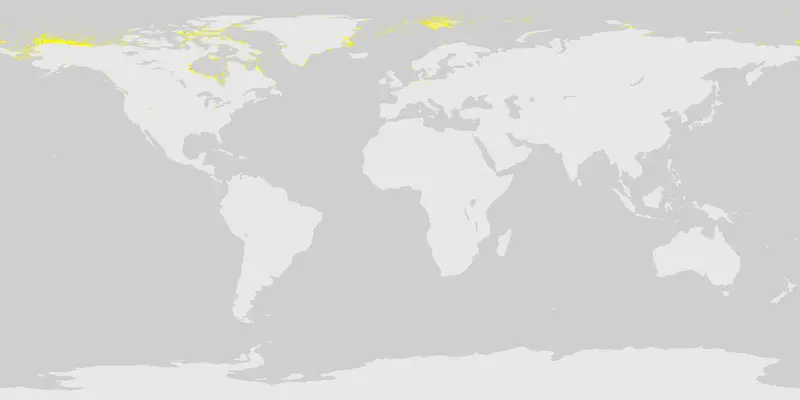
Polar bears live around the Arctic Ocean in Canada, Alaska, Greenland, Norway's Svalbard and Russia. Scientists recognize around twenty subpopulations. In the United States they occur only in Alaska, in the southern and northern Beaufort Sea and the Chukchi Sea. Polar bears move with the sea ice, traveling great distances as it forms and melts. When ice retreats in summer, some bears come ashore and wait, living on stored fat. Hudson Bay near Churchill, Manitoba, is the best-known place to watch them as they gather to wait for freeze-up.
Where and when to look
The most accessible place in North America to see wild polar bears is Churchill, Manitoba, on the shore of Hudson Bay, where bears gather in autumn waiting for the bay to freeze. Tours use large tundra vehicles that keep people safely elevated. In the United States, the Alaskan village of Kaktovik on Barter Island has become a destination in fall, when bears come ashore near the coast; visits are tightly managed and guided by local residents. At sea, bears are seen from icebreakers and research ships. Signs of polar bears include large rounded tracks crossing sea ice and snow, and breathing holes or seal lairs that have been broken open. Because these bears are rarely seen in the wild, iNaturalist and GBIF records are sparse compared with bears that live in places people visit often, so our charts here say more about Alaskan field seasons than about the bears themselves. For most people, the best way to learn about wild polar bears is through long-term research programs and public webcams that follow bears near Churchill and in Alaska, which show hunting, resting and mothers with cubs without disturbing anyone. Reading those observations alongside the sea-ice reports published each autumn gives a vivid picture of how the timing of freeze-up shapes a bear's year.
When & where in the US
GBIF holds 2,797 occurrence records of this species from the United States. States with the most records:
- Alaska 1,339
- New Mexico 15
- Michigan 8
- Washington 6
- California 5
Occurrence records reflect where and when people look and report (observer effort), not just where the animal is common. Busy birding states and summer months are over-represented; zoo and museum records can appear for non-native species.
Source: GBIF occurrence search for country US.[8]
What it eats
Ringed and bearded seals are the main prey. A polar bear waits beside a breathing hole or stalks seals resting on the ice, and in spring breaks into snow lairs where seals have their pups. Seal blubber provides the energy bears need in a frigid climate. When ice is scarce they scavenge whale carcasses, take birds and eggs, and eat some vegetation, but these foods do not replace seals. A good sense of smell helps them find seals across long distances.
Reproduction and life cycle
Mating occurs on the sea ice in spring. Pregnant females dig maternity dens in snowdrifts on land or sea ice in fall, and cubs are born during winter, small and blind. The family stays in the den until spring, living off the mother's fat. Cubs remain with their mother for over two years, learning to hunt seals. Females have few cubs over a lifetime, so adult female survival matters a great deal.
Threats and conservation
The polar bear is listed as vulnerable on the IUCN Red List, as checked through GBIF. The main threat is the loss of Arctic sea ice from climate change, which shortens the hunting season and forces longer fasts. Pollution, oil development, shipping and conflicts with people in Arctic towns add pressure. Polar bears are protected in the United States under the Endangered Species Act and the Marine Mammal Protection Act.
How to tell it apart
- Grizzly bear: A brown bear with a shoulder hump and dished face; grizzlies and polar bears meet and occasionally hybridize in the western Arctic.
- American black bear: Smaller, straight-faced and usually black or brown; lives in forests.
- Orca: A fellow Arctic and sub-Arctic predator; the orca is a toothed whale, never on land.
Photo: (c) Morten Ross, some rights reserved (CC BY), uploaded by Morten Ross — CC BY 4.0, source[9]. See all image credits.
Sources
- GBIF Backbone Taxonomy — Ursus maritimus (species 2433451), via GBIF API — retrieved 2026-11-21
- GBIF — synonyms of Ursus maritimus — retrieved 2026-11-21
- GBIF — vernacular names of Ursus maritimus — retrieved 2026-11-21
- ITIS — full hierarchy for TSN 180542 — retrieved 2026-11-21
- IUCN Red List category via GBIF (Ursus maritimus) — retrieved 2026-11-21
- Animal Diversity Web (University of Michigan) — Ursus maritimus account — retrieved 2026-11-21
- GBIF occurrence density map tile for Ursus maritimus — retrieved 2026-11-21
- GBIF occurrence search — Ursus maritimus, country US, month and state facets — retrieved 2026-11-21
- iNaturalist taxon 41644 — Ursus maritimus (photo source) — retrieved 2026-11-21

Written under the pen name Maya Reynolds with AI-assisted drafting, then checked against the sources cited on each page. Last reviewed 2026-11-21. Numbers in the fact table come only from the linked sources; all prose is original. See our editorial policy.