Orca
Orcinus orca (Linnaeus, 1758) · also called killer whale, Blackfish, Epaulard, Orca (Killer Whale), Orca Whale, Schwertwal
The orca, or killer whale, is the largest member of the dolphin family, a black-and-white predator found in every ocean and living in close-knit family pods.

Quick facts
| Kingdom | Animalia[4] |
|---|---|
| Phylum | Chordata[4] |
| Class | Mammalia[4] |
| Order | Cetacea[4] |
| Family | Delphinidae[4] |
| Genus | Orcinus[4] |
| Species | Orcinus orca[1] |
| Authority | (Linnaeus, 1758)[1] |
| ITIS TSN | 180469[4] |
| Synonyms | Delphinus duhameli Lacépède, 1804; Delphinus gladiator Bonnaterre, 1789; Delphinus grampus Blainville, 1817; Delphinus grampus Desmarest, 1817; Delphinus orca Linnaeus, 1758; Delphinus orca ensidoratus Kerr, 1792; Delphinus serra Borowski, 1780; Delphinus victorini Grill, 1858[2] |
| Other common names | killer whale, Blackfish, Epaulard, Orca (Killer Whale), Orca Whale, Schwertwal[3] |
| Length | 9.75 m (32 ft)[6] |
| Weight | 7200 kg (7.94 tons)[6] |
| Young per litter or brood | 1[6] |
| Gestation | 12 to 18 months[6] |
| Lifespan | Not available from our sources |
| Diet type | carnivore[6] |
| Habitat | Coastal and open oceans from the poles to the tropics |
| IUCN Red List | Data Deficient (DD)[5] IUCN page Population trend: not available through GBIF; see the IUCN assessment. |
Where it lives
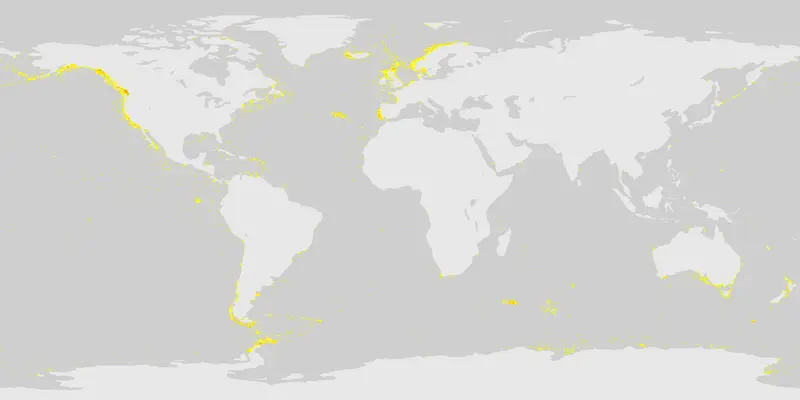
Orcas live in all oceans, but they are most numerous in cold, productive waters such as the Antarctic, the North Pacific and the North Atlantic. In the United States they are seen in Alaska, along the Pacific Northwest coast and Puget Sound, and offshore of California, with occasional sightings elsewhere. Scientists recognize several ecotypes that differ in diet, behavior and genetics. In the Pacific Northwest, salmon-eating residents and mammal-eating Bigg's orcas share the same waters but do not mix.
Where and when to look
Orcas are found in every ocean, from icy polar seas to warmer coastal waters, but some places offer especially good chances to see them. In North America, the inland waters of Washington State and British Columbia, Southeast Alaska and the waters off Monterey in California are popular choices. Elsewhere, Norway's northern fjords, Iceland, the Crozet Islands, Argentina's Patagonian coast and New Zealand all have well-known populations. Each population tends to have its own hunting style, diet and calls, and scientists recognize several distinct ecotypes, some of which may eventually be named as separate species. Summer is peak season in the Pacific Northwest, when resident orcas follow salmon runs, while other groups that hunt seals and porpoises can turn up at almost any time of year. In northern Norway, orcas have gathered in winter to feed on herring. Calm mornings are ideal, because a tall black dorsal fin slicing through flat water and the bushy blow of an exhale are easiest to spot without whitecaps. Shore-based viewing from headlands and parks is a gentle, low-impact option, and binoculars help a great deal. Adult males are easy to recognize by their towering, straight dorsal fins, which can be nearly as tall as a person. Females and young animals have smaller, curved fins. Researchers identify individuals by the shape and nicks of the dorsal fin and the gray saddle patch behind it. Calves often have a peachy or orange tint to their white patches for their first year or so, and they swim close to their mothers. Orcas are social and vocal, communicating with clicks, whistles and pulsed calls, and each family group has its own dialect. On some trips, a hydrophone lowered into the water lets you listen in. Choose operators that follow regional whale-watching guidelines, which set minimum approach distances, limit speeds and restrict time near pods. Boats should never cut in front of a pod, chase animals or separate mothers and calves, and engines should idle or shut off when orcas come close. If you are in a kayak or small boat, give them a wide berth and let them pass.
When & where in the US
GBIF holds 17,242 occurrence records of this species from the United States. States with the most records:
- Washington 1,448
- Alaska 1,237
- California 544
- Oregon 39
- Massachusetts 22
Occurrence records reflect where and when people look and report (observer effort), not just where the animal is common. Busy birding states and summer months are over-represented; zoo and museum records can appear for non-native species.
Source: GBIF occurrence search for country US.[8]
What it eats
Each ecotype has a specialty. Resident orcas of the Pacific Northwest feed mainly on salmon, especially Chinook. Bigg's orcas hunt seals, sea lions, porpoises and even larger whales. Other populations take sharks, rays, penguins or schooling fish like herring. Hunting techniques are learned and passed down; some groups create waves to wash seals off ice floes, and others herd fish into tight balls.
Reproduction and life cycle
Orca society is organized around mothers. Among Pacific Northwest residents, sons and daughters stay with their mothers for life, forming matrilines that travel together. Calves are born after a long pregnancy and are nursed for a long time. Females have few calves over their lives and go through menopause, and older females lead groups to food, especially in poor salmon years. Different groups have distinct call dialects.
Threats and conservation
As a species, the orca is listed as data deficient on the IUCN Red List, as checked through GBIF, because several ecotypes may be separate species. The endangered Southern Resident population of the Pacific Northwest faces a shortage of Chinook salmon, chemical pollution and noise and disturbance from vessels. Pollutants that build up in the food chain are a concern for many populations.
How to tell it apart
- Great white shark: A shark, not a mammal; gray above and white below with a vertical tail, gill slits and no blowhole.
- Blue whale: Far larger, mottled blue-gray, with a tiny dorsal fin and a tall vertical blow.
- Giant panda: Shares the famous black-and-white pattern, but lives on land in China.
Photo: (c) Martín Acosta Albarracín, some rights reserved (CC BY), uploaded by Martín Acosta Albarracín — CC BY 4.0, source[9]. See all image credits.
Sources
- GBIF Backbone Taxonomy — Orcinus orca (species 2440483), via GBIF API — retrieved 2026-11-21
- GBIF — synonyms of Orcinus orca — retrieved 2026-11-21
- GBIF — vernacular names of Orcinus orca — retrieved 2026-11-21
- ITIS — full hierarchy for TSN 180469 — retrieved 2026-11-21
- IUCN Red List category via GBIF (Orcinus orca) — retrieved 2026-11-21
- Animal Diversity Web (University of Michigan) — Orcinus orca account — retrieved 2026-11-21
- GBIF occurrence density map tile for Orcinus orca — retrieved 2026-11-21
- GBIF occurrence search — Orcinus orca, country US, month and state facets — retrieved 2026-11-21
- iNaturalist taxon 41521 — Orcinus orca (photo source) — retrieved 2026-11-21

Written under the pen name Maya Reynolds with AI-assisted drafting, then checked against the sources cited on each page. Last reviewed 2026-11-21. Numbers in the fact table come only from the linked sources; all prose is original. See our editorial policy.