Great white shark
Carcharodon carcharias (Linnaeus, 1758) · also called Great White, Grey Death, Grey Pointer, Man Eater, Man-eater, Man-eater Shark
The great white shark is the largest predatory fish in the ocean, a torpedo-shaped shark with a gray back, white belly and rows of serrated teeth.

Quick facts
| Kingdom | Animalia[4] |
|---|---|
| Phylum | Chordata[4] |
| Class | Chondrichthyes[4] (GBIF backbone ranks Elasmobranchii as a class; conventionally it is an order or subclass within Chondrichthyes[1]) |
| Order | Lamniformes[4] |
| Family | Lamnidae[4] |
| Genus | Carcharodon[4] |
| Species | Carcharodon carcharias[1] |
| Authority | (Linnaeus, 1758)[1] |
| ITIS TSN | 159903[4] |
| Synonyms | Carcharias atwoodi Storer, 1848; Carcharias carcharias (Linnaeus, 1758); Carcharias lamia Rafinesque, 1810; Carcharias maso Morris, 1898; Carcharias productus (Agassiz, 1838); Carcharias sulcidens (Agassiz, 1835); Carcharias verus Cloquet, 1817; Carcharias vorax Owen, 1853[2] |
| Other common names | Great White, Grey Death, Grey Pointer, Man Eater, Man-eater, Man-eater Shark[3] |
| Length | 4–7 m (13.1–23 ft)[6] |
| Weight | 3000 kg (3.31 tons)[6] |
| Lifespan (max. recorded / range) | 30 years[6] |
| Young per litter or brood | 2 to 14[6] |
| Gestation (average) | 14 months[6] |
| Diet type | carnivore[6] |
| Habitat | Coastal and offshore temperate seas, from surf zones to the open ocean |
| IUCN Red List | Vulnerable (VU)[5] IUCN page Population trend: not available through GBIF; see the IUCN assessment. |
Where it lives
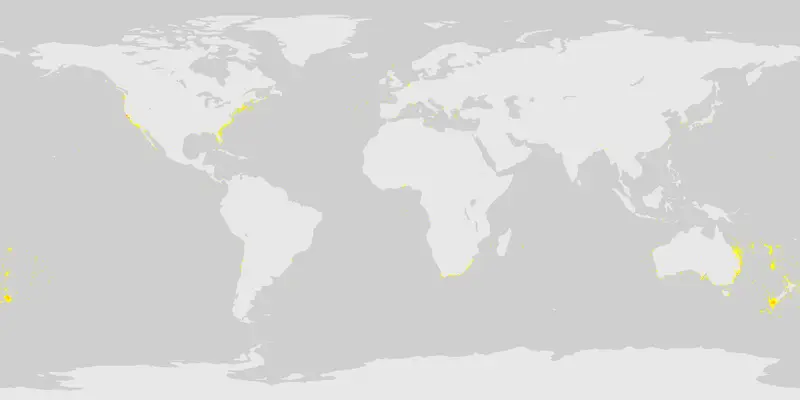
Great whites occur in temperate and subtropical seas around the world, with hot spots off California and Mexico's Guadalupe Island, the northeastern United States, South Africa, southern Australia and New Zealand. Satellite tags have shown that individuals make long migrations across ocean basins. Off Cape Cod, increasing numbers of great whites follow the recovering gray seal population, and off California young sharks use shallow nursery waters near beaches. Because they spend most of their time offshore, they are rarely seen, so GBIF occurrence records include many tagging and survey reports.
Where and when to look
White sharks live in cool and temperate coastal waters around the world, but they gather in a few places where seals and sea lions breed. Well-known hotspots include the Farallon Islands off San Francisco, Guadalupe Island off Baja California, the coast of Cape Cod in Massachusetts, the southern coast of South Africa and the waters off South Australia and New Zealand. Sightings in each area tend to peak during certain seasons. Off central California, sharks are most active in fall around seal colonies. Along Cape Cod, late summer and early fall are the busiest months, when gray seals crowd the beaches. The most common way to see them up close is from a cage-diving boat, where the sharks are drawn in with chum or bait and viewed from a submerged cage. This practice is debated, because baiting may change shark behavior, and some regions have restricted or banned it. A gentler option is to watch from shore or a boat during natural hunting events. At some sites, sharks hunt seals by charging up from below at high speed, sometimes launching clear out of the water in a breach, especially in the early morning low light. Mature females are generally larger than males, and in some populations the biggest animals are always females. Males can be identified by a pair of claspers, the reproductive organs on the underside near the pelvic fins. Young sharks often stay closer to shore in warmer nursery areas, where they feed on fish and rays before switching to seals as they grow. Researchers identify individuals by the jagged line where the gray back meets the white belly and by scars and notches on the dorsal fin. If you swim or surf in white shark country, follow local beach advisories and flag systems, avoid murky water and areas with lots of seals, and stay out of the water at dawn and dusk. Report sightings to lifeguards or local authorities. Choose dive and boat operators that follow regional rules, avoid harassing sharks, and support research and conservation of this misunderstood predator.
When & where in the US
GBIF holds 3,441 occurrence records of this species from the United States. States with the most records:
- California 581
- Florida 229
- North Carolina 140
- Georgia 49
- Massachusetts 34
Occurrence records reflect where and when people look and report (observer effort), not just where the animal is common. Busy birding states and summer months are over-represented; zoo and museum records can appear for non-native species.
Source: GBIF occurrence search for country US.[8]
What it eats
Young great whites eat mostly fish, rays and smaller sharks. As they grow they add seals, sea lions, dolphins and the carcasses of dead whales. They often attack from below with a sudden burst, then wait for prey to weaken. Sharks have keen senses, including the ability to detect weak electrical fields produced by animals. They can go long periods between big meals.
Reproduction and life cycle
Great white sharks mature slowly and reproduce slowly. Mating has rarely been observed. Females give birth to live pups after a long pregnancy, and the embryos feed on unfertilized eggs inside the mother. The pups are independent at birth. Because females take many years to mature and have few young, populations recover slowly after losses.
Threats and conservation
The great white shark is listed as vulnerable on the IUCN Red List, as checked through GBIF. Bycatch in fisheries, targeted killing, trade in jaws and fins, and beach protection nets in some regions have reduced numbers. Protections in the United States, South Africa and Australia have helped some populations. Shark bites on people are rare, and most involve mistaken identity.
How to tell it apart
- Orca: A mammal that breathes air through a blowhole and has a tall dorsal fin, black and white; orcas sometimes hunt great whites.
- Blue whale: A filter-feeding whale with a horizontal tail fluke; no teeth.
- American bullfrog: Not a look-alike; one of the few other animals here that will try to swallow nearly anything that fits.
Photo: (c) Michel Frisch, some rights reserved (CC BY) — CC BY 4.0, source[9]. See all image credits.
Sources
- GBIF Backbone Taxonomy — Carcharodon carcharias (species 2420694), via GBIF API — retrieved 2026-11-21
- GBIF — synonyms of Carcharodon carcharias — retrieved 2026-11-21
- GBIF — vernacular names of Carcharodon carcharias — retrieved 2026-11-21
- ITIS — full hierarchy for TSN 159903 — retrieved 2026-11-21
- IUCN Red List category via GBIF (Carcharodon carcharias) — retrieved 2026-11-21
- Animal Diversity Web (University of Michigan) — Carcharodon carcharias account — retrieved 2026-11-21
- GBIF occurrence density map tile for Carcharodon carcharias — retrieved 2026-11-21
- GBIF occurrence search — Carcharodon carcharias, country US, month and state facets — retrieved 2026-11-21
- iNaturalist taxon 50873 — Carcharodon carcharias (photo source) — retrieved 2026-11-21

Written under the pen name Maya Reynolds with AI-assisted drafting, then checked against the sources cited on each page. Last reviewed 2026-11-21. Numbers in the fact table come only from the linked sources; all prose is original. See our editorial policy.