American bullfrog
Lithobates catesbeianus (Shaw, 1802) · also called American Bull Frog, Bullfrog, North American Bullfrog, Bull Frog, Bullfrog, Common Bullfrog
The American bullfrog is the largest true frog in North America, a big green pond frog whose deep, cow-like call booms across summer nights.

Quick facts
| Kingdom | Animalia[4] |
|---|---|
| Phylum | Chordata[4] |
| Class | Amphibia[4] |
| Order | Anura[4] |
| Family | Ranidae[4] |
| Genus | Lithobates[4] (ITIS hierarchy: Aquarana[4]) |
| Species | Lithobates catesbeianus[1] |
| Authority | (Shaw, 1802)[1] |
| ITIS TSN | 1269861[4] |
| Synonyms | Lithobates catesbiana (Shaw, 1802); Rana catesbeiana Shaw, 1802; Rana mugiens Merrem, 1820; Rana scapularis Harlan, 1826; Rana catesbeiana; Rana mugiens; Rana scapularis; Rana conspersa[2] · Also treated as Aquarana catesbeiana (iNaturalist and some recent amphibian classifications) |
| Other common names | American Bull Frog, Bullfrog, North American Bullfrog, Bull Frog, Bullfrog, Common Bullfrog[3] |
| Length | 460 mm (18.1 in)[6] |
| Weight | 0.5 kg (1.1 lb)[6] |
| Lifespan (max. recorded / range) | 16 years[6] |
| Young per litter or brood | 20000[6] |
| Incubation (time to hatching) (average) | 4 days[6] |
| Diet type | carnivore[6] |
| Habitat | Permanent ponds, lakes, slow rivers, marshes and reservoirs |
| IUCN Red List | Least Concern (LC)[5] IUCN page Population trend: not available through GBIF; see the IUCN assessment. |
Where it lives
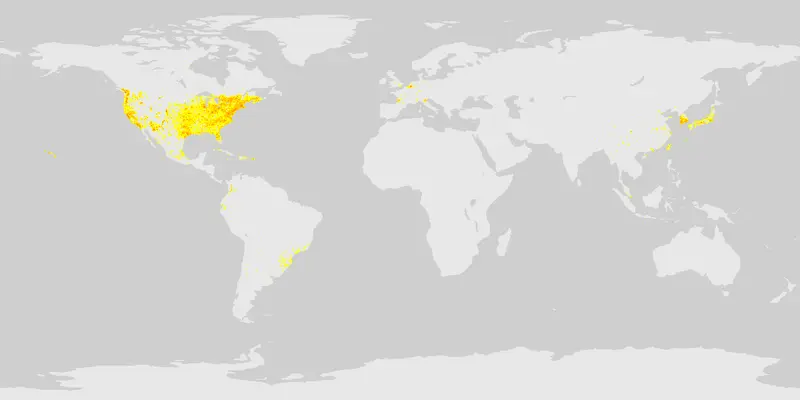
Bullfrogs are native to the eastern and central United States and southeastern Canada. People have introduced them across the West, to Hawaii and to many other countries, often for frog-leg farming or by moving fish stock. In many of those places they are a harmful invasive species that eats and outcompetes native frogs, turtles and snakes. Bullfrogs need permanent water because their tadpoles take a long time to develop, usually more than one season. Look for adults sitting at the waterline at night, eyes shining in a flashlight beam.
Where and when to look
The surest way to find a bullfrog is to wait for a warm, still evening in late spring or early summer and simply stand by a pond. As the light fades, males begin a deep, resonant call that carries across the water like someone blowing over the mouth of a big jug, often described as jug-o-rum or a low, droning rumm. On muggy nights the chorus can last until well after midnight, and a single loud male may answer a rival from across the cove. Daytime searching works too. Walk slowly along the bank and scan the waterline, especially sunny shallows with floating plants, lily pads or a fallen log; bullfrogs like to rest with just the eyes and the top of the head above the surface. Any careless footstep sends them leaping with a squeak and a splash, so approach from upwind with soft steps and pause often. Look closely at the round eardrum behind each eye to sort the sexes. In adult males it is noticeably larger than the eye, and during the breeding season their throats turn yellow. In females the eardrum is about the same size as the eye or a little smaller, and the throat stays pale. Young frogs look like smaller copies of the adults but are often greener and more spotted. Tadpoles are worth noticing too: they are big, olive and speckled, and in many northern ponds they spend more than one winter in the water before changing into frogs, so you can find them in almost any month the water is open. Signs that bullfrogs live nearby include rings spreading on calm water, the eyeshine of a frog caught in a flashlight beam at night, and large, floating mats of jelly-like eggs in early summer. Please watch rather than handle. Frog skin absorbs lotions, insect repellent and sunscreen, and moving frogs or tadpoles between ponds can spread disease. In regions where bullfrogs are not native, such as much of the West, ask local wildlife officials how they want sightings reported.
When & where in the US
GBIF holds 121,062 occurrence records of this species from the United States. States with the most records:
- California 12,205
- Texas 11,450
- Arizona 8,804
- New York 6,812
- Ohio 5,659
Occurrence records reflect where and when people look and report (observer effort), not just where the animal is common. Busy birding states and summer months are over-represented; zoo and museum records can appear for non-native species.
Source: GBIF occurrence search for country US.[7]
What it eats
A bullfrog will try to eat almost anything that moves and fits in its mouth. Insects, crayfish, snails, fish, other frogs including smaller bullfrogs, snakes, small turtles, young birds, bats and rodents have all been recorded. It is a sit-and-wait hunter, lunging with a big open mouth and using its front legs to stuff in large prey. Tadpoles eat algae, plant material and small invertebrates.
Reproduction and life cycle
Males defend calling territories along the shore and call in deep, resonant bursts. They also wrestle each other for prime spots. A female lays a huge floating sheet of eggs among water plants. The tadpoles grow large and often spend one or two winters in the pond before transforming into frogs. Large adult males have eardrums much larger than their eyes, a quick way to tell the sexes apart.
Threats and conservation
In its native range the American bullfrog is common and listed as least concern. Pollution, wetland loss and diseases such as chytrid fungus affect it, though it is more resistant than many frogs and may help spread these diseases where it is introduced. In the West, removing invasive bullfrogs is a common conservation action for native amphibians. Never move frogs or tadpoles between ponds.
How to tell it apart
- Common garter snake: A frequent pond-edge neighbor and predator of small frogs; limbless and striped.
- Eastern box turtle: A land turtle that may visit the edge of the same pond; armored and slow.
- Raccoon: A major predator of bullfrogs, often heard splashing along the shallows at night.
Photo: (c) Kelsey Low, some rights reserved (CC BY), uploaded by Kelsey Low — CC BY 4.0, source[8]. See all image credits.
Sources
- GBIF Backbone Taxonomy — Lithobates catesbeianus (species 2427091), via GBIF API — retrieved 2026-11-21
- GBIF — synonyms of Lithobates catesbeianus — retrieved 2026-11-21
- GBIF — vernacular names of Lithobates catesbeianus — retrieved 2026-11-21
- ITIS — full hierarchy for TSN 1269861 — retrieved 2026-11-21
- IUCN Red List category via GBIF (Lithobates catesbeianus) — retrieved 2026-11-21
- Animal Diversity Web (University of Michigan) — Lithobates catesbeianus account — retrieved 2026-11-21
- GBIF occurrence search — Lithobates catesbeianus, country US, month and state facets — retrieved 2026-11-21
- iNaturalist taxon 65979 — Lithobates catesbeianus (photo source) — retrieved 2026-11-21
Written under the pen name Maya Reynolds with AI-assisted drafting, then checked against the sources cited on each page. Last reviewed 2026-11-21. Numbers in the fact table come only from the linked sources; all prose is original. See our editorial policy.