Eastern box turtle
Terrapene carolina (Linnaeus, 1758) · also called American Box Turtle, Box Turtle, Common Box Turtle, Eastern Box Turtle [carolina], Florida Box Turtle, Florida Box Turtle [bauri]
The eastern box turtle is a small land turtle of the eastern United States with a high domed shell and a hinged lower shell that closes the animal inside like a box.

Quick facts
| Kingdom | Animalia[4] |
|---|---|
| Phylum | Chordata[4] |
| Class | Reptilia[4] (GBIF backbone ranks Testudines as a class; conventionally it is an order or subclass within Reptilia[1]) |
| Order | Testudines[4] |
| Family | Emydidae[4] |
| Genus | Terrapene[4] |
| Species | Terrapene carolina[1] |
| Authority | (Linnaeus, 1758)[1] |
| ITIS TSN | 173776[4] |
| Synonyms | Cistudo carolina (Linnaeus, 1758); Cistudo eurypygia Cope, 1870; Cistudo major Agassiz, 1857; Cistudo triunguis Agassiz, 1857; Cistudo virginea Agassiz, 1857; Emys kinosternoides Gray, 1831; Emys schneideri Schweigger, 1812; Emys tritentaculata St.Hilaire, 1829[2] |
| Other common names | American Box Turtle, Box Turtle, Common Box Turtle, Eastern Box Turtle [carolina], Florida Box Turtle, Florida Box Turtle [bauri][3] |
| Length | 11–18 cm (4.33–7.09 in)[6] |
| Lifespan (max. recorded / range) | 138 years[6] |
| Young per litter or brood | 3 to 8[6] |
| Weight | Not available from our sources |
| Diet type | omnivore[6] |
| Habitat | Moist deciduous woods, forest edges, meadows near woods and old fields · ADW biomes: savanna or grassland savanna or grassland forest forest[6] |
| IUCN Red List | Vulnerable (VU)[5] IUCN page Population trend: not available through GBIF; see the IUCN assessment. |
Where it lives
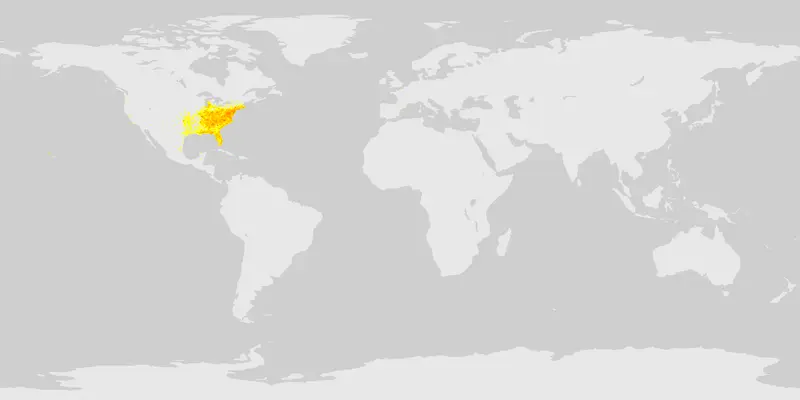
Eastern box turtles live from southern New England and the Great Lakes south to Florida and west to Texas and Kansas, with several regional subspecies, including the Florida, Gulf Coast and three-toed box turtles. They are woodland turtles that wander into adjacent fields and yards, especially after summer rains. Box turtles keep remarkably small home ranges and many spend their whole long lives within a modest patch of woods. A turtle moved even a short distance often tries to walk home and can die on roads in the attempt, so the best rule is to help it across a road in the direction it was heading and leave it there. In the cold months they burrow into soil and leaf litter and hibernate, which is why US sightings in the GBIF chart drop to almost nothing in winter.
Where and when to look
Box turtles are easiest to find on warm mornings after a summer rain, when they come out of leaf litter to hunt slugs, earthworms and mushrooms and to feast on fallen berries. Walk slowly along the edges of moist woods, old fields and stream banks, and keep your eyes on the ground, because the high, domed shell with yellow and orange blotches blends into dead leaves surprisingly well. In the heat of midsummer they often soak in shallow puddles or rest under logs, and in fall they burrow into soft soil or leaf piles to spend the winter. Adult males usually have red or orange eyes, a slightly concave lower shell and thicker tails, while females tend to have brown or yellowish brown eyes and a flat plastron. The hinge on the lower shell lets the turtle close up completely, a habit you will see if you get too close. Many box turtles are killed on roads in spring and early summer, when they move to nesting areas; if you help one cross, carry it in the direction it was heading. Never take a box turtle home or release it somewhere new, since these turtles live a very long time in a small home range and struggle when moved.
When & where in the US
GBIF holds 89,613 occurrence records of this species from the United States. States with the most records:
- Virginia 13,039
- North Carolina 12,684
- Florida 7,870
- Maryland 7,398
- Tennessee 5,419
Occurrence records reflect where and when people look and report (observer effort), not just where the animal is common. Busy birding states and summer months are over-represented; zoo and museum records can appear for non-native species.
Source: GBIF occurrence search for country US.[7]
What it eats
Box turtles are omnivores with eclectic tastes. They eat earthworms, slugs, snails, insects and grubs, plus mushrooms, berries, fallen fruit, flowers and leafy plants. Young turtles lean toward animal food, while older ones eat more plants. Box turtles are among the few animals that eat some mushrooms that are poisonous to people, and they disperse the seeds of the fruit they swallow. Their slow, wandering foraging is tied closely to moisture, and they are most active on humid mornings and after rain.
Reproduction and life cycle
Box turtles grow slowly and take years to reach breeding age. Mating takes place from spring into fall, and females can store sperm and lay fertile eggs for years afterward. In early summer a female digs a flask-shaped nest in loose, sunny soil, often in the evening, lays her eggs and covers them. The hatchlings emerge late in summer or fall, or overwinter in the nest. Nest predators such as raccoons, skunks and foxes destroy many clutches, so each adult that lives a long life is important to the population.
Threats and conservation
Box turtles are listed as vulnerable on the IUCN Red List, as checked here through GBIF. They are threatened by road deaths, habitat loss and fragmentation, mowing and land clearing, and collection for the pet trade, which is illegal or restricted in many states. Because adults live so long and reproduce so slowly, losing even a few adults each year can make a local population decline. Never take a wild box turtle home, slow down on wooded roads after rain, and keep lawn mowers high in fields where turtles roam.
How to tell it apart
- American bullfrog: Shares damp yards and woods, but it is a smooth-skinned green frog that leaps into water; it has no shell.
- Common garter snake: Another reptile of the garden, long and striped, moving quickly through grass.
- Eastern chipmunk: Kids sometimes spot the orange blotches first; a chipmunk is furry and fast, the turtle slow and armored.
Photo: (c) evangrimes, some rights reserved (CC BY) — CC BY 4.0, source[8]. See all image credits.
Sources
- GBIF Backbone Taxonomy — Terrapene carolina (species 2443173), via GBIF API — retrieved 2026-11-21
- GBIF — synonyms of Terrapene carolina — retrieved 2026-11-21
- GBIF — vernacular names of Terrapene carolina — retrieved 2026-11-21
- ITIS — full hierarchy for TSN 173776 — retrieved 2026-11-21
- IUCN Red List category via GBIF (Terrapene carolina) — retrieved 2026-11-21
- Animal Diversity Web (University of Michigan) — Terrapene carolina account — retrieved 2026-11-21
- GBIF occurrence search — Terrapene carolina, country US, month and state facets — retrieved 2026-11-21
- iNaturalist taxon 39814 — Terrapene carolina (photo source) — retrieved 2026-11-21
Written under the pen name Maya Reynolds with AI-assisted drafting, then checked against the sources cited on each page. Last reviewed 2026-11-21. Numbers in the fact table come only from the linked sources; all prose is original. See our editorial policy.