Common garter snake
Thamnophis sirtalis (Linnaeus, 1758) · also called Common Gartersnake, Garden Snake, Lowe's Garter Snake
The common garter snake is a slim, harmless, striped snake found across more of North America than any other reptile, often the first snake a child meets in a garden.

Quick facts
| Kingdom | Animalia[4] |
|---|---|
| Phylum | Chordata[4] |
| Class | Reptilia[4] (GBIF backbone ranks Squamata as a class; conventionally it is an order or subclass within Reptilia[1]) |
| Order | Squamata[4] |
| Family | Colubridae[4] |
| Genus | Thamnophis[4] |
| Species | Thamnophis sirtalis[1] |
| Authority | (Linnaeus, 1758)[1] |
| ITIS TSN | 174136[4] |
| Synonyms | Coluber ibibe Daudin, 1803; Coluber infemalis Blainville, 1835; Coluber ordinatus Linnaeus, 1766; Coluber parietalis Say, 1823; Coluber sirtalis Linnaeus, 1758; Coluber taenia Schoepf, 1788; Eutaenia dorsalis Baird & Girard, 1853; Eutaenia infernalis Girard[2] |
| Other common names | Common Gartersnake, Garden Snake, Lowe's Garter Snake[3] |
| Length | 46–137 cm (1.51–4.49 ft)[6] |
| Weight | 150 g (5.29 oz)[6] |
| Lifespan (max. recorded / range) | 20 years[6] |
| Young per litter or brood | 4 to 80[6] |
| Gestation | 2 to 3 months[6] |
| Diet type | carnivore[6] |
| Habitat | Meadows, marsh edges, streams, woodland clearings, parks and gardens · ADW biomes: savanna or grassland savanna or grassland forest forest[6] |
| IUCN Red List | Least Concern (LC)[5] IUCN page Population trend: not available through GBIF; see the IUCN assessment. |
Where it lives
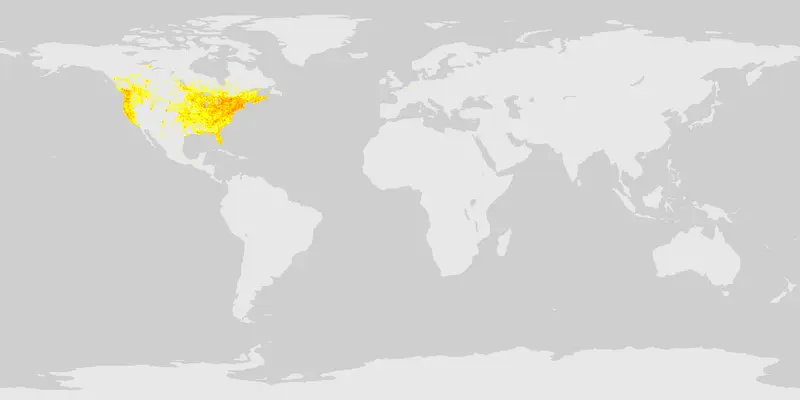
Common garter snakes live from the Atlantic to the Pacific and from central Canada south to Florida and the Gulf states, reaching farther north than any other snake in the Americas. They are missing from the driest deserts of the Southwest. The species has many color forms, from the yellow-striped eastern garter to the red-sided garter of the northern plains and the striking blue-tinged forms of Florida. Near water and in damp meadows they can be abundant. In the far north they gather by the thousands in communal winter dens, and their spring emergence in Manitoba is a famous wildlife spectacle.
Where and when to look
Garter snakes are among the first reptiles to appear each year, and a sunny afternoon in early spring, while patches of snow still linger in shady corners, can be the best time of all to find them. They spend the winter together in underground dens, often in rock crevices, old foundations or ant mounds, and when they emerge, dozens of snakes may bask near the entrance before scattering. In parts of Canada and the northern prairies, a few famous dens draw visitors every spring, when large numbers of males gather around each female in tangled mating balls. Through the summer, look along pond edges, stream banks, wet meadows, garden borders and the sunny side of stone walls, especially in the morning, when snakes stretch out to warm up before hunting frogs, toads, earthworms and small fish. Turning over a flat board or sheet of metal left in a field can reveal one hiding underneath, but always lift the cover toward you so anything under it can escape away from your hands, and put it back exactly as you found it. A garter snake usually announces itself with a quick rustle as it slides away through the grass; three pale stripes running down a dark body, one along the back and one low on each side, are the key field mark, although colors range from olive and brown to almost black, and some populations carry red spots between the stripes. Females are usually longer and heavier than males, while males have relatively longer, thicker tails. Unlike most snakes, garter snakes give birth to live young, usually in late summer, so August and September are good months to see tiny, fully striped babies in the garden. A garter snake that is picked up will often thrash, nip and release a strong-smelling musk, so it is kinder and cleaner simply to watch. These snakes are harmless to people and help control garden slugs, so leaving some long grass, a brush pile or a stone wall in your yard gives them a safe place to live.
When & where in the US
GBIF holds 141,262 occurrence records of this species from the United States. States with the most records:
- New York 13,114
- California 12,717
- Ohio 9,064
- Pennsylvania 8,977
- Oregon 8,787
Occurrence records reflect where and when people look and report (observer effort), not just where the animal is common. Busy birding states and summer months are over-represented; zoo and museum records can appear for non-native species.
Source: GBIF occurrence search for country US.[7]
What it eats
Garter snakes hunt actively, flicking their tongues to track scent. They eat earthworms, slugs, frogs, toads, salamanders, small fish, tadpoles and occasionally small rodents or nestling birds. Earthworms are a staple in gardens, making garter snakes harmless neighbors for gardeners. They swallow prey alive. Some populations in the Pacific Northwest can safely eat newts that carry a powerful toxin, an evolutionary arms race that biologists study closely.
Reproduction and life cycle
Mating happens in spring, often right outside the winter den, where many males may court a single female in a tangled mating ball. Garter snakes do not lay eggs; females give birth to live young in late summer. The newborn snakes are fully independent at once and disperse to find their own food. Litters can be large, which helps make up for heavy predation on the young.
Threats and conservation
The species overall is listed as least concern. The San Francisco garter snake, a vivid subspecies, is federally endangered because of habitat loss around wetlands. Garter snakes are killed by hawks, herons, raccoons, foxes and cats, and many people kill them out of fear or by lawn mowing. A garter snake may release a musky smell or nip if grabbed, but it is not dangerous. Leaving a brushy, unmowed corner and a log or flat stone gives them shelter.
How to tell it apart
- Eastern box turtle: The other common garden reptile, but a turtle has a domed shell and moves slowly.
- American bullfrog: Bullfrogs share pond edges and are on the garter snake menu as tadpoles; frogs have legs and smooth damp skin.
- Monarch butterfly: Not a look-alike; both are signs of a healthy, pesticide-light garden.
Photo: (c) Tom Kennedy, some rights reserved (CC BY), uploaded by Tom Kennedy — CC BY 4.0, source[8]. See all image credits.
Sources
- GBIF Backbone Taxonomy — Thamnophis sirtalis (species 2457522), via GBIF API — retrieved 2026-11-21
- GBIF — synonyms of Thamnophis sirtalis — retrieved 2026-11-21
- GBIF — vernacular names of Thamnophis sirtalis — retrieved 2026-11-21
- ITIS — full hierarchy for TSN 174136 — retrieved 2026-11-21
- IUCN Red List category via GBIF (Thamnophis sirtalis) — retrieved 2026-11-21
- Animal Diversity Web (University of Michigan) — Thamnophis sirtalis account — retrieved 2026-11-21
- GBIF occurrence search — Thamnophis sirtalis, country US, month and state facets — retrieved 2026-11-21
- iNaturalist taxon 28362 — Thamnophis sirtalis (photo source) — retrieved 2026-11-21
Written under the pen name Maya Reynolds with AI-assisted drafting, then checked against the sources cited on each page. Last reviewed 2026-11-21. Numbers in the fact table come only from the linked sources; all prose is original. See our editorial policy.