Raccoon
Procyon lotor (Linnaeus, 1758) · also called American Raccoon, Bandit-masked Raccoon, Common Raccoon, Coon, Mapache, North American Raccoon
The raccoon is a clever, adaptable North American mammal with a black eye mask, a ringed tail and nimble front paws, as at home in city alleys as in wooded swamps.

Quick facts
| Kingdom | Animalia[4] |
|---|---|
| Phylum | Chordata[4] |
| Class | Mammalia[4] |
| Order | Carnivora[4] |
| Family | Procyonidae[4] |
| Genus | Procyon[4] |
| Species | Procyon lotor[1] |
| Authority | (Linnaeus, 1758)[1] |
| ITIS TSN | 180575[4] |
| Synonyms | Procyon gloveralleni Nelson & Goldman, 1930; Procyon maynardi Bangs, 1898; Procyon minor Miller, 1911; Procyon nanus Simpson, 1929; Procyon gloveralleni; Procyon maynardi; Procyon minor[2] |
| Other common names | American Raccoon, Bandit-masked Raccoon, Common Raccoon, Coon, Mapache, North American Raccoon[3] |
| Length | 603–950 mm (1.98–3.12 ft)[6] |
| Weight | 1.8–10.4 kg (3.97–22.9 lb)[6] |
| Lifespan (max. recorded / range) | 16 years[6] |
| Young per litter or brood | 3.0 to 7.0[6] |
| Gestation | 63 to 65.0 days[6] |
| Diet type | omnivore[6] |
| Habitat | Wooded streams, marshes, farmland, suburbs and cities · ADW biomes: savanna or grassland savanna or grassland chaparral chaparral forest forest rainforest rainforest scrub forest scrub forest[6] |
| IUCN Red List | Least Concern (LC)[5] IUCN page Population trend: not available through GBIF; see the IUCN assessment. |
Where it lives
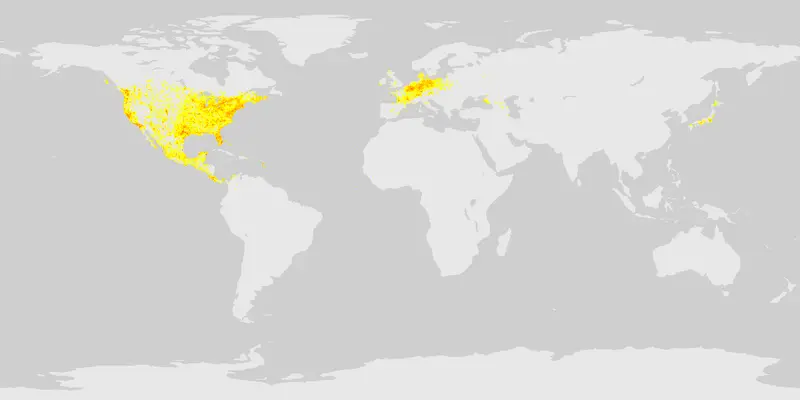
Raccoons range from southern Canada through most of the United States into Central America. They are absent only from parts of the high Rockies and the driest deserts. Their populations have grown and spread north over the past century, helped by farms and towns that offer food and shelter. Raccoons have also been introduced in Europe and Japan. The best wild habitat combines water and trees, since they forage along streams and den in hollow trees, but they readily use attics, chimneys, sheds and storm drains instead.
Where and when to look
Raccoons are easiest to observe at dusk near water, where they wade the shallows of creeks and ponds feeling for crayfish and frogs with their front paws, or along the edges of suburbs where woodland meets yards. Tracks are a great way to confirm a visitor: the front print looks like a tiny human hand with five long fingers, and the hind print resembles a small, flat foot, often placed side by side in mud. Trail cameras pointed at a creek crossing or the base of a large hollow tree usually record raccoons within a few nights. In late spring, mothers with kits sometimes forage in daylight, which is normal; a raccoon that stumbles, circles or seems disoriented may be sick and should be reported to local animal control rather than approached. Raccoons use shared latrine sites, often at the base of a tree or on a flat rooftop; avoid touching droppings. Wash your hands after yard work in places where raccoons are active, and keep children and dogs away from latrine spots.
When & where in the US
GBIF holds 123,598 occurrence records of this species from the United States. States with the most records:
- Texas 22,563
- California 15,565
- Florida 10,752
- New York 5,647
- Illinois 4,973
Occurrence records reflect where and when people look and report (observer effort), not just where the animal is common. Busy birding states and summer months are over-represented; zoo and museum records can appear for non-native species.
Source: GBIF occurrence search for country US.[7]
What it eats
Raccoons will eat almost anything. In natural settings they feel through shallow water for crayfish, frogs, fish and mussels, and take insects, worms, fruit, nuts, corn, bird eggs and small rodents. In towns they raid trash cans, pet food dishes, gardens and bird feeders. The famous "washing" of food is really a habit of handling food, often in water, which seems to make their very sensitive front paws work even better at feeling details. Securing garbage lids and feeding pets indoors are the most effective ways to avoid conflicts.
Reproduction and life cycle
Mating takes place in late winter. Females give birth in spring in a tree hollow, a rock crevice, a burrow or a building. The young, called kits, stay in the den for several weeks and then follow their mother on nightly foraging trips through the summer, learning what to eat and where. Families often stay together into fall or even winter. People who find a raccoon family in an attic should wait for the young to leave with their mother, then seal the opening.
Threats and conservation
Raccoons are common and listed as least concern. They are trapped for fur in many states, and vehicles are a major cause of death. The species is a carrier of rabies in the eastern United States, and of raccoon roundworm, a parasite whose eggs in droppings can be dangerous to people and pets, so latrines should be cleaned with care. Never feed raccoons; it leads to bold animals, disease spread and conflicts.
How to tell it apart
- Virginia opossum: Another gray nighttime visitor, but with a pointed white face, black ears and a long naked tail, and no mask.
- Striped skunk: Also forages at night in yards but is black with white stripes and a bushy plume of a tail; it waddles and rarely climbs.
- Eastern gray squirrel: Gray and fond of feeders, but squirrels are small, active by day and have plain bushy tails.
- Red fox: Similar size in the dark, but a fox has long legs, an orange coat, a white-tipped tail and moves like a dog.
Photo: no rights reserved — CC0 1.0, source[8]. See all image credits.
Sources
- GBIF Backbone Taxonomy — Procyon lotor (species 5218786), via GBIF API — retrieved 2026-11-21
- GBIF — synonyms of Procyon lotor — retrieved 2026-11-21
- GBIF — vernacular names of Procyon lotor — retrieved 2026-11-21
- ITIS — full hierarchy for TSN 180575 — retrieved 2026-11-21
- IUCN Red List category via GBIF (Procyon lotor) — retrieved 2026-11-21
- Animal Diversity Web (University of Michigan) — Procyon lotor account — retrieved 2026-11-21
- GBIF occurrence search — Procyon lotor, country US, month and state facets — retrieved 2026-11-21
- iNaturalist taxon 41663 — Procyon lotor (photo source) — retrieved 2026-11-21
Written under the pen name Maya Reynolds with AI-assisted drafting, then checked against the sources cited on each page. Last reviewed 2026-11-21. Numbers in the fact table come only from the linked sources; all prose is original. See our editorial policy.