Striped skunk
Mephitis mephitis (Schreber, 1776) · also called Alaska Sable, Common Skunk, Long-tailed Skunk, Northern Skunk, Prairie Polecat, Wood Pussie
The striped skunk is a cat-sized black-and-white mammal of North America that defends itself with a sulfurous spray and spends its nights digging for grubs.

Quick facts
| Kingdom | Animalia[4] |
|---|---|
| Phylum | Chordata[4] |
| Class | Mammalia[4] |
| Order | Carnivora[4] |
| Family | Mephitidae[4] |
| Genus | Mephitis[4] |
| Species | Mephitis mephitis[1] |
| Authority | (Schreber, 1776)[1] |
| ITIS TSN | 180562[4] |
| Synonyms | Mephitis mesomelas Lichtenstein, 1832; Viverra mephitis Schreber, 1776; Viverra mephitis[2] |
| Other common names | Alaska Sable, Common Skunk, Long-tailed Skunk, Northern Skunk, Prairie Polecat, Wood Pussie[3] |
| Length | 465–815 mm (18.3–32.1 in)[6] |
| Weight | 0.7–6.3 kg (1.54–13.9 lb)[6] |
| Lifespan (max. recorded / range) | 7 years[6] |
| Young per litter or brood | 2.0 to 10.0[6] |
| Gestation | 59 to 77 days[6] |
| Diet type | omnivore[6] |
| Habitat | Mixed woods, fields, farmland, brushy edges and suburbs · ADW biomes: savanna or grassland savanna or grassland chaparral chaparral forest forest scrub forest scrub forest[6] |
| IUCN Red List | Least Concern (LC)[5] IUCN page Population trend: not available through GBIF; see the IUCN assessment. |
Where it lives
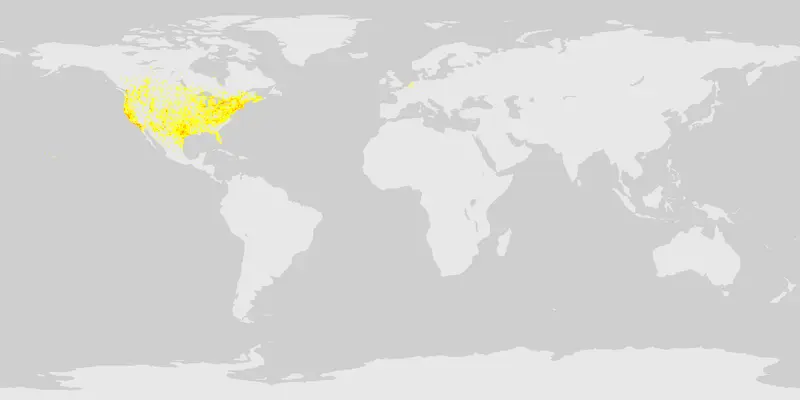
Striped skunks occur from southern Canada across nearly all of the United States into northern Mexico. They are missing mainly from the hottest deserts and the highest mountains. The species favors a patchwork of open land and cover, such as fields bordered by hedgerows or neighborhoods with decks, sheds and woodpiles to den under. In the coldest parts of the range skunks spend much of the winter in dens, sometimes several females together, coming out on milder nights. That winter lull, and a busy late summer when young disperse, show up in many regional sighting records.
Where and when to look
Skunks are mainly active at night, but you are most likely to catch a glimpse at dusk or in the hour before dawn, when one waddles across a lawn or along a wooded road edge with its bushy tail held low. Spring is a lively season, since males roam widely looking for mates in late winter and early spring, and that is when road sightings and the telltale smell spike. Look for shallow, cone-shaped holes scattered across a lawn, often appearing overnight; skunks dig them while hunting grubs, beetle larvae and earthworms, and the damage looks like someone poked the turf with a broom handle. Tracks show five toes on both the front and hind feet, with long claws on the front prints, and the animal walks with a short, shuffling gait. In summer, a mother may lead a single-file line of kits through the grass, one of the most charming sights a backyard can offer. Males are usually a little larger than females, but the two look alike, and the width of the white stripes varies a lot from animal to animal. Skunks give plenty of warning before they spray: they stamp the front feet, raise the tail, hiss and may turn in a U shape so both head and rear face you. If you see that, back away slowly and quietly. Keep dogs leashed at night, pick up fallen fruit and pet food, and cap window wells, where young skunks often get trapped. Never approach a skunk that seems unafraid, stumbles or is active and disoriented in the middle of the day, because skunks are one of the animals that can carry rabies; call your local animal control or a wildlife rehabilitator instead.
When & where in the US
GBIF holds 38,287 occurrence records of this species from the United States. States with the most records:
- California 9,257
- Texas 7,482
- New York 1,842
- Arkansas 1,140
- Oregon 1,096
Occurrence records reflect where and when people look and report (observer effort), not just where the animal is common. Busy birding states and summer months are over-represented; zoo and museum records can appear for non-native species.
Source: GBIF occurrence search for country US.[7]
What it eats
Skunks are omnivores with a strong taste for insects. They dig small cone-shaped holes in lawns to reach beetle grubs, and they also eat grasshoppers, crickets, bees and wasps, plus mice, voles, eggs, frogs, berries, corn and carrion. Gardeners often discover overnight pockmarks in turf; the culprit is usually a skunk on a grub hunt, which means it is also eating lawn pests. Skunks will come to spilled birdseed and pet food left outside.
Reproduction and life cycle
Mating happens in late winter, and males wander widely in search of females. Young are born in a den in spring, blind and with their stripe pattern already visible on the skin. After several weeks they follow their mother in a tidy single-file line on nightly foraging trips. By late summer they strike out on their own. Young skunks can spray within weeks of birth, though their aim improves with age.
Threats and conservation
Striped skunks are common and listed as least concern. Great horned owls, which have a poor sense of smell, are one of their few regular predators. Many skunks die on roads, and the species is a major carrier of rabies in parts of the Midwest and West. A skunk that sprays usually gives plenty of warning first, stamping its front feet, raising its tail and turning sideways. Back away slowly. Sealing gaps under porches and sheds in late summer, once young have left, prevents denning conflicts.
How to tell it apart
- Raccoon: Also a night forager in yards, but gray with a black mask and a ringed tail; raccoons climb readily and handle food with their front paws.
- Virginia opossum: Gray body, white face and naked tail; no stripes and no bushy plume.
- Eastern gray squirrel: Some city squirrels are black, but they are small, active by day and live in trees.
Photo: (c) Dan Dzurisin, some rights reserved (CC BY) — CC BY 4.0, source[8]. See all image credits.
Sources
- GBIF Backbone Taxonomy — Mephitis mephitis (species 5219380), via GBIF API — retrieved 2026-11-21
- GBIF — synonyms of Mephitis mephitis — retrieved 2026-11-21
- GBIF — vernacular names of Mephitis mephitis — retrieved 2026-11-21
- ITIS — full hierarchy for TSN 180562 — retrieved 2026-11-21
- IUCN Red List category via GBIF (Mephitis mephitis) — retrieved 2026-11-21
- Animal Diversity Web (University of Michigan) — Mephitis mephitis account — retrieved 2026-11-21
- GBIF occurrence search — Mephitis mephitis, country US, month and state facets — retrieved 2026-11-21
- iNaturalist taxon 41880 — Mephitis mephitis (photo source) — retrieved 2026-11-21
Written under the pen name Maya Reynolds with AI-assisted drafting, then checked against the sources cited on each page. Last reviewed 2026-11-21. Numbers in the fact table come only from the linked sources; all prose is original. See our editorial policy.