Virginia opossum
Didelphis virginiana Kerr, 1792 · also called North American Opossum, Opossum, Possum, Opossum De Virginie, Zarigieya De Virginia
The Virginia opossum is the only marsupial north of Mexico, a gray, white-faced animal with a bare prehensile tail that raises its young in a pouch.

Quick facts
| Kingdom | Animalia[4] |
|---|---|
| Phylum | Chordata[4] |
| Class | Mammalia[4] |
| Order | Didelphimorphia[4] |
| Family | Didelphidae[4] |
| Genus | Didelphis[4] |
| Species | Didelphis virginiana[1] |
| Authority | Kerr, 1792[1] |
| ITIS TSN | 179921[4] |
| Synonyms | Didelphis marsupialis virginiana (Kerr, 1792)[2] |
| Other common names | North American Opossum, Opossum, Possum, Opossum De Virginie, Zarigieya De Virginia[3] |
| Length | 33–55 cm (13–21.7 in)[6] |
| Weight | 1.9–6 kg (4.19–13.2 lb)[6] |
| Lifespan (max. recorded / range) | 10 years[6] |
| Young per litter or brood | 4 to 25[6] |
| Gestation | 12 to 13 days[6] |
| Diet type | omnivore[6] |
| Habitat | Woodlands, farmland, streamsides and suburban neighborhoods · ADW biomes: forest forest scrub forest scrub forest[6] |
| IUCN Red List | Least Concern (LC)[5] IUCN page Population trend: not available through GBIF; see the IUCN assessment. |
Where it lives
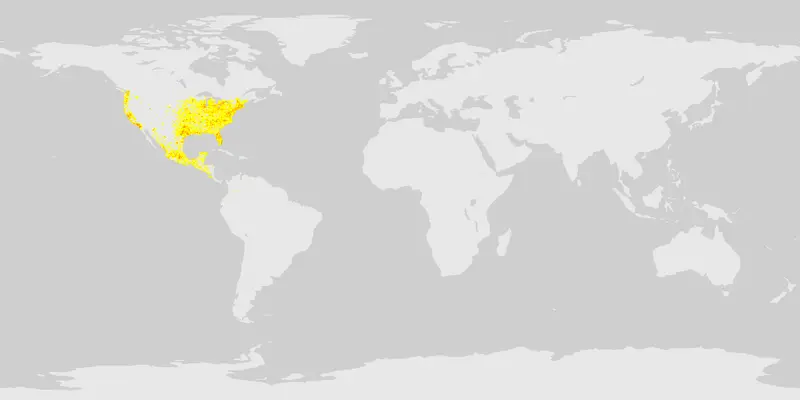
Opossums are native to Central America and the eastern and central United States, and over the past century they have spread north into New England, the Great Lakes region and southern Canada. They were also introduced to California in the early twentieth century and now live along much of the Pacific Coast. Cold winters limit them, and northern opossums frequently lose the tips of their ears and tails to frostbite. They do not hibernate, but they stay in dens during bad weather. Their spread follows towns closely, because buildings and gardens offer shelter and food.
Where and when to look
Opossums keep night hours, so the best time to see one is after dark, especially in the hour or two after sunset, when they leave daytime dens in brush piles, hollow logs, crawl spaces and old burrows to wander in search of food. A flashlight swept slowly across a yard or the edge of a wooded path will often catch a pale face and glowing eyes moving at a steady, unhurried walk. Opossums are frequent visitors to compost piles, fallen fruit under trees and pet food left outdoors, and a trail camera aimed at those spots will show how often they pass through. In snow or soft mud, look for the unmistakable tracks: the hind foot has a thumb-like toe set out at an angle, so the print looks a bit like a small human hand. Opossums are usually quiet, but a cornered animal may hiss, growl, drool and show a mouth full of teeth, and only rarely does one play dead, falling over with its mouth open and sometimes releasing a foul smell. Give that animal room and it will usually get up and leave on its own. Spring and summer are the best seasons to see mothers carrying several young on their backs after the babies leave the pouch, a sight children never forget. Males tend to be larger than females, though the two are hard to tell apart at a distance. Cold winters are hard on opossums because their ears and tails are nearly bare and can be damaged by frostbite, so many northern animals have ragged ear tips. If you find a young opossum alone, do not take it home; contact a licensed wildlife rehabilitator, who can judge whether it needs help. Slowing down on rural roads at night saves many of them each year.
When & where in the US
GBIF holds 58,074 occurrence records of this species from the United States. States with the most records:
- Texas 12,449
- California 8,847
- Florida 4,833
- North Carolina 2,520
- Illinois 2,473
Occurrence records reflect where and when people look and report (observer effort), not just where the animal is common. Busy birding states and summer months are over-represented; zoo and museum records can appear for non-native species.
Source: GBIF occurrence search for country US.[7]
What it eats
The opossum is a generalist scavenger and forager. It eats insects, snails, slugs, worms, fruit, grains, eggs, small rodents, carrion and garbage, and it readily cleans up fallen fruit in yards. Opossums also eat many ticks while grooming, though the exact number is debated by researchers. Their resistance to many snake venoms lets them eat venomous snakes on occasion. Their long snout and many sharp teeth, more than any other North American land mammal, help them handle such a varied menu.
Reproduction and life cycle
Young opossums are born after a very short pregnancy, so tiny and underdeveloped that they look like pink beans. They crawl into the mother's pouch and attach to a teat, where they keep developing for weeks. Later they ride on her back as she forages. Litters can be large, but many young do not survive. Opossums live short lives in the wild compared with mammals of similar size, which is part of why they breed so quickly.
Threats and conservation
Opossums are listed as least concern and are common. They are often killed on roads because they move slowly and freeze when frightened. When seriously threatened an opossum may play dead, going limp, drooling and releasing a foul smell, which deters many predators. Despite their reputation, they rarely carry rabies. Brush piles and low decks give them shelter; securing trash prevents conflicts.
How to tell it apart
- Raccoon: Larger and stockier, with a black mask across a gray face and a furry tail ringed in black.
- Eastern gray squirrel: Gray but much smaller, busy by day, with a fluffy tail held over its back.
- Striped skunk: Black and white like the opossum's face, but a skunk has broad white stripes on a black body and a big bushy tail.
Photo: (c) Shirley Zundell, some rights reserved (CC BY), uploaded by Shirley Zundell — CC BY 4.0, source[8]. See all image credits.
Sources
- GBIF Backbone Taxonomy — Didelphis virginiana (species 2439923), via GBIF API — retrieved 2026-11-21
- GBIF — synonyms of Didelphis virginiana — retrieved 2026-11-21
- GBIF — vernacular names of Didelphis virginiana — retrieved 2026-11-21
- ITIS — full hierarchy for TSN 179921 — retrieved 2026-11-21
- IUCN Red List category via GBIF (Didelphis virginiana) — retrieved 2026-11-21
- Animal Diversity Web (University of Michigan) — Didelphis virginiana account — retrieved 2026-11-21
- GBIF occurrence search — Didelphis virginiana, country US, month and state facets — retrieved 2026-11-21
- iNaturalist taxon 42652 — Didelphis virginiana (photo source) — retrieved 2026-11-21
Written under the pen name Maya Reynolds with AI-assisted drafting, then checked against the sources cited on each page. Last reviewed 2026-11-21. Numbers in the fact table come only from the linked sources; all prose is original. See our editorial policy.