Eastern gray squirrel
Sciurus carolinensis Gmelin, 1788 · also called American Squirrel, Ardilla Gris Oriental, Black Squirrel, Carolina Gray Squirrel, Carolina Grey Squirrel, Eastern Grey Squirrel
The eastern gray squirrel is a bushy-tailed tree squirrel of eastern North America, a nut-burying acrobat that has become the most familiar wild mammal in many American towns.

Quick facts
| Kingdom | Animalia[4] |
|---|---|
| Phylum | Chordata[4] |
| Class | Mammalia[4] |
| Order | Rodentia[4] |
| Family | Sciuridae[4] |
| Genus | Sciurus[4] |
| Species | Sciurus carolinensis[1] |
| Authority | Gmelin, 1788[1] |
| ITIS TSN | 180175[4] |
| Synonyms | None listed[2] |
| Other common names | American Squirrel, Ardilla Gris Oriental, Black Squirrel, Carolina Gray Squirrel, Carolina Grey Squirrel, Eastern Grey Squirrel[3] |
| Length | 380–525 mm (15–20.7 in)[6] |
| Weight | 338–750 g (11.9–26.5 oz)[6] |
| Lifespan (max. recorded / range) | 12.5 years[6] |
| Young per litter or brood | 2.0 to 8.0[6] |
| Gestation (average) | 44.0 days[6] |
| Diet type | omnivore[6] |
| Habitat | Hardwood and mixed forests, parks, campuses and leafy suburbs · ADW biomes: forest[6] |
| IUCN Red List | Least Concern (LC)[5] IUCN page Population trend: not available through GBIF; see the IUCN assessment. |
Where it lives
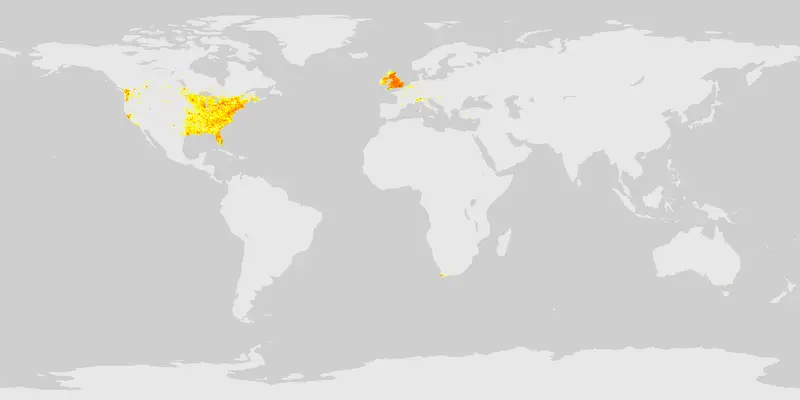
Gray squirrels are native from the Atlantic coast west to the Great Plains and from southern Canada to the Gulf Coast. They have also been introduced far outside that range, including to parts of the western United States, Britain, Ireland and Italy, where they compete with native red squirrels. Their ideal habitat is mature forest with plenty of nut trees such as oaks, hickories and walnuts, and city parks with big old trees copy that habitat closely. Black and nearly white color forms occur in some towns and make for local celebrities. Because squirrels do not migrate or hibernate, the GBIF US chart for this species mostly reflects when people are outdoors to notice them.
Where and when to look
Gray squirrels are active by day and busiest in the first few hours after sunrise and again in late afternoon, so an early walk through any park with big oaks, hickories or walnuts is almost guaranteed to turn up several. Autumn is the best season for behavior: squirrels bury nuts one at a time in scattered spots, pat the soil down and sometimes pretend to bury a nut when another squirrel is watching. In winter, look up for leafy nests called dreys, rounded balls of twigs and leaves wedged high in tree forks, and in snow, follow their bounding tracks, with the larger hind feet landing ahead of the front ones. Listen for a raspy, scolding chatter and a sharp quaa call, often paired with a flicking tail, which signals that a hawk, cat or person has been noticed. Late winter brings noisy mating chases through the treetops, when several males follow one female. Males and females look alike, and some populations include black or reddish individuals of the same species. Avoid hand-feeding, which can lead to bites and to squirrels raiding attics and bird feeders.
When & where in the US
GBIF holds 253,668 occurrence records of this species from the United States. States with the most records:
- Florida 30,539
- New York 22,556
- North Carolina 17,962
- Massachusetts 17,247
- Virginia 15,003
Occurrence records reflect where and when people look and report (observer effort), not just where the animal is common. Busy birding states and summer months are over-represented; zoo and museum records can appear for non-native species.
Source: GBIF occurrence search for country US.[7]
What it eats
Nuts and seeds are the foundation: acorns, hickory nuts, walnuts, beechnuts and maple seeds, plus buds, flowers, fungi, fruit and the occasional insect or bird egg. In fall a gray squirrel buries nuts one at a time in many scattered spots, a strategy called scatter hoarding. It finds many of them again using memory and smell, but forgets plenty, and those nuts sprout. That makes squirrels important planters of oak and hickory forests. They are also notorious at bird feeders, where their problem-solving skills defeat many so-called squirrel-proof designs.
Reproduction and life cycle
Gray squirrels usually have two breeding seasons, one in late winter and another in summer. Several males chase a receptive female through the treetops in noisy mating chases. Young are born in a tree cavity or a leaf nest called a drey, a ball of leaves and twigs built high in a fork. The babies are born hairless and helpless and stay in the nest for weeks before venturing out. Females raise the young alone. Young squirrels that appear on the ground in spring are often old enough to be on their own even if they look small.
Threats and conservation
The species is abundant and listed as least concern. Natural predators include hawks, owls, foxes, coyotes, snakes and bobcats, and in towns cars and cats take many. Squirrels sometimes chew wiring in attics and can cause house fires, so sealing entry points is the humane long-term fix rather than trapping. Where introduced outside its range, the gray squirrel is treated as an invasive species because it damages trees and displaces native squirrels.
How to tell it apart
- Eastern chipmunk: Smaller and ground-dwelling, with bold stripes on the face and back and a thin tail held upright; it stuffs food into cheek pouches.
- Eastern cottontail: Shares the lawn, but a cottontail has long ears, a short white powder-puff tail and hops; it never climbs trees.
- Virginia opossum: Also gray, but the opossum is larger, has a white face and a naked, rat-like tail, and moves slowly at night.
- Raccoon: A gray night visitor with a black mask and ringed tail, much heavier, and rarely seen leaping branch to branch.
Photo: (c) Diliff, some rights reserved (CC BY-SA) — CC BY-SA 4.0, source[8]. See all image credits.
Sources
- GBIF Backbone Taxonomy — Sciurus carolinensis (species 5219681), via GBIF API — retrieved 2026-11-21
- GBIF — synonyms of Sciurus carolinensis — retrieved 2026-11-21
- GBIF — vernacular names of Sciurus carolinensis — retrieved 2026-11-21
- ITIS — full hierarchy for TSN 180175 — retrieved 2026-11-21
- IUCN Red List category via GBIF (Sciurus carolinensis) — retrieved 2026-11-21
- Animal Diversity Web (University of Michigan) — Sciurus carolinensis account — retrieved 2026-11-21
- GBIF occurrence search — Sciurus carolinensis, country US, month and state facets — retrieved 2026-11-21
- iNaturalist taxon 46017 — Sciurus carolinensis (photo source) — retrieved 2026-11-21
Written under the pen name Maya Reynolds with AI-assisted drafting, then checked against the sources cited on each page. Last reviewed 2026-11-21. Numbers in the fact table come only from the linked sources; all prose is original. See our editorial policy.