Blue whale
Balaenoptera musculus (Linnaeus, 1758) · also called Blue Rorqual, Northern Indian Ocean Blue Whale, Northern Indian Ocean population, Ostende whale, Pygmy Blue Whale, Pygmy Blue Whale (brevicauda); Antarctic Blue Whale
The blue whale is the largest animal known to have ever lived, a slender blue-gray baleen whale that feeds on tiny shrimp-like krill in all of the world's oceans.

Quick facts
| Kingdom | Animalia[4] |
|---|---|
| Phylum | Chordata[4] |
| Class | Mammalia[4] |
| Order | Cetacea[4] |
| Family | Balaenopteridae[4] |
| Genus | Balaenoptera[4] |
| Species | Balaenoptera musculus[1] |
| Authority | (Linnaeus, 1758)[1] |
| ITIS TSN | 180528[4] |
| Synonyms | Balaena borealis Fischer, 1829; Balaena maximus; Balaena musculus Linnaeus, 1758; Balaenoptera brevicauda Ichihara, 1966; Balaenoptera carolinae Malm, 1866; Balaenoptera gigas Reinhardt, 1857; Balaenoptera indica Blyth, 1859; Balaenoptera jubartes Lacépède, 1804[2] |
| Other common names | Blue Rorqual, Northern Indian Ocean Blue Whale, Northern Indian Ocean population, Ostende whale, Pygmy Blue Whale, Pygmy Blue Whale (brevicauda); Antarctic Blue Whale[3] |
| Length | 33.5 m (110 ft)[6] |
| Weight | 190000 kg (209 tons)[6] |
| Lifespan (max. recorded / range) | 80–90 years[6] |
| Young per litter or brood (average) | 1[6] |
| Gestation | 11 to 12 months[6] |
| Diet type | carnivore[6] |
| Habitat | Open ocean and continental shelf edges with rich krill swarms |
| IUCN Red List | Endangered (EN)[5] IUCN page Population trend: not available through GBIF; see the IUCN assessment. |
Where it lives
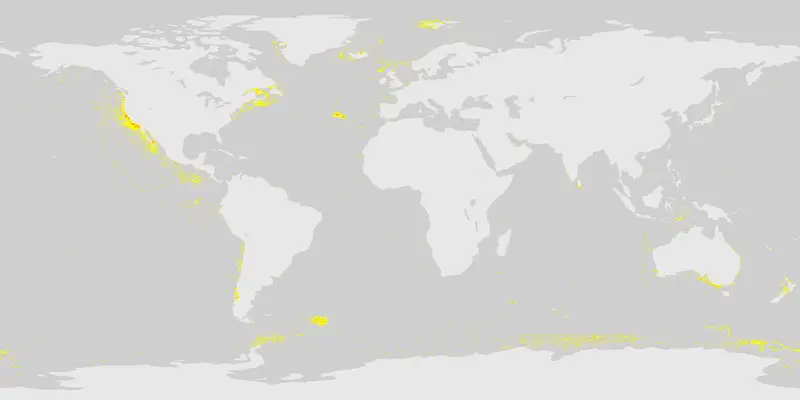
Blue whales occur in every ocean, usually far offshore, though they feed close to land where cold, upwelling water brings krill near the surface. Several populations are recognized, including the huge Antarctic blue whale, the North Atlantic and North Pacific populations and the smaller pygmy blue whale of the southern Indian Ocean and the waters around Australia. Off the US West Coast, the eastern North Pacific population feeds in summer and fall from California to Oregon and migrates south to Mexico and Central America in winter. Whale-watching boats from Monterey Bay and the Channel Islands have some of the most reliable chances to see one, which helps explain the California-heavy state list in our GBIF chart.
Where and when to look
Blue whales roam all the world's oceans, but a few coastlines give watchers a real chance. Off California, especially near Monterey Bay and the Santa Barbara Channel, they arrive in summer and early fall to feed on dense swarms of krill. Sri Lanka's southern coast, the Gulf of California, the Azores and parts of Chile are other reliable spots in their seasons. Look first for the blow, a tall, slender column of spray that can rise higher than a house and hang in the air on calm days. Then watch for a long, mottled blue-gray back that seems to roll forever before a tiny dorsal fin appears. Before a deep dive, the whale may lift its broad tail flukes. Seabirds wheeling over one patch of sea, or reddish krill clouds near the surface, hint that feeding whales are close. Telling males from females is not possible from a boat; females actually grow a little longer than males, and researchers sort individuals by the unique pale mottling on each flank, photographed on every trip. A calm, overcast morning with little wind is ideal, and seasick-prone watchers should pick larger, steadier vessels. Choose operators that follow local approach rules, keep engines slow, and give whales space to feed. Ship strikes are a serious threat, so many areas ask vessels to slow down where whales gather.
When & where in the US
GBIF holds 12,478 occurrence records of this species from the United States. States with the most records:
- California 390
- Alaska 11
- Massachusetts 5
- Oregon 5
- New Jersey 3
Occurrence records reflect where and when people look and report (observer effort), not just where the animal is common. Busy birding states and summer months are over-represented; zoo and museum records can appear for non-native species.
Source: GBIF occurrence search for country US.[8]
What it eats
Blue whales eat krill almost exclusively. They feed by lunging into a dense swarm with the mouth wide open, the pleated throat expanding like a balloon to take in a vast gulp of water. The whale then closes its mouth and pushes the water out through the baleen plates that hang from the upper jaw, trapping the krill. Feeding dives follow the krill as they move up and down through the day. A single blue whale needs enormous amounts of krill in the feeding season to build reserves for migration and breeding, so their movements track the most productive parts of the ocean.
Reproduction and life cycle
Much about blue whale breeding remains unknown because it happens in remote warm waters. Calves are born after a pregnancy of around a year and grow at astonishing speed on the mother's fat-rich milk. Mothers and calves travel together until the calf is weaned. Blue whales produce some of the loudest and lowest-pitched calls of any animal, below the range of human hearing, and those calls can travel across ocean basins. Scientists have noted that the pitch of blue whale songs has been slowly dropping over decades, a puzzle still being studied.
Threats and conservation
Commercial whaling in the twentieth century killed the vast majority of blue whales, especially in the Antarctic, before the species was protected by international agreement. It is listed as endangered on the IUCN Red List, as checked through GBIF. Recovery has been slow. Today the main risks are collisions with large ships in busy shipping lanes, entanglement in fishing gear, ocean noise that masks their calls, and climate-driven changes to krill. Slow-speed zones for ships off California have been introduced to reduce strikes.
How to tell it apart
- Orca: Much smaller and boldly black and white, with a tall dorsal fin and teeth; orcas hunt in pods.
- Great white shark: A fish with gills and a vertical tail, gray above and white below.
- African bush elephant: Holds the land record for size, but a blue whale outweighs it many times over.
Photo: (c) David Slater, some rights reserved (CC BY) — CC BY 4.0, source[9]. See all image credits.
Sources
- GBIF Backbone Taxonomy — Balaenoptera musculus (species 2440735), via GBIF API — retrieved 2026-11-21
- GBIF — synonyms of Balaenoptera musculus — retrieved 2026-11-21
- GBIF — vernacular names of Balaenoptera musculus — retrieved 2026-11-21
- ITIS — full hierarchy for TSN 180528 — retrieved 2026-11-21
- IUCN Red List category via GBIF (Balaenoptera musculus) — retrieved 2026-11-21
- Animal Diversity Web (University of Michigan) — Balaenoptera musculus account — retrieved 2026-11-21
- GBIF occurrence density map tile for Balaenoptera musculus — retrieved 2026-11-21
- GBIF occurrence search — Balaenoptera musculus, country US, month and state facets — retrieved 2026-11-21
- iNaturalist taxon 41553 — Balaenoptera musculus (photo source) — retrieved 2026-11-21

Written under the pen name Maya Reynolds with AI-assisted drafting, then checked against the sources cited on each page. Last reviewed 2026-11-21. Numbers in the fact table come only from the linked sources; all prose is original. See our editorial policy.