African bush elephant
Loxodonta africana (Blumenbach, 1797) · also called African Savanna Elephant, African elephant, African savannah elephant, Atlas Elephant, Bush Elephant, Carthaginian Elephant
The African bush elephant is the largest living land animal, a gray, wrinkled giant of African savannas with huge fan-shaped ears and tusks in both sexes.

Quick facts
| Kingdom | Animalia[4] |
|---|---|
| Phylum | Chordata[4] |
| Class | Mammalia[4] |
| Order | Proboscidea[4] |
| Family | Elephantidae[4] |
| Genus | Loxodonta[4] |
| Species | Loxodonta africana[1] |
| Authority | (Blumenbach, 1797)[1] |
| ITIS TSN | 584939[4] |
| Synonyms | Elephas africana Blumenbach, 1797; Elephas capensis Cuvier, 1798; Elephas africanus[2] |
| Other common names | African Savanna Elephant, African elephant, African savannah elephant, Atlas Elephant, Bush Elephant, Carthaginian Elephant[3] |
| Length | 2.2–4 m (7.22–13.1 ft)[6] |
| Weight | 2000–6100 kg (2.2–6.72 tons)[6] |
| Lifespan (max. recorded / range) | 65 years[6] |
| Young per litter or brood | 1 to 2[6] |
| Gestation (average) | 22 months[6] |
| Diet type | herbivore[6] |
| Habitat | Savanna, grassland, woodland, swamps and semi-desert · ADW biomes: desert or dune desert or dune savanna or grassland savanna or grassland rainforest rainforest scrub forest scrub forest[6] |
| IUCN Red List | Endangered (EN)[5] IUCN page Population trend: not available through GBIF; see the IUCN assessment. |
Where it lives
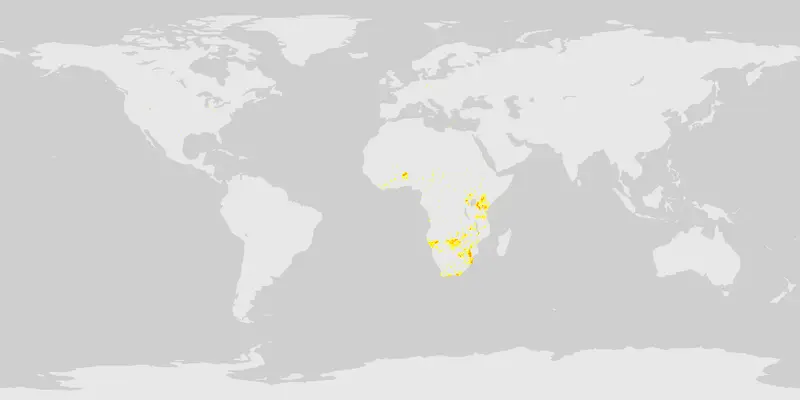
Bush elephants live in much of eastern and southern Africa and patches of West and Central Africa. The biggest populations are in Botswana, Zimbabwe, Tanzania, Zambia and Kenya. They once ranged across almost all of Africa south of the Sahara. Elephants move seasonally between water and food, sometimes along routes passed down by older matriarchs. Forest elephants, once considered the same species, are now treated as a separate, smaller species living in the rainforests of Central and West Africa.
Where and when to look
African bush elephants are found across much of sub-Saharan Africa, from open savanna and grasslands to woodlands and semi-desert. Famous places to see them include the parks and reserves of Kenya, Tanzania, Botswana, Zambia, Zimbabwe, Namibia and South Africa. The dry season is usually the best time for a safari, as elephants gather in large numbers near rivers, swamps and waterholes. In some parks, herds of hundreds can be seen crossing rivers or bathing together, an unforgettable sight. Elephants are active day and night, but midday often brings them to water to drink, bathe and throw mud or dust over their backs to cool off and protect their skin. Early morning and late afternoon are good times to see them feeding on grass, leaves, bark and fruit. Signs include broken branches, trees with stripped bark, piles of fibrous dung, and wide paths worn through the bush. You may hear deep rumbles, many too low for people to hear, along with trumpeting when they are excited or alarmed. Herds are led by an older female, the matriarch, and made up of related females and their young. Adult males usually live alone or in loose bachelor groups. Bulls are larger, with a more rounded forehead, thicker tusks and a heavier build. Females have a more angular forehead and thinner tusks. Young elephants stay close to their mothers, and calves are often surrounded by protective aunts and sisters. Watching elephants responsibly means giving them plenty of space, especially herds with calves and bulls in musth, a period when males have high hormone levels, swollen temporal glands and can be unpredictable. Warning signs include head shaking, ears spread wide, mock charges and trumpeting. Remain seated in the vehicle, trust a good driver to read the herd's mood, and never block an elephant's route to water. Skip elephant rides and circus-style shows, and look for sanctuaries and lodges with a clear record of caring for wild herds and the people who live alongside them.
When & where in the US
GBIF holds 10 occurrence records of this species from the United States. States with the most records:
- Washington 2
- Illinois 1
- Nebraska 1
- North Carolina 1
- Ohio 1
Occurrence records reflect where and when people look and report (observer effort), not just where the animal is common. Busy birding states and summer months are over-represented; zoo and museum records can appear for non-native species.
Source: GBIF occurrence search for country US.[7]
What it eats
Elephants are herbivores that spend most of the day feeding. They eat grasses, leaves, bark, roots, fruit and branches, pulling food down with the trunk and stripping bark with tusks. Because their digestion is not very efficient, they need enormous amounts of food and water. They also dig for water in dry riverbeds and seek mineral-rich soil. By knocking down trees and spreading seeds in their dung, elephants shape savanna ecosystems.
Reproduction and life cycle
Elephant society centers on family herds led by an older female, the matriarch, with her daughters and their calves. Adult males live alone or in bachelor groups and join herds to breed. Males enter musth, a period of high hormones and aggressiveness. Pregnancy lasts longer than in any other mammal, and the calf relies on its mother and the herd for years. Long gaps between births mean populations grow slowly.
Threats and conservation
The African bush elephant is listed as endangered on the IUCN Red List, as checked through GBIF. Poaching for ivory caused major declines, and habitat loss and conflict with farmers over crop raiding are growing threats as human populations expand. Anti-poaching patrols, protected corridors and community-led conservation have helped some populations recover, while others continue to fall.
How to tell it apart
- Giraffe: Also a towering savanna herbivore, but tall and spotted with a long neck and small horn-like ossicones.
- American bison: The heaviest land animal in North America, but far smaller than an elephant and covered in shaggy brown fur.
- Blue whale: The blue whale is far heavier; the elephant holds the record only on land.
Photo: (c) dhfischer, some rights reserved (CC BY), uploaded by dhfischer — CC BY 4.0, source[8]. See all image credits.
Sources
- GBIF Backbone Taxonomy — Loxodonta africana (species 2435350), via GBIF API — retrieved 2026-11-21
- GBIF — synonyms of Loxodonta africana — retrieved 2026-11-21
- GBIF — vernacular names of Loxodonta africana — retrieved 2026-11-21
- ITIS — full hierarchy for TSN 584939 — retrieved 2026-11-21
- IUCN Red List category via GBIF (Loxodonta africana) — retrieved 2026-11-21
- Animal Diversity Web (University of Michigan) — Loxodonta africana account — retrieved 2026-11-21
- GBIF occurrence search — Loxodonta africana, country US, month and state facets — retrieved 2026-11-21
- iNaturalist taxon 43694 — Loxodonta africana (photo source) — retrieved 2026-11-21
Written under the pen name Maya Reynolds with AI-assisted drafting, then checked against the sources cited on each page. Last reviewed 2026-11-21. Numbers in the fact table come only from the linked sources; all prose is original. See our editorial policy.