Giraffe
Giraffa camelopardalis (Linnaeus, 1758) · also called Giraffa, Girafte, Kordofan Giraffe (antiquorum), Masai Giraffe (tippelskirchi), Nigerian Giraffe, Northern Giraffe
The giraffe is the tallest living animal, an African browser with a very long neck, long legs, a patchwork coat and short horn-like ossicones.

Quick facts
| Kingdom | Animalia[4] |
|---|---|
| Phylum | Chordata[4] |
| Class | Mammalia[4] |
| Order | Artiodactyla[4] |
| Family | Giraffidae[4] |
| Genus | Giraffa[4] |
| Species | Giraffa camelopardalis[1] |
| Authority | (Linnaeus, 1758)[1] |
| ITIS TSN | 625036[4] |
| Synonyms | Camelopardalis capensis Lesson, 1842; Cervus camelopardalis Linnaeus, 1758; Cervus camelopardalis[2] |
| Other common names | Giraffa, Girafte, Kordofan Giraffe (antiquorum), Masai Giraffe (tippelskirchi), Nigerian Giraffe, Northern Giraffe[3] |
| Height | 4.7–5.7 m (15.4–18.7 ft)[6] |
| Weight | 1180–1930 kg (2601–4255 lb)[6] |
| Lifespan (max. recorded / range) | 25 years[6] |
| Young per litter or brood | 1[6] |
| Gestation | 400 to 468 days[6] |
| Diet type | herbivore[6] |
| Habitat | Savanna, open woodland and dry bushland with acacia trees · ADW biomes: savanna or grassland savanna or grassland scrub forest scrub forest[6] |
| IUCN Red List | Vulnerable (VU)[5] IUCN page Population trend: not available through GBIF; see the IUCN assessment. |
Where it lives
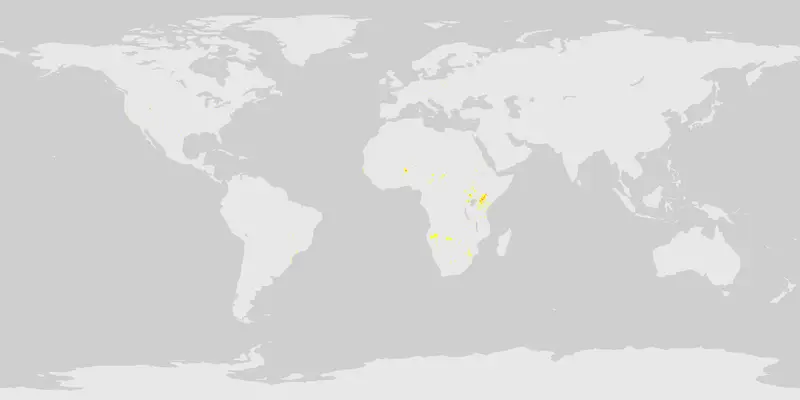
Giraffes live in scattered populations across eastern, southern, central and western Africa, from Niger to South Africa. Their range has shrunk substantially over the past century. Researchers have recently proposed splitting giraffes into several species based on genetics, including the northern, reticulated, Masai and southern giraffes; for now the IUCN and GBIF still treat them under one species name, and we follow that here. US records on GBIF reflect animals in zoos.
Where and when to look
Giraffes live in the savannas, open woodlands and grasslands of sub-Saharan Africa, and the best places to see them in the wild include Kenya, Tanzania, Uganda, Namibia, Botswana, Zambia and South Africa. They are easy to spot from a distance, often standing tall above the trees as they browse on acacia leaves and other plants. Visibility improves in the drier months, when leaves thin out and browsers stay within reach of water. Early morning and late afternoon are good times to see giraffes feeding, while midday they may rest in the shade or stand still, chewing their cud. Giraffes have a distinctive coat pattern of patches separated by lighter lines, and different populations have different patterns. Reticulated giraffes in northern Kenya have large, neat liver-colored patches with bright white lines, while Masai giraffes in southern Kenya and Tanzania have jagged, leaf-like patches. Genetic studies have suggested that giraffes may be several separate species rather than one, though experts still debate how to split them. Males are usually taller and heavier than females, with thicker, bald-topped horns called ossicones. Females have thinner ossicones with tufts of hair on top. Males sometimes engage in necking, swinging their long necks and heads at each other to establish dominance. Calves are born after a long pregnancy, dropping to the ground from their standing mother, and can stand and walk within an hour. Young giraffes often gather in groups called creches, watched over by one or more adults while their mothers feed nearby. Giraffes are generally calm, but they can kick with great force when threatened, so stay in your vehicle and keep a respectful distance. Avoid getting between a mother and her calf. Watch for giraffes drinking at waterholes, where they must spread their front legs wide and lower their heads, a vulnerable moment when they are alert for predators. Closer to home, many accredited zoos keep giraffe herds, and some fund field projects in Africa; a feeding platform there is a fine way for children to appreciate that long purple tongue up close.
When & where in the US
GBIF holds 36 occurrence records of this species from the United States. States with the most records:
- California 8
- New Mexico 6
- Washington 6
- Texas 4
- Michigan 3
Occurrence records reflect where and when people look and report (observer effort), not just where the animal is common. Busy birding states and summer months are over-represented; zoo and museum records can appear for non-native species.
Source: GBIF occurrence search for country US.[7]
What it eats
Giraffes browse leaves, shoots and flowers from trees and shrubs, favoring acacias. Their long, dark, prehensile tongues and tough lips work around sharp thorns. Being so tall lets them reach leaves that few other animals can. They need to spread their front legs wide to drink, which makes them vulnerable at water holes, so they get much of their moisture from leaves. Giraffes often chew bones to get minerals.
Reproduction and life cycle
Males compete by necking, swinging their heavy heads and necks at each other. Females give birth standing up, so the calf drops to the ground at birth, and it can stand and walk within an hour. Mothers sometimes leave calves together in a nursery group watched by one adult. Lions and hyenas take many young calves, so early survival is low.
Threats and conservation
The giraffe as a whole is listed as vulnerable on the IUCN Red List, as checked through GBIF, and some regional populations are more threatened. Habitat loss and fragmentation, hunting for meat, civil unrest and drought have driven declines. Translocations to protected areas and community conservation programs have helped populations in Niger, Kenya and Uganda grow.
How to tell it apart
- African bush elephant: Another savanna giant, but gray, wrinkled, trunked and very broad.
- Cheetah: Spotted, yes, but a slim cat with black spots, a long tail and fast sprinting gait.
- Pronghorn: The only giraffe-like patterning in North America is a play of tan and white on a small fast runner of the plains.
Photo: (c) tlaloc27, some rights reserved (CC BY) — CC BY 4.0, source[8]. See all image credits.
Sources
- GBIF Backbone Taxonomy — Giraffa camelopardalis (species 2441205), via GBIF API — retrieved 2026-11-21
- GBIF — synonyms of Giraffa camelopardalis — retrieved 2026-11-21
- GBIF — vernacular names of Giraffa camelopardalis — retrieved 2026-11-21
- ITIS — full hierarchy for TSN 625036 — retrieved 2026-11-21
- IUCN Red List category via GBIF (Giraffa camelopardalis) — retrieved 2026-11-21
- Animal Diversity Web (University of Michigan) — Giraffa camelopardalis account — retrieved 2026-11-21
- GBIF occurrence search — Giraffa camelopardalis, country US, month and state facets — retrieved 2026-11-21
- iNaturalist taxon 42157 — Giraffa camelopardalis (photo source) — retrieved 2026-11-21
Written under the pen name Maya Reynolds with AI-assisted drafting, then checked against the sources cited on each page. Last reviewed 2026-11-21. Numbers in the fact table come only from the linked sources; all prose is original. See our editorial policy.