American bison
Bison bison (Linnaeus, 1758) · also called Buffalo, Bison
The American bison is the heaviest land animal in North America, a humped, shaggy grazer that once roamed the plains in vast herds and is now the national mammal of the United States.

Quick facts
| Kingdom | Animalia[4] |
|---|---|
| Phylum | Chordata[4] |
| Class | Mammalia[4] |
| Order | Artiodactyla[4] |
| Family | Bovidae[4] |
| Genus | Bison[4] (ITIS hierarchy: Bos[4]) |
| Species | Bison bison[1] |
| Authority | (Linnaeus, 1758)[1] |
| ITIS TSN | 203618[4] |
| Synonyms | Bison americanus Brisson, 1762; Bison americanus pennsylvanicus Shoemaker, 1915; Bison sylvestris Hay, 1915; Bos americanus Zimmermann, 1780; Bison americanus; Bison sylvestris; Bison americanus pennsylvanicus[2] · Also treated as Bos bison (GBIF and iNaturalist) |
| Other common names | Buffalo, Bison[3] |
| Length | 2.1–3.8 m (6.89–12.5 ft)[6] |
| Weight | 318–900 kg (701–1984 lb)[6] |
| Lifespan (max. recorded / range) | 40 years[6] |
| Young per litter or brood (average) | 1[6] |
| Gestation (average) | 285 days[6] |
| Diet type | herbivore[6] |
| Habitat | Grasslands, river valleys, sagebrush and mountain meadows · ADW biomes: savanna or grassland savanna or grassland forest forest scrub forest scrub forest[6] |
| IUCN Red List | Near Threatened (NT)[5] IUCN page Population trend: not available through GBIF; see the IUCN assessment. |
Where it lives
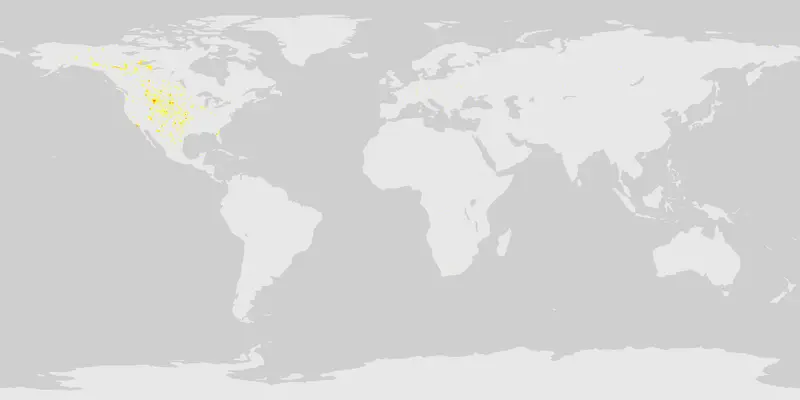
Bison once ranged across much of North America, from the eastern woodlands to the Rocky Mountains and from Canada into Mexico. By the late nineteenth century, commercial hunting and deliberate destruction had reduced the population to a few hundred wild animals. Yellowstone is the only place in the United States where bison have lived continuously since prehistoric times, and its herds are among the most genetically important in the country. Today most bison live on private ranches, while public herds graze in places like Yellowstone, Grand Teton, Wind Cave, Badlands, Theodore Roosevelt National Park and tribal lands. Yellowstone bison move from the high interior to lower valleys in winter, sometimes leaving the park.
Where and when to look
In Yellowstone, the Lamar and Hayden valleys are the surest places to see bison, often from the road itself, since herds graze right up to the pavement and sometimes walk down the middle of it. Summer brings the rut, when bulls roar with a deep rolling bellow, wallow in dust and walk beside cows they are guarding; it is spectacular and also the time to be most careful. In spring, look for the bright cinnamon calves that visitors call red dogs. In winter, bison use their heads like snowplows, and herds gather near thermal areas where the ground stays warm and snow is thinner. Watch the tail as a mood signal: a tail hanging down and swishing is relaxed, while a tail held straight up or kinked can mean a bison is about to charge or run. Outside the park, public herds in Custer State Park, Theodore Roosevelt National Park, Wind Cave and the National Bison Range offer good viewing as well. Binoculars let you watch calves nurse and bulls spar without crowding the herd or stepping off the road.
When & where in the US
GBIF holds 29,218 occurrence records of this species from the United States. States with the most records:
- Wyoming 10,142
- South Dakota 5,288
- Kentucky 3,115
- North Dakota 1,746
- Montana 1,727
Occurrence records reflect where and when people look and report (observer effort), not just where the animal is common. Busy birding states and summer months are over-represented; zoo and museum records can appear for non-native species.
Source: GBIF occurrence search for country US.[7]
NPS, number in Yellowstone: In recent years, the bison population in Yellowstone has ranged from 3,500 to nearly 6,000[9]
What it eats
Bison are grazers. They eat grasses and sedges for most of the year, cropping vegetation close to the ground. In winter they swing their massive heads side to side to sweep snow away and reach plants buried beneath. Bison wallowing, rolling in dust or mud, creates shallow depressions that hold rainwater and support different plants and insects. Their grazing and wallowing shape grassland ecosystems in ways ecologists compare to fire.
Reproduction and life cycle
The rut takes place in summer. Bulls bellow, wallow and fight head to head for access to cows, and the rumble of a herd during the rut is one of the great sounds of a Yellowstone summer. Calves are born in spring, cinnamon red rather than dark brown, and are up and walking within hours. Cows and calves live in groups, while mature bulls often travel alone or in small bachelor groups outside the breeding season.
Threats and conservation
On the IUCN Red List, the American bison is listed as near threatened, as checked through GBIF. Wild herds are few and fragmented, and many ranch bison carry cattle genes from past crossbreeding. Brucellosis, a disease shared with cattle, complicates management when bison leave Yellowstone in winter. For visitors, bison are one of the park's biggest safety issues: they can sprint fast and injure people who approach too closely.
How to tell it apart
- Elk: The other large Yellowstone grazer, but elk are slimmer, tan with a pale rump, and bulls carry branching antlers.
- Moose: Taller at the shoulder with long legs, a drooping nose and palmate antlers; moose stay near willows and water.
- Grizzly bear: Also humped at the shoulder and brown, but a grizzly is a carnivore with a dished face and claws, and it walks on flat feet.
- Pronghorn: Shares the open valleys but is small, fast and tan with white bands.
Photo: (c) Syd Cannings, some rights reserved (CC BY) — CC BY 4.0, source[8]. See all image credits.
Sources
- GBIF Backbone Taxonomy — Bison bison (species 2441176), via GBIF API — retrieved 2026-11-21
- GBIF — synonyms of Bison bison — retrieved 2026-11-21
- GBIF — vernacular names of Bison bison — retrieved 2026-11-21
- ITIS — full hierarchy for TSN 203618 — retrieved 2026-11-21
- IUCN Red List category via GBIF (Bison bison) — retrieved 2026-11-21
- Animal Diversity Web (University of Michigan) — Bison bison account — retrieved 2026-11-21
- GBIF occurrence search — Bison bison, country US, month and state facets — retrieved 2026-11-21
- iNaturalist taxon 208700 — Bison bison (photo source) — retrieved 2026-11-21
- National Park Service — Yellowstone: American bison — retrieved 2026-11-21
Written under the pen name Maya Reynolds with AI-assisted drafting, then checked against the sources cited on each page. Last reviewed 2026-11-21. Numbers in the fact table come only from the linked sources; all prose is original. See our editorial policy.