Moose
Alces alces (Linnaeus, 1758) · also called American Moose, Caucasian Moose, Elk, Elk (in Europe); Caucasian Moose (caucasica), Elk/Moose, Eurasian Elk
The moose is the largest living deer, a long-legged, dark-brown browser of northern forests and wetlands with a drooping muzzle, a hanging dewlap and broad palm-shaped antlers.

Quick facts
| Kingdom | Animalia[4] |
|---|---|
| Phylum | Chordata[4] |
| Class | Mammalia[4] |
| Order | Artiodactyla[4] |
| Family | Cervidae[4] |
| Genus | Alces[4] |
| Species | Alces alces[1] |
| Authority | (Linnaeus, 1758)[1] |
| ITIS TSN | 180703[4] |
| Synonyms | Alces alce (Linnaeus, 1758); Alces antiquorum Rüppell, 1842; Alces coronatus; Alces europaeus Burnett, 1830; Alces jubata Fitzinger, 1860; Alces machilis; Alces muswa Richardson, 1852; Alces palmatus[2] |
| Other common names | American Moose, Caucasian Moose, Elk, Elk (in Europe); Caucasian Moose (caucasica), Elk/Moose, Eurasian Elk[3] |
| Length | 2.3–3.1 m (7.55–10.2 ft)[6] |
| Weight | 270–771 kg (595–1700 lb)[6] |
| Lifespan (max. recorded / range) | 22 years[6] |
| Young per litter or brood | 1 to 2[6] |
| Gestation (average) | 231 days[6] |
| Diet type | herbivore[6] |
| Habitat | Boreal and mixed forest, willow flats, lakeshores and marshes · ADW biomes: tundra tundra taiga taiga forest forest scrub forest scrub forest mountains mountains[6] |
| IUCN Red List | Least Concern (LC)[5] IUCN page Population trend: not available through GBIF; see the IUCN assessment. |
Where it lives
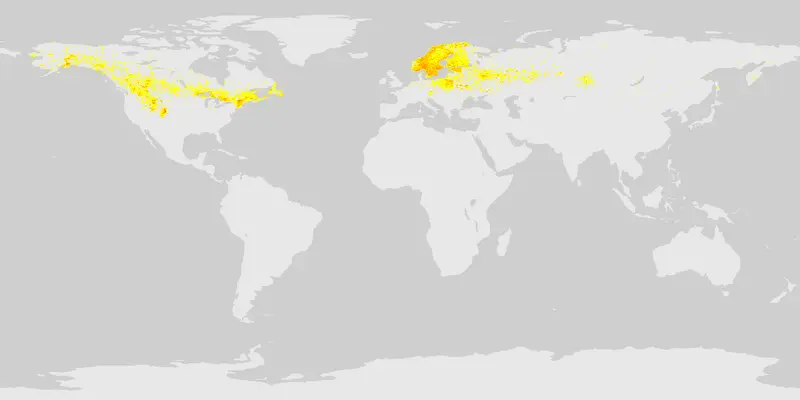
Moose live across northern North America, Scandinavia and northern Asia, where they are called elk in British English. In the United States they occur in Alaska, the northern Rockies including Yellowstone and Grand Teton, northern Minnesota, Michigan, northern New England and New York. Moose need cool conditions and do poorly in long hot spells. They are most often seen near willows along rivers and ponds, sometimes standing chest-deep in water to feed or escape biting insects.
Where and when to look
Moose are animals of willow flats, marshy lakeshores and young forests, especially in the northern Rockies, New England, the upper Great Lakes and Alaska. The best times to look are the first and last couple of hours of daylight, when they browse on willow, aspen, birch and water plants. In summer, scan ponds and slow streams: moose often wade in to eat submerged plants and escape biting flies, sometimes plunging their heads fully underwater and coming up dripping with weeds. In winter, look for them in thickets near frozen streams, where they browse on twigs. Their size alone makes moose hard to miss once you find them. They are the largest members of the deer family, with long legs, a humped shoulder and a flap of skin called a bell hanging under the throat. Mature bulls carry broad, flattened antlers shaped like an open hand, which grow over the summer, are scraped clean of velvet in late summer, and drop in winter. Cows lack antlers and have a lighter, narrower face. In spring and early summer, a cow may be followed by one or two reddish-brown calves, which stay with her for about a year. The fall rut is the noisiest time. Cows give long, moaning calls, and bulls respond with deep grunts and croaks. Bulls may thrash shrubs with their antlers and dig shallow pits that they urinate in to advertise themselves. Other signs include stripped bark on young trees, browse lines on willows where branches have been nipped off at moose height, large heart-shaped tracks and piles of oval pellets. Moose may seem slow or indifferent, but they are among the most dangerous animals for people in North America. Cows with calves are very protective, and bulls in the rut can be aggressive. Warning signs include ears laid back, raised hackles and licking lips. Keep a wide distance, put a car, tree or large boulder between you and the animal if it approaches, and never let dogs chase or bark at them. If a moose charges, run away and get behind something solid; they usually stop after a short distance.
When & where in the US
GBIF holds 23,055 occurrence records of this species from the United States. States with the most records:
- Alaska 6,611
- Colorado 4,280
- Wyoming 3,189
- Vermont 2,328
- Montana 1,043
Occurrence records reflect where and when people look and report (observer effort), not just where the animal is common. Busy birding states and summer months are over-represented; zoo and museum records can appear for non-native species.
Source: GBIF occurrence search for country US.[7]
NPS, number in Yellowstone: Fewer than 200 Population has declined in last 40 years due to loss of old growth forests[9]
What it eats
The name moose likely comes from an Algonquian word meaning twig eater. They browse willow, birch, aspen, balsam fir and many shrubs, and in summer wade into lakes and ponds for aquatic plants, which supply sodium. In winter they rely on twigs and bark. A moose can reach high branches by standing on its hind legs or bending saplings down with its body.
Reproduction and life cycle
The rut begins in early fall. Bulls grunt, cows give long moaning calls, and rival bulls fight with their massive antlers. Calves are born in late spring, often as twins where food is plentiful. Mothers are fiercely protective and can be dangerous to people and dogs. Calves stay with the mother for about a year, until she drives them off before giving birth again.
Threats and conservation
Moose are listed as least concern globally, but several US populations have declined. Winter ticks, which thrive with shorter winters, can cover a single moose in huge numbers and kill calves. Brain worm, spread from white-tailed deer, and heat stress also affect them. In Yellowstone, moose numbers fell after large fires in the late twentieth century removed old forest they used in winter.
How to tell it apart
- Elk: Lighter tan with a pale rump and a lighter, more compact face; elk antlers branch rather than form palms.
- White-tailed deer: Much smaller and lighter, with a white tail flag and no dewlap.
- American black bear: Dark and large in the woods, but a bear walks flat-footed with a short face.
- American bison: Shorter-legged and humped with horns, a grazer of open valleys rather than willow thickets.
Photo: (c) mikaelsoderberg, some rights reserved (CC BY) — CC BY 4.0, source[8]. See all image credits.
Sources
- GBIF Backbone Taxonomy — Alces alces (species 2440940), via GBIF API — retrieved 2026-11-21
- GBIF — synonyms of Alces alces — retrieved 2026-11-21
- GBIF — vernacular names of Alces alces — retrieved 2026-11-21
- ITIS — full hierarchy for TSN 180703 — retrieved 2026-11-21
- IUCN Red List category via GBIF (Alces alces) — retrieved 2026-11-21
- Animal Diversity Web (University of Michigan) — Alces alces account — retrieved 2026-11-21
- GBIF occurrence search — Alces alces, country US, month and state facets — retrieved 2026-11-21
- iNaturalist taxon 522193 — Alces alces (photo source) — retrieved 2026-11-21
- National Park Service — Yellowstone: Moose — retrieved 2026-11-21
Written under the pen name Maya Reynolds with AI-assisted drafting, then checked against the sources cited on each page. Last reviewed 2026-11-21. Numbers in the fact table come only from the linked sources; all prose is original. See our editorial policy.