American black bear
Ursus americanus Pallas, 1780 · also called Black bear, Baribal, Oso Negro Americano, Ours Noir
The American black bear is the most common and widespread bear in North America, a shy forest omnivore that comes in black, brown, cinnamon and even blond.

Quick facts
| Kingdom | Animalia[4] |
|---|---|
| Phylum | Chordata[4] |
| Class | Mammalia[4] |
| Order | Carnivora[4] |
| Family | Ursidae[4] |
| Genus | Ursus[4] |
| Species | Ursus americanus[1] |
| Authority | Pallas, 1780[1] |
| ITIS TSN | 180544[4] |
| Synonyms | Euarctos americanus (Pallas, 1780); Euarctos vitabilis Gidley, 1913; Ursus amplidens Leidy, 1853; Ursus optimus Schultz, 1938[2] |
| Other common names | Black bear, Baribal, Oso Negro Americano, Ours Noir[3] |
| Length | 1200–2000 mm (3.94–6.56 ft)[6] |
| Weight | 39–409 kg (86–902 lb)[6] |
| Lifespan (max. recorded / range) | 30 years[6] |
| Young per litter or brood | 1.0 to 5.0[6] |
| Gestation (average) | 220.0 days[6] |
| Diet type | omnivore[6] |
| Habitat | Forests, swamps, mountains and wooded suburbs · ADW biomes: forest forest scrub forest scrub forest[6] |
| IUCN Red List | Least Concern (LC)[5] IUCN page Population trend: not available through GBIF; see the IUCN assessment. |
Where it lives
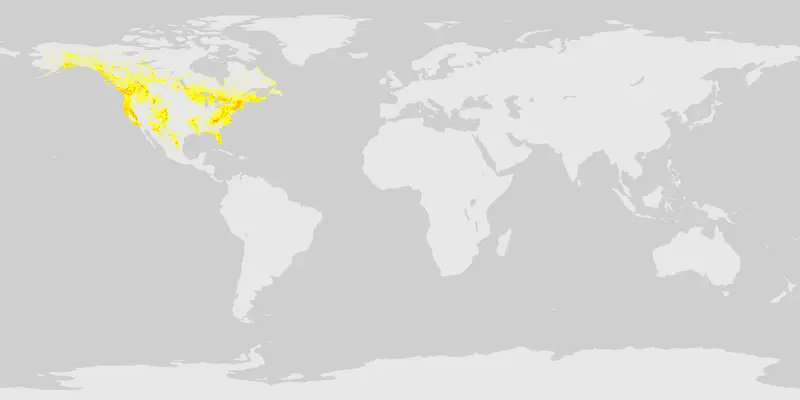
Black bears live across Canada and Alaska and in much of the United States, from the Appalachians and New England through the Upper Midwest, Florida, the Gulf states, the Rockies and the Pacific mountains, into northern Mexico. Many eastern populations have grown and spread over recent decades, and bears now regularly appear on the edges of towns in New Jersey, Pennsylvania, North Carolina and Florida. In Yellowstone black bears are found mostly in forested areas, while grizzlies use more open country. The species is far more numerous than all other North American bears combined.
Where and when to look
Black bears are most often spotted in spring and early summer, when they come out of their dens hungry and graze on fresh green grasses, clover and dandelions in meadows, along forest roads and on the edges of clearings. Early morning and the hours before dark are the best times; in the heat of the day bears usually rest in shade. Late summer and fall bring them to berry patches, oak stands with fallen acorns, and old orchards as they fatten up for winter. In some parks, bears are easiest to see from a pullout overlooking a sunny hillside, using binoculars or a spotting scope. You will find signs more often than bears. Look for logs torn apart for grubs, rocks flipped over, claw and bite marks on trees and utility poles, and droppings packed with seeds or berry skins. Tracks show a broad hind foot that looks a bit like a flat human footprint, with five toes. Despite the name, coat color varies a great deal, from black to brown, cinnamon and even blond, so color alone is not a reliable clue. Adult males are generally larger and heavier than females, with broader heads, while a female with cubs is usually the bear you see moving with small, playful followers in spring. Always keep a generous distance, stay in or near your vehicle at roadside sightings, and never feed a bear or leave food unattended. Follow the specific distance rules posted by the park you are visiting, carry bear spray where it is recommended, and store food, trash and toiletries in bear-proof lockers or containers.
When & where in the US
GBIF holds 46,066 occurrence records of this species from the United States. States with the most records:
- California 7,096
- Alaska 3,971
- North Carolina 3,011
- New York 2,761
- Wyoming 2,672
Occurrence records reflect where and when people look and report (observer effort), not just where the animal is common. Busy birding states and summer months are over-represented; zoo and museum records can appear for non-native species.
Source: GBIF occurrence search for country US.[8]
What it eats
Black bears are opportunists that eat mostly plants. Grasses and new shoots in spring, berries in summer and acorns, beechnuts and other nuts in fall make up much of the year. They tear apart logs for insects, raid ant nests and beehives, catch fish, and take deer fawns and elk calves when they can. Around homes they quickly learn to eat birdseed, garbage, pet food and grill grease, and a bear that gets used to human food often has to be removed. Taking feeders in during bear season is one of the most important actions homeowners in bear country can take.
Reproduction and life cycle
Mating happens in summer, but as in other bears, the embryo implants only in fall. Cubs are born in the winter den, very small and almost hairless, and grow quickly on rich milk. Mothers emerge in spring with their cubs, which stay with her through their first year and den with her a second winter. Black bear mothers often send cubs up trees for safety, so a lone cub in a tree likely has a mother close by.
Threats and conservation
The species is listed as least concern and is hunted in many states under regulation. Some regional populations, such as the Louisiana black bear, were once listed as threatened before recovering. Habitat fragmentation, vehicle strikes and conflicts with people are the main pressures. Most black bears flee from people, but any bear can be dangerous; never feed bears and keep a safe distance.
How to tell it apart
- Grizzly bear: A grizzly has a pronounced shoulder hump, a dished face, short rounded ears and long pale claws.
- Raccoon: In a dark yard, a raccoon at a feeder can surprise people; a bear is many times larger.
- Moose: Dark and large, but a moose is a long-legged, long-faced deer.
Photo: (c) Jay Pruett, some rights reserved (CC BY) — CC BY 4.0, source[9]. See all image credits.
Sources
- GBIF Backbone Taxonomy — Ursus americanus (species 2433407), via GBIF API — retrieved 2026-11-21
- GBIF — synonyms of Ursus americanus — retrieved 2026-11-21
- GBIF — vernacular names of Ursus americanus — retrieved 2026-11-21
- ITIS — full hierarchy for TSN 180544 — retrieved 2026-11-21
- IUCN Red List category via GBIF (Ursus americanus) — retrieved 2026-11-21
- Animal Diversity Web (University of Michigan) — Ursus americanus account — retrieved 2026-11-21
- GBIF occurrence density map tile for Ursus americanus — retrieved 2026-11-21
- GBIF occurrence search — Ursus americanus, country US, month and state facets — retrieved 2026-11-21
- iNaturalist taxon 41638 — Ursus americanus (photo source) — retrieved 2026-11-21

Written under the pen name Maya Reynolds with AI-assisted drafting, then checked against the sources cited on each page. Last reviewed 2026-11-21. Numbers in the fact table come only from the linked sources; all prose is original. See our editorial policy.