American robin
Turdus migratorius Linnaeus, 1766 · also called American Robin (migratorius Group), Canadian Thrush, Migratory Thrush, Red Robin, Red-breasted Thrush, Robin Redbreast
The American robin is a large thrush with a gray-brown back and a warm orange breast, the familiar worm hunter of lawns from Alaska to Mexico.

Quick facts
| Kingdom | Animalia[4] |
|---|---|
| Phylum | Chordata[4] |
| Class | Aves[4] |
| Order | Passeriformes[4] |
| Family | Turdidae[4] |
| Genus | Turdus[4] |
| Species | Turdus migratorius[1] |
| Authority | Linnaeus, 1766[1] |
| ITIS TSN | 179759[4] |
| Synonyms | None listed[2] |
| Other common names | American Robin (migratorius Group), Canadian Thrush, Migratory Thrush, Red Robin, Red-breasted Thrush, Robin Redbreast[3] |
| Length | 23–28 cm (9.06–11 in)[6] |
| Weight | 77 g (2.72 oz)[6] |
| Lifespan (max. recorded / range) | 14 years[6] |
| Eggs per season | 3 to 5[6] |
| Incubation (time to hatching) (average) | 14 days[6] |
| Diet type | omnivore[6] |
| Habitat | Lawns, parks, open woodland, farmland and mountain forests · ADW biomes: forest forest scrub forest scrub forest[6] |
| IUCN Red List | Least Concern (LC)[5] IUCN page Population trend: not available through GBIF; see the IUCN assessment. |
Where it lives
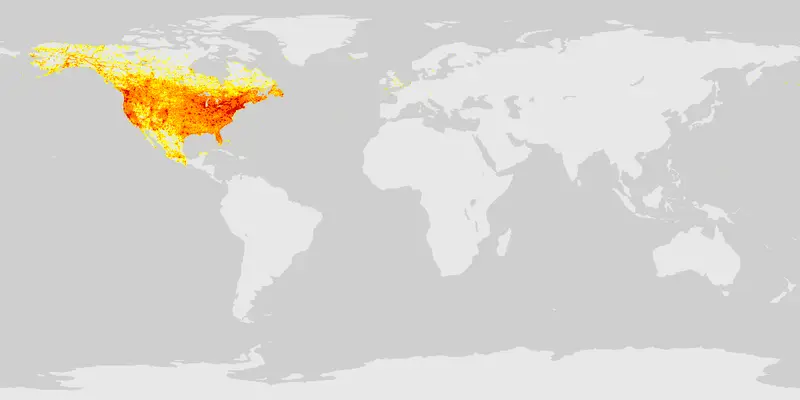
Robins breed across nearly all of North America, from the Alaskan tundra edge to the mountains of Mexico, and they are one of the few birds found in every one of the lower forty-eight states. The popular idea that robins leave for the winter is only half true. Northern birds do move south, but many robins stay surprisingly far north through the cold months; they simply change habits, gather in flocks, roost in woods and eat fruit instead of hunting lawns, so people stop noticing them. Spring arrival in a given town is really a shift back to visible lawn feeding as the ground thaws. That seasonal pattern shows clearly in the US occurrence chart, where records climb steeply in spring. In the West they range from city parks to high mountain meadows near timberline.
Where and when to look
To see robins at their most entertaining, watch a lawn on a mild morning after rain, when earthworms come close to the surface and birds hunt in a stop-start rhythm you can almost set a clock by. In late winter and early spring, robins that have spent the cold months in woods and river bottoms suddenly appear on lawns as the ground softens, and males start singing before dawn, a rich caroling phrase that sounds like cheerily, cheer up, cheerio. In fall and winter, look instead for noisy flocks stripping berries from hollies, junipers, crabapples and sumac, often mixed with cedar waxwings. Nest-watching is easy because robins accept porches and light fixtures, but give them space, since frequent visits can cause a pair to abandon. A clue that a robin is nearby is a loud, repeated tut tut or a whinny of alarm, which often means a cat, hawk or crow is near the nest.
When & where in the US
GBIF holds 24,045,005 occurrence records of this species from the United States. States with the most records:
- New York 1,956,624
- Pennsylvania 1,556,002
- Ohio 1,264,281
- California 1,183,953
- Massachusetts 1,163,264
Occurrence records reflect where and when people look and report (observer effort), not just where the animal is common. Busy birding states and summer months are over-represented; zoo and museum records can appear for non-native species.
Source: GBIF occurrence search for country US.[7]
What it eats
The robin's diet swings with the seasons. From spring through early summer it feeds heavily on earthworms, beetle grubs, caterpillars and other soft invertebrates. Its famous head-tilted pose on a lawn is mostly about looking with one eye, though it may also pick up faint sounds of prey moving. It runs a few steps, freezes, then stabs and pulls. In late summer, fall and winter the bird turns to fruit: chokecherry, holly, juniper berries, crabapples, sumac and dogwood. Flocks can strip a fruiting tree in an afternoon, and occasionally birds that gorge on fermenting berries act clumsy. Planting native fruiting shrubs is the single best way to feed robins, since they rarely visit seed feeders.
Reproduction and life cycle
Robins are among the earliest nesters in many areas. The female builds a sturdy cup from grass and twigs and then plasters the inside with mud, shaping it with her breast before adding a soft grass lining. Nests sit in the fork of a tree, on a ledge of a building, a porch light or a gutter, which is why so many families get to watch a robin nest up close. The eggs are the clear sky blue that gave a color its name. The female incubates, and both parents feed the young a steady stream of worms and insects. Fledglings leave the nest with short tails and spotted breasts, and they look helpless on the ground for a few days; the parents are almost always nearby, so the best help is to keep pets inside and leave the bird alone. Pairs commonly raise two or three broods in a season.
Threats and conservation
Robins are abundant and listed as least concern, but they absorb many human-made hazards because they live where we do. Lawn pesticides are a particular concern since robins eat soil invertebrates directly; the species was a symbol of the pesticide era for that reason. Window strikes, outdoor cats and vehicles take a toll, and the bird is a common carrier of West Nile virus, though populations have stayed robust. Warmer winters are changing when and where robins overwinter, a pattern that citizen science records help track over time.
How to tell it apart
- Northern cardinal: A cardinal is red all over (male) or buff with red accents (female), has a pointed crest and a thick red seed-cracking bill, and is smaller.
- Mourning dove: Feeds on the same lawns but is plain tan-gray with a tiny head, black spots on the wings and a long pointed tail; it walks with bobbing steps rather than running and pausing.
- Blue jay: Similar in size, but blue above, white below, with a crest and loud calls.
- Red-tailed hawk: Young birders sometimes confuse the robin's rusty breast with the hawk's rusty tail, but the hawk is a raptor with a hooked bill and broad wings, far bigger.
Photo: (c) Judy Gallagher, some rights reserved (CC BY) — CC BY 4.0, source[8]. See all image credits.
Sources
- GBIF Backbone Taxonomy — Turdus migratorius (species 9510564), via GBIF API — retrieved 2026-11-21
- GBIF — synonyms of Turdus migratorius — retrieved 2026-11-21
- GBIF — vernacular names of Turdus migratorius — retrieved 2026-11-21
- ITIS — full hierarchy for TSN 179759 — retrieved 2026-11-21
- IUCN Red List category via GBIF (Turdus migratorius) — retrieved 2026-11-21
- Animal Diversity Web (University of Michigan) — Turdus migratorius account — retrieved 2026-11-21
- GBIF occurrence search — Turdus migratorius, country US, month and state facets — retrieved 2026-11-21
- iNaturalist taxon 12727 — Turdus migratorius (photo source) — retrieved 2026-11-21
Written under the pen name Maya Reynolds with AI-assisted drafting, then checked against the sources cited on each page. Last reviewed 2026-11-21. Numbers in the fact table come only from the linked sources; all prose is original. See our editorial policy.