Mourning dove
Zenaida macroura (Linnaeus, 1758) · also called American Mourning Dove, Carolina Pigeon, Carolina Turtle Dove, Long-tailed Pea Dove, Mourning Dove (Mainland)
The mourning dove is a slender, soft-gray dove with a long pointed tail and a mournful cooing song, one of the most widespread and numerous birds in the United States.

Quick facts
| Kingdom | Animalia[4] |
|---|---|
| Phylum | Chordata[4] |
| Class | Aves[4] |
| Order | Columbiformes[4] |
| Family | Columbidae[4] |
| Genus | Zenaida[4] |
| Species | Zenaida macroura[1] |
| Authority | (Linnaeus, 1758)[1] |
| ITIS TSN | 177125[4] |
| Synonyms | Columba macroura Linnaeus, 1758; Zenaidura macroura (Linnaeus, 1758); Columba macroura[2] |
| Other common names | American Mourning Dove, Carolina Pigeon, Carolina Turtle Dove, Long-tailed Pea Dove, Mourning Dove (Mainland)[3] |
| Length | 22.5–36 cm (8.86–14.2 in)[6] |
| Weight | 96–170 g (3.39–6 oz)[6] |
| Lifespan (max. recorded / range) | 19.3 years[6] |
| Eggs per season (average) | 2.0[6] |
| Incubation (time to hatching) (average) | 14.0 days[6] |
| Diet type | herbivore[6] |
| Habitat | Open country, farmland, suburbs, desert edges and roadsides · ADW biomes: desert or dune desert or dune savanna or grassland savanna or grassland chaparral chaparral forest forest scrub forest scrub forest[6] |
| IUCN Red List | Least Concern (LC)[5] IUCN page Population trend: not available through GBIF; see the IUCN assessment. |
Where it lives
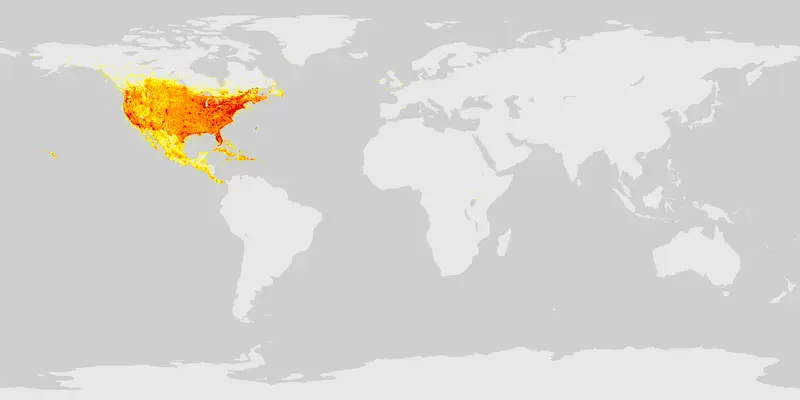
Mourning doves breed from southern Canada through the entire lower forty-eight states into Mexico and the Caribbean. Northern birds tend to drift south for the winter while southern birds mostly stay, so across much of the country you can find them in every month. They are birds of open ground with a few trees for perching and nesting, which is why farm country, suburbs and city edges suit them so well. In the arid Southwest they gather at water holes at dawn and dusk, flying long distances to drink. Overhead wires along a country road are one of the classic places to see a row of them sitting shoulder to shoulder.
Where and when to look
The soft, hollow cooing that drifts across neighborhoods on spring mornings, often mistaken for an owl, is usually a male mourning dove. Doves are easiest to watch in the early morning and late afternoon, when they walk slowly over lawns, gravel roads and bare ground picking up seeds, or sit side by side on power lines. When one bursts into flight, listen for a whistling twitter made by the wings, not the voice. Males have a faint pinkish wash on the breast and a bluish gray crown, while females look a little browner overall, but the difference is subtle and best seen when a pair sits together. Watch in spring for the male's display flight: he climbs with loud wing claps, then glides in a wide circle with wings and tail spread. Nests are flimsy platforms of twigs in shrubs, gutters and hanging planters, and pairs may raise several broods in a single season. If a nest appears on your porch, use another door for a couple of weeks rather than flushing the adults again and again.
When & where in the US
GBIF holds 26,098,081 occurrence records of this species from the United States. States with the most records:
- California 2,196,160
- New York 1,691,689
- Texas 1,579,789
- Florida 1,558,199
- Pennsylvania 1,437,775
Occurrence records reflect where and when people look and report (observer effort), not just where the animal is common. Busy birding states and summer months are over-represented; zoo and museum records can appear for non-native species.
Source: GBIF occurrence search for country US.[7]
What it eats
Doves eat almost nothing but seeds. They pick them from the ground rather than from plants, taking grains such as corn and wheat, plus seeds of grasses, ragweed, pigweed and many other weeds. A dove fills a pouch in its throat called the crop with seeds as fast as it can, then flies to a safe perch to digest them. They also swallow small grit to help grind food. Unlike most birds, doves can drink by sucking water up without tipping their heads back. At home, they happily eat millet and cracked corn scattered on the ground or on a low platform feeder.
Reproduction and life cycle
Mourning doves have one of the longest breeding seasons of any North American bird and in warm regions may nest almost year-round. The male brings twigs to the female, who arranges them into a flimsy platform that is sometimes so thin the eggs show through from below. Both parents take turns incubating, the male often by day and the female by night. For their first days the young, called squabs, are fed crop milk, a rich fluid produced in the lining of the parents' crops. Because a pair can raise many broods in one year, the species keeps its numbers high despite heavy losses to predators and hunting.
Threats and conservation
The mourning dove is abundant and listed as least concern, and it is also the most hunted game bird in North America, with seasons regulated by state wildlife agencies. Natural predators include hawks, falcons, cats and snakes. Lead shot left in fields can poison doves that swallow it as grit, which is one reason some areas encourage non-toxic shot. Window collisions and disease spread at crowded feeders are local concerns. Clean feeding areas and native grasses that go to seed help support healthy populations.
How to tell it apart
- American robin: Shares lawns but stands upright, has an orange breast and a yellow bill, and runs and stops; doves shuffle with small steps and bobbing heads.
- Peregrine falcon: In fast direct flight a dove can suggest a small falcon, but the falcon has broad shoulders, a dark helmet and a hooked bill, and doves clap their wings on takeoff with a whistling sound.
- Red-tailed hawk: Far bigger and heavier, with a broad rounded tail rather than the dove's long tapered tail edged in white.
Photo: (c) Timothy Lindsey, some rights reserved (CC BY), uploaded by Timothy Lindsey — CC BY 4.0, source[8]. See all image credits.
Sources
- GBIF Backbone Taxonomy — Zenaida macroura (species 2495347), via GBIF API — retrieved 2026-11-21
- GBIF — synonyms of Zenaida macroura — retrieved 2026-11-21
- GBIF — vernacular names of Zenaida macroura — retrieved 2026-11-21
- ITIS — full hierarchy for TSN 177125 — retrieved 2026-11-21
- IUCN Red List category via GBIF (Zenaida macroura) — retrieved 2026-11-21
- Animal Diversity Web (University of Michigan) — Zenaida macroura account — retrieved 2026-11-21
- GBIF occurrence search — Zenaida macroura, country US, month and state facets — retrieved 2026-11-21
- iNaturalist taxon 3454 — Zenaida macroura (photo source) — retrieved 2026-11-21
Written under the pen name Maya Reynolds with AI-assisted drafting, then checked against the sources cited on each page. Last reviewed 2026-11-21. Numbers in the fact table come only from the linked sources; all prose is original. See our editorial policy.