Red-tailed hawk
Buteo jamaicensis (Gmelin, 1788) · also called Chicken Hawk, Hen Hawk, Macaw, Macou, Mouse Hawk, Red-tailed Buzzard
The red-tailed hawk is a big, broad-winged hawk with a rusty-red tail on adults, the most common and widespread large hawk in North America.

Quick facts
| Kingdom | Animalia[4] |
|---|---|
| Phylum | Chordata[4] |
| Class | Aves[4] |
| Order | Accipitriformes[4] |
| Family | Accipitridae[4] |
| Genus | Buteo[4] |
| Species | Buteo jamaicensis[1] |
| Authority | (Gmelin, 1788)[1] |
| ITIS TSN | 175350[4] |
| Synonyms | Falco jamaicensis Gmelin, 1788; Falco jamaicensis[2] |
| Other common names | Chicken Hawk, Hen Hawk, Macaw, Macou, Mouse Hawk, Red-tailed Buzzard[3] |
| Length | 45–65 cm (17.7–25.6 in)[6] |
| Weight | 795–1224 g (1.75–2.7 lb)[6] |
| Lifespan (max. recorded / range) | 29.5 years[6] |
| Eggs per season | 1 to 5[6] |
| Incubation (time to hatching) | 28 to 35 days[6] |
| Diet type | carnivore[6] |
| Habitat | Open country with scattered trees, roadsides, deserts, forest edges and cities · ADW biomes: desert or dune desert or dune savanna or grassland savanna or grassland forest forest rainforest rainforest scrub forest scrub forest[6] |
| IUCN Red List | Least Concern (LC)[5] IUCN page Population trend: not available through GBIF; see the IUCN assessment. |
Where it lives
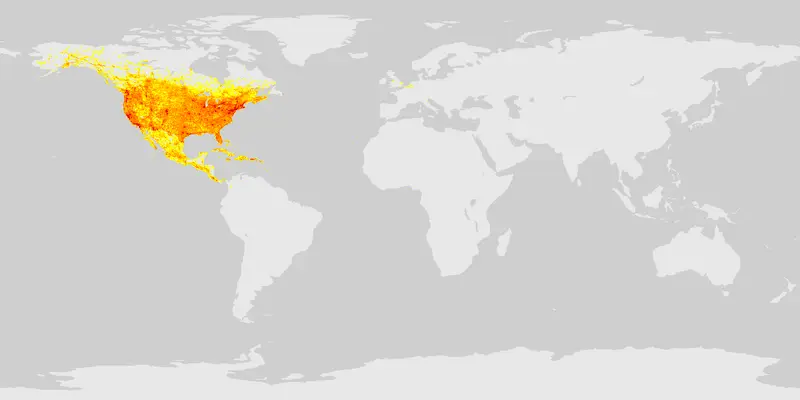
Red-tails breed from central Alaska and northern Canada south through every part of the lower forty-eight states and into Central America. Northern birds migrate south in fall while many others stay put. The species is famously variable; birds from the West range from pale to nearly chocolate brown, the Great Plains have very pale birds, and the far north holds the dark Harlan's form. Look for them on fence posts, telephone poles and highway light poles, where they sit watching the grassy shoulders for rodents. In many cities pairs nest on building ledges and hunt in parks.
Where and when to look
For many people, the red-tail is the first hawk they learn, partly because it sits out in the open. Drive any highway with open fields on either side, especially in winter, and scan fence posts, light poles and the tops of lone trees; a hunched, chunky hawk with a pale chest and a dark band across the belly is very likely this species. Mid-morning, once the ground warms and thermals begin to rise, is the best time to watch them soar in slow circles with broad wings and a short, fanned tail. Adults show the brick red tail from above as they bank, while young birds in their first year or so have brown, finely banded tails and paler eyes, which surprises many beginners. The famous scream, a raspy, descending kee-eeee-arr, is often dubbed into movies for eagles, so it is worth hearing the real thing. Plumage varies a great deal, from very pale birds on the plains to dark brown ones in the West, so rely on shape and the belly band. Females are noticeably larger than males, which helps when a pair perches together in late winter, the time when courtship flights and stick-carrying begin. Fall hawk-watch sites on ridges and lakeshores can show many red-tails in a single day. If you find a nest, watch from far away, because a hawk that keeps flushing leaves eggs and chicks exposed.
When & where in the US
GBIF holds 10,188,261 occurrence records of this species from the United States. States with the most records:
- California 1,663,717
- New York 671,370
- Pennsylvania 575,670
- Texas 511,232
- Colorado 475,057
Occurrence records reflect where and when people look and report (observer effort), not just where the animal is common. Busy birding states and summer months are over-represented; zoo and museum records can appear for non-native species.
Source: GBIF occurrence search for country US.[7]
What it eats
Rodents are the mainstay: voles, mice, rats, ground squirrels, pocket gophers and rabbits. A red-tail typically hunts from a perch, waiting patiently and then dropping onto prey with its legs extended. It also soars and hovers into the wind, called kiting, over open slopes. Birds, snakes, lizards and large insects round out the diet, and in winter it may eat carrion. The hawk's powerful feet do the killing; the hooked bill tears food into bite-sized pieces. Because they eat so many rodents, red-tails are welcome neighbors on farms.
Reproduction and life cycle
Pairs often stay together for years and defend a territory all year in milder regions. Courtship includes high circling flights in which the male dives steeply and climbs again, sometimes touching or grasping the female's feet. The pair builds or reuses a bulky stick nest high in a tall tree, on a cliff, or on a building or tower, adding fresh green sprigs through the season. Both adults incubate, though the female does more. Young hawks remain near the nest for weeks after their first flights while learning to hunt.
Threats and conservation
Red-tailed hawks are common and assessed as least concern. Their main hazards come from people: vehicle collisions along roads where they hunt, electrocution on poorly designed power poles, illegal shooting, and secondary poisoning when they eat rodents killed with anticoagulant rat poisons. Using traps or exclusion rather than poisons around homes and farms protects hawks, owls and pets.
How to tell it apart
- Bald eagle: Adult eagles have a white head and tail and are much larger, with long plank-like wings; young eagles are blotchy brown but still bigger, with a heavy bill.
- Peregrine falcon: Falcons have long pointed wings, a narrow tail, a dark helmet and rapid flight; red-tails have broad rounded wings and soar in slow circles.
- Northern cardinal: Only shares the color red, and only on the hawk's tail. Beginners sometimes report a "red bird" high on a pole; size and hooked bill settle it.
- Mourning dove: Distant birds on wires can look similar in silhouette, but doves are slim with tiny heads and long pointed tails.
Photo: no rights reserved, uploaded by Claude Lyneis — CC0 1.0, source[8]. See all image credits.
Sources
- GBIF Backbone Taxonomy — Buteo jamaicensis (species 2480542), via GBIF API — retrieved 2026-11-21
- GBIF — synonyms of Buteo jamaicensis — retrieved 2026-11-21
- GBIF — vernacular names of Buteo jamaicensis — retrieved 2026-11-21
- ITIS — full hierarchy for TSN 175350 — retrieved 2026-11-21
- IUCN Red List category via GBIF (Buteo jamaicensis) — retrieved 2026-11-21
- Animal Diversity Web (University of Michigan) — Buteo jamaicensis account — retrieved 2026-11-21
- GBIF occurrence search — Buteo jamaicensis, country US, month and state facets — retrieved 2026-11-21
- iNaturalist taxon 5212 — Buteo jamaicensis (photo source) — retrieved 2026-11-21
Written under the pen name Maya Reynolds with AI-assisted drafting, then checked against the sources cited on each page. Last reviewed 2026-11-21. Numbers in the fact table come only from the linked sources; all prose is original. See our editorial policy.