Peregrine falcon
Falco peregrinus Tunstall, 1771 · also called Duck Hawk, Dutch hawk, Great-footed Hawk, Peregrine, Peregrine Falcon (Eurasian), Rock Falcon
The peregrine falcon is a crow-sized falcon found on every continent except Antarctica, a bird hunter famous for its stooping dives, the fastest movement of any animal.

Quick facts
| Kingdom | Animalia[4] |
|---|---|
| Phylum | Chordata[4] |
| Class | Aves[4] |
| Order | Falconiformes[4] |
| Family | Falconidae[4] |
| Genus | Falco[4] |
| Species | Falco peregrinus[1] |
| Authority | Tunstall, 1771[1] |
| ITIS TSN | 175604[4] |
| Synonyms | None listed[2] |
| Other common names | Duck Hawk, Dutch hawk, Great-footed Hawk, Peregrine, Peregrine Falcon (Eurasian), Rock Falcon[3] |
| Length | 36–58 cm (14.2–22.8 in)[6] |
| Weight | 907 g (32 oz)[6] |
| Lifespan (max. recorded / range) | 20 years[6] |
| Dive (stoop) speed (ADW) | over 180 mph (290 km/h), possibly up to 200 mph, in a dive[6] |
| Eggs per season | 2 to 6[6] |
| Incubation (time to hatching) | 33 to 35 days[6] |
| Diet type | carnivore[6] |
| Habitat | Cliffs, coasts, wetlands, tundra and tall buildings in cities · ADW biomes: tundra tundra taiga taiga desert or dune desert or dune savanna or grassland savanna or grassland chaparral chaparral forest forest scrub forest scrub forest mountains mountains[6] |
| IUCN Red List | Least Concern (LC)[5] IUCN page Population trend: not available through GBIF; see the IUCN assessment. |
Where it lives
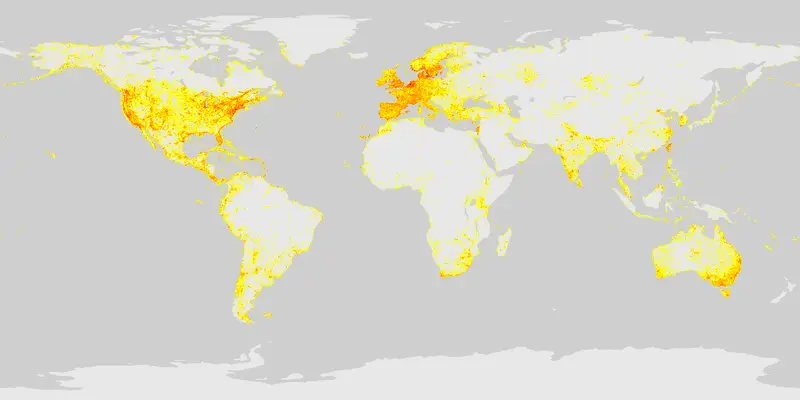
Peregrines are among the most widely distributed birds on Earth. In North America they nest on Arctic tundra, sea cliffs, river canyons and mountain crags, and today they also nest on skyscrapers, bridges and smokestacks in dozens of American cities. Arctic birds migrate enormous distances to South America, while many temperate birds stay close to home. Coastlines, barrier islands and big lakes funnel migrants in fall, and city pairs are easy to see year-round on their favorite ledges. Many cities run nest cameras that let anyone watch a peregrine family.
Where and when to look
Peregrines have adapted to cities so well that a downtown skyline can be one of the best places to see one. Look for a compact, dark-hooded falcon perched on a ledge, a church steeple or the top of a bridge tower, often in the same spot day after day, and check for whitewash below favored perches. Many cities, power plants and universities host nest boxes on tall buildings, and some of them stream live video in spring, so families can watch eggs hatch and downy chicks grow without disturbing anyone. Outside cities, peregrines nest on cliffs along rivers and coasts, and in fall they move along shorelines, barrier islands and ridges, where hawk-watch counters see them streaking past on long, pointed wings. Coastal mudflats and marshes in autumn and winter are good bets too, because peregrines hunt shorebirds and ducks there. The most exciting thing to see is a hunting stoop: the falcon climbs high, folds its wings and drops toward a pigeon or shorebird, sometimes with a sudden burst of panic in the flock below as the first clue. Near a nest, listen for a harsh, repeated kak-kak-kak alarm call. Adults are slate blue gray above with a dark helmet and a thick sideburn mark, while juveniles are browner with heavy vertical streaks below. Females are clearly larger than males, a size difference falconers have long noticed. Peregrines nearly disappeared from much of the country in the last century because of pesticide poisoning, and their comeback is a real conservation success story. Cliff nests are often closed to climbers in spring, and those closures deserve respect, since a falcon flushed repeatedly from eggs may abandon the site entirely.
When & where in the US
GBIF holds 999,824 occurrence records of this species from the United States. States with the most records:
- California 186,323
- New York 86,882
- New Jersey 74,258
- Texas 51,622
- Massachusetts 50,286
Occurrence records reflect where and when people look and report (observer effort), not just where the animal is common. Busy birding states and summer months are over-represented; zoo and museum records can appear for non-native species.
Source: GBIF occurrence search for country US.[7]
What it eats
Peregrines eat birds almost exclusively, from shorebirds and ducks to pigeons, doves, starlings and songbirds. They hunt in the open air. A peregrine climbs high, folds its wings and drops in a steep stoop, striking prey with its feet, then catches it or follows it to the ground. City falcons do well on pigeons. Prey is plucked on a favored perch, and a careful look below a peregrine's ledge often reveals a scatter of feathers. The falcon's notched upper bill helps it dispatch prey quickly.
Reproduction and life cycle
Peregrines do not build nests. They scrape a shallow hollow in gravel or debris on a cliff ledge, or use a nest box placed on a building or bridge. Courtship involves aerial displays and food passes in which the male drops food to the female in flight. Both adults incubate, and the female does most of the brooding while the male hunts. After fledging, young falcons practice flying and chasing each other around the nest site before they leave to find territories of their own.
Threats and conservation
In the middle of the last century, peregrines disappeared as breeders from the eastern United States because of DDT, which caused eggshell thinning. Bans on the pesticide and an ambitious captive breeding and release program brought them back, and the species was removed from the federal endangered list. It is now assessed as least concern worldwide. Remaining risks include collisions, illegal take, and contaminants that build up in their bird prey.
How to tell it apart
- Red-tailed hawk: Bulkier with broad rounded wings and a fan-shaped tail; a red-tail soars in lazy circles, while a peregrine powers along on narrow pointed wings.
- Mourning dove: A dove in fast flight also has pointed wings and a long tail, but it lacks the falcon's dark helmet and broad chest.
- Bald eagle: Many times larger, with a white head on adults and slow, heavy wingbeats.
Photo: (c) Nicolás Villaseca Merino, some rights reserved (CC BY-SA), uploaded by Nicolás Villaseca Merino — CC BY-SA 4.0, source[8]. See all image credits.
Sources
- GBIF Backbone Taxonomy — Falco peregrinus (species 2481047), via GBIF API — retrieved 2026-11-21
- GBIF — synonyms of Falco peregrinus — retrieved 2026-11-21
- GBIF — vernacular names of Falco peregrinus — retrieved 2026-11-21
- ITIS — full hierarchy for TSN 175604 — retrieved 2026-11-21
- IUCN Red List category via GBIF (Falco peregrinus) — retrieved 2026-11-21
- Animal Diversity Web (University of Michigan) — Falco peregrinus account — retrieved 2026-11-21
- GBIF occurrence search — Falco peregrinus, country US, month and state facets — retrieved 2026-11-21
- iNaturalist taxon 4647 — Falco peregrinus (photo source) — retrieved 2026-11-21
Written under the pen name Maya Reynolds with AI-assisted drafting, then checked against the sources cited on each page. Last reviewed 2026-11-21. Numbers in the fact table come only from the linked sources; all prose is original. See our editorial policy.