Bobcat
Lynx rufus (Schreber, 1777) · also called Bay Lynx, Cat Lynx, Common American Wild Cat, Howling Lynx, Lince americano, Red Lynx
The bobcat is a medium-sized wild cat of North America with short ear tufts, a buff to brown coat marked with dark spots and stripes, and the stubby tail that earned it its name.

Quick facts
| Kingdom | Animalia[4] |
|---|---|
| Phylum | Chordata[4] |
| Class | Mammalia[4] |
| Order | Carnivora[4] |
| Family | Felidae[4] |
| Genus | Lynx[4] |
| Species | Lynx rufus[1] |
| Authority | (Schreber, 1777)[1] |
| ITIS TSN | 180582[4] |
| Synonyms | Felis calcaratus Cope, 1899; Felis rufus Schreber, 1777; Lynx compressus Brown, 1908; Felis rufus[2] |
| Other common names | Bay Lynx, Cat Lynx, Common American Wild Cat, Howling Lynx, Lince americano, Red Lynx[3] |
| Length | 65–105 cm (2.13–3.44 ft)[6] |
| Weight | 4–15 kg (8.82–33.1 lb)[6] |
| Lifespan (max. recorded / range) | 12 years[6] |
| Young per litter or brood | 1 to 6[6] |
| Gestation | 50 to 70 days[6] |
| Diet type | carnivore[6] |
| Habitat | Forests, mountains, brushland, chaparral, grassland and semi-desert · ADW biomes: desert or dune desert or dune savanna or grassland savanna or grassland chaparral chaparral forest forest mountains mountains[6] |
| IUCN Red List | Least Concern (LC)[5] IUCN page Population trend: not available through GBIF; see the IUCN assessment. |
Where it lives
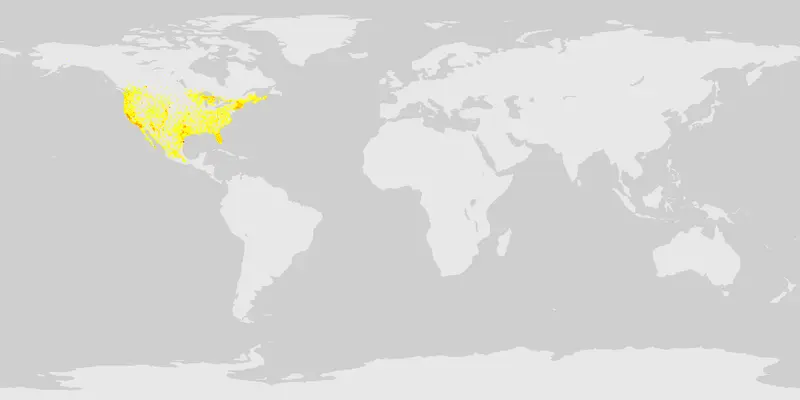
Bobcats roam a huge slice of the continent, from southern Canada all the way to southern Mexico. They are flexible about where they live, settling in woodland, mountain slopes, brushy country, chaparral, grassland and semi-desert alike. What they need most is a safe place to rest, and they sleep tucked away in hollow trees, dense thickets or cracks among rocks. In the United States they are far more numerous in the Southeast than in the western states. In that southeastern region they are also getting more comfortable around towns and suburbs, yet they are so secretive that most residents never notice them. Community wildlife records collected through GBIF come mostly from Texas, followed by California, New Mexico, Arizona and Florida, which reflects both where the cats live and where people go looking. Those records climb in late winter and early spring and are fewest in late summer and early fall. Bobcats are mostly creatures of the night, though they are often up and about at dusk too, so your best chance of a sighting comes at the edges of the day. They spend most of their time on the ground but can climb well when they need to. If you are lucky enough to spot one, look for the black tip on the tail, the black backs of the ears and the ruffs of fur on the cheeks that look a lot like sideburns.
When & where in the US
GBIF holds 100,051 occurrence records of this species from the United States. States with the most records:
- Texas 57,507
- California 14,788
- New Mexico 5,020
- Arizona 2,245
- Florida 1,902
Occurrence records reflect where and when people look and report (observer effort), not just where the animal is common. Busy birding states and summer months are over-represented; zoo and museum records can appear for non-native species.
Source: GBIF occurrence search for country US.[8]
What it eats
A bobcat eats meat and nothing else. It is a stealthy hunter that creeps close to its target, then springs, and when the pounce succeeds it kills with a bite through the bones of the neck. Like other cats it has excellent eyesight and hearing and a keen nose, all of which help it find prey in poor light. Rodents and rabbits make up much of what it catches. It also takes small hoofed mammals, large birds that live on the ground, and now and then a reptile. As a result the bobcat plays an important role as a predator of many kinds of small mammals and birds, helping keep their numbers in check. Occasionally a bobcat helps itself to poultry or small domestic animals, and in some places that habit has led people to try to wipe the cats out entirely. A simpler fix is to keep chickens in a secure coop and small pets indoors at night, when bobcats do most of their hunting. They do not need people to feed them, and leaving food out only encourages them to linger where they may get into trouble.
Reproduction and life cycle
Bobcats keep to themselves for nearly the whole year, and males and females meet only for the short time it takes to court and mate. Each cat claims a home range that may cover from one to several square kilometers, and it marks the borders with urine, droppings and scent from glands under the tail to warn intruders away. A successful male's range overlaps those of several females and sometimes another male, while females hold smaller ranges that do not overlap with one another. Their mating system resembles that of house cats, and both sexes may have more than one partner. These cats are usually quiet, but in the breeding season they yowl and hiss to communicate. Mating generally happens in early spring, though the timing varies. About two months later the female gives birth, usually to around three kittens, though a litter can range from one to six. The kittens first open their eyes at roughly ten days old and nurse into their second month. After weaning, the mother brings meat to them and teaches them how to hunt, and she stays with her family for most of a year. Fathers play no part in raising the young. The kittens head off on their own during winter at about eight months old. Females can breed at around one year, while males usually wait until about two.
Threats and conservation
The IUCN lists the bobcat as least concern, and there are probably close to a million of them living in the United States. Numbers vary a lot from place to place. In some areas they are quite rare, while in others the population is steady and sometimes dense, so certain states allow regulated hunting while others protect the cat completely. Because bobcat fur has long been valuable, the species was once hunted and trapped extensively, and today it is listed under CITES Appendix II, which means international trade in it is controlled. One subspecies, the Mexican bobcat found only in central Mexico, is listed as endangered by the US Fish and Wildlife Service. Young bobcats have natural enemies, including foxes, coyotes and large owls, but grown cats have little to fear apart from people. In the wild a bobcat may live to about twelve years, and in captivity some have lived far longer. For people, a bobcat is very rarely a danger, and attacks on humans happen only on rare occasions. If you meet one, give it room and let it slip away on its own. A bobcat acting oddly bold in daylight should be reported to local wildlife officials.
How to tell it apart
- Mountain lion: A mountain lion is far larger, with a plain tawny coat and a very long, rope-like tail. A bobcat is spotted, has ear tufts, and its tail looks chopped off.
- Red fox: A red fox may be the same size, but it has a pointed muzzle, rusty-orange fur, black legs and a long, bushy white-tipped tail. Foxes trot in straight lines while bobcats move with a cat's stalking gait.
- Coyote: A coyote is a dog-like animal with a narrow snout, big pointed ears without tufts and a bushy, drooping tail. Bobcats have a rounded cat face and a short tail.
- Striped skunk: Skunks and bobcats both prowl at dusk in suburbs, but a skunk is short-legged, black and white, and waddles with a big plumed tail held high.
Photo: (c) ayden, some rights reserved (CC BY) — CC BY 4.0, source[9]. See all image credits.
Sources
- GBIF Backbone Taxonomy — Lynx rufus (species 2435246), via GBIF API — retrieved 2026-11-21
- GBIF — synonyms of Lynx rufus — retrieved 2026-11-21
- GBIF — vernacular names of Lynx rufus — retrieved 2026-11-21
- ITIS — full hierarchy for TSN 180582 — retrieved 2026-11-21
- IUCN Red List category via GBIF (Lynx rufus) — retrieved 2026-11-21
- Animal Diversity Web (University of Michigan) — Lynx rufus account — retrieved 2026-11-21
- GBIF occurrence density map tile for Lynx rufus — retrieved 2026-11-21
- GBIF occurrence search — Lynx rufus, country US, month and state facets — retrieved 2026-11-21
- iNaturalist taxon 41976 — Lynx rufus (photo source) — retrieved 2026-11-21

Written under the pen name Maya Reynolds with AI-assisted drafting, then checked against the sources cited on each page. Last reviewed 2026-11-21. Numbers in the fact table come only from the linked sources; all prose is original. See our editorial policy.