American alligator
Alligator mississippiensis (Daudin, 1801) · also called alligator, Common Alligator, Florida Alligator, Gator, Louisiana Alligator, Louisiana alligator.
The American alligator is the largest reptile in the United States, a broad-snouted, armored crocodilian of southeastern fresh waters that came back from the edge of extinction after legal protection and was taken off the endangered list.

Quick facts
| Kingdom | Animalia[4] |
|---|---|
| Phylum | Chordata[4] |
| Class | Reptilia[4] (GBIF backbone ranks Crocodylia as a class; conventionally it is an order or subclass within Reptilia[1]) |
| Order | Crocodilia[4] |
| Family | Alligatoridae[4] |
| Genus | Alligator[4] |
| Species | Alligator mississippiensis[1] |
| Authority | (Daudin, 1801)[1] |
| ITIS TSN | 551771[4] |
| Synonyms | Alligator lucius (Cuvier, 1807); Crocodilus cuvieri Leach, 1815; Crocodilus lucius Cuvier, 1807; Crocodilus mississipiensis Daudin, 1801; Crocodylus mississippiensis Daudin, 1802; Alligator mississipiensis; Crocodilus mississipiensis[2] |
| Other common names | alligator, Common Alligator, Florida Alligator, Gator, Louisiana Alligator, Louisiana alligator.[3] |
| Length | 257–437 cm (8.43–14.3 ft)[6] |
| Weight | 91–360 kg (201–794 lb)[6] |
| Lifespan (max. recorded / range) | 56 years[6] |
| Young per litter or brood | 2 to 58[6] |
| Diet type | carnivore[6] |
| Habitat | Freshwater marshes, swamps, rivers, lakes, ponds and man-made ponds or canals |
| IUCN Red List | Least Concern (LC)[5] IUCN page Population trend: not available through GBIF; see the IUCN assessment. |
Where it lives
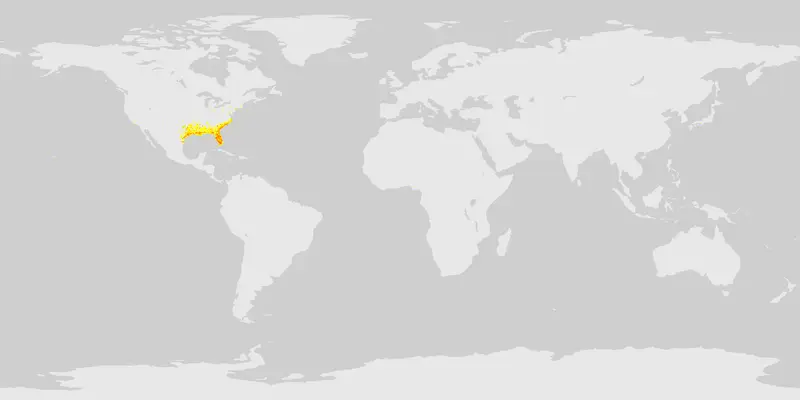
No crocodilian anywhere lives farther north than this one. Alligators range from the tidal waters of North Carolina south through every county in Florida and west as far as central Texas, and they also occur in South Carolina, Georgia, Alabama, Mississippi, Louisiana, Arkansas and Oklahoma. In Everglades National Park they reach the southern edge of their range. Now and then former pets are let loose in states such as California, New Jersey or Virginia, but those animals do not last long. Alligators handle salt poorly, so they stick mainly to fresh water: marshes, swamps, rivers, lakes and ponds. They can put up with brackish water for short spells, and they sometimes show up around mangroves. They also move into places people build, from fishponds and dammed lakes to the occasional backyard swimming pool. Big males spend most of their time in open water, while smaller animals keep to plant-choked wetlands where hiding is easier. As cold-blooded animals they warm themselves in the sun, basking early in the morning in summer, for longer stretches in early spring and through much of the day in winter. They are busiest in spring. When it turns very cold or very dry they retreat into dens dug into the bank, and they can survive brief freezes. To watch them safely, visit a public park or refuge with established trails and keep a respectful distance.
When & where in the US
GBIF holds 86,230 occurrence records of this species from the United States. States with the most records:
- Florida 50,303
- Texas 15,478
- Louisiana 6,128
- South Carolina 5,904
- Georgia 3,371
Occurrence records reflect where and when people look and report (observer effort), not just where the animal is common. Busy birding states and summer months are over-represented; zoo and museum records can appear for non-native species.
Source: GBIF occurrence search for country US.[8]
What it eats
An alligator is a generalist meat eater, and what it eats depends mostly on its size. Youngsters take insects and other small invertebrates, plus small fish and frogs. Adults move on to fish, turtles, snakes, birds and small mammals, and they will even eat smaller alligators. A diet study in Texas found invertebrates, amphibians and reptiles making up large shares of the menu, with mammals, birds and fish adding smaller amounts. The list of prey in that work runs from largemouth bass, spotted gar and freshwater mussels to green tree frogs, mud turtles, water moccasins, moorhens and feral hogs. When usual prey is scarce an alligator will scavenge dead animals. It also swallows stones and odd objects, even bottle caps, which help crush meat, bone and shell during digestion. Sensitive spots on its jaws and scales let it feel ripples in the water and tell what it is holding in its mouth, and its eyes stay above the surface as it swims. Water temperature controls its appetite, and feeding stops when the water cools below roughly seventy degrees Fahrenheit. Never feed an alligator. Feeding or provoking one is illegal, and the National Park Service says most attacks on people trace back to illegal feeding, which makes the animals bolder and less likely to flee.
Reproduction and life cycle
Courtship begins in spring and runs into early summer. Both sexes leave scent trails from glands to help mates find one another, and the rituals can go on for hours. Males bellow, a deep sound made by gulping air since they have no vocal cords, and they slap their heads on the water to send signals a long way. Rival males face off with jaws wide open, lunging upward and hissing. In early summer the female piles up mud, leaves and plant debris into a mound a short distance from the water, shaping it with her tail rather than her mouth and choosing a spot high enough to escape flooding. A finished nest stands about three and a half feet tall and twice as wide. She lays a clutch of goose-sized eggs, often around forty, then covers them. Nest temperature decides the sex of each baby, with warmer eggs becoming males and cooler ones becoming females. For about two months she stays close without sitting on the mound, keeping it damp and chasing off raccoons, the main egg thieves. When the young call from inside their eggs, she opens the nest and carries the hatchlings to the water a few at a time in a pouch formed by her lowered tongue. The babies are black with bright yellow cross bands that help hide them. They gather in groups called pods and usually stay near their mother for about a year, sometimes two or three. Even so, herons, big fish, raccoons and larger alligators eat many, and by one estimate only about four out of every thirty-five hatchlings reach adulthood.
Threats and conservation
Hunting and the loss of wetlands drove alligator numbers down, and the species was listed as endangered in the late nineteen sixties under a law that came before the Endangered Species Act. Numbers started to rebound once hunting was banned and alligator farms took pressure off wild animals. Poaching still went on into the seventies because the belly skin makes valuable leather, and the National Park Service notes that stricter rules on moving hides may have prevented extinction. The species was removed from the endangered list in the late nineteen eighties and today is rated least concern by the IUCN. Trade is still watched under CITES Appendix II, which requires permits for import and export. People still kill many alligators without meaning to, by hitting them with cars and boats or catching them in nets and fishing lines, and hunters take them legally for meat, hides and teeth. In the Everglades the alligator is called a keystone species, because the holes it digs hold water through the dry season and shelter fish, birds and other animals. Serious conflicts with people are rare, but they do happen, most often in Florida, usually involving large alligators and people who are swimming or building homes in alligator habitat. Treat any fresh water in alligator country with care, keep children and pets away from the edge, and report an alligator that approaches people to your state wildlife agency.
How to tell it apart
- Eastern box turtle: A turtle has a hard shell enclosing its body and a toothless beak. An alligator has a long, flexible body covered in bony scales, a long muscular tail and a toothy, wide snout.
- American bullfrog: At night, both show eyes above the water, but a bullfrog's eyes are set in a smooth green head and close together. An alligator's eyes sit on the sides of a long, broad, rounded snout that stretches well out in front of them.
- Common garter snake: A snake swimming at the surface lacks legs entirely and moves in waves. Young alligators also carry yellow bands, but they have four legs, a broad snout and a ridged tail.
- American beaver: A swimming beaver shows a rounded brown head and a flat tail that slaps the water. An alligator's snout is long, broad and rounded, its back is studded with bony plates, and its tail makes up about half its length.
Photo: no rights reserved, uploaded by Vijay Barve — CC0 1.0, source[9]. See all image credits.
Sources
- GBIF Backbone Taxonomy — Alligator mississippiensis (species 2441370), via GBIF API — retrieved 2026-11-21
- GBIF — synonyms of Alligator mississippiensis — retrieved 2026-11-21
- GBIF — vernacular names of Alligator mississippiensis — retrieved 2026-11-21
- ITIS — full hierarchy for TSN 551771 — retrieved 2026-11-21
- IUCN Red List category via GBIF (Alligator mississippiensis) — retrieved 2026-11-21
- Animal Diversity Web (University of Michigan) — Alligator mississippiensis account — retrieved 2026-11-21
- GBIF occurrence density map tile for Alligator mississippiensis — retrieved 2026-11-21
- GBIF occurrence search — Alligator mississippiensis, country US, month and state facets — retrieved 2026-11-21
- iNaturalist taxon 26159 — Alligator mississippiensis (photo source) — retrieved 2026-11-21
- National Park Service — Yellowstone: American alligator — retrieved 2026-11-21

Written under the pen name Maya Reynolds with AI-assisted drafting, then checked against the sources cited on each page. Last reviewed 2026-11-21. Numbers in the fact table come only from the linked sources; all prose is original. See our editorial policy.