American beaver
Castor canadensis Kuhl, 1820 · also called beaver, Admiralty Beaver, Bank Beaver, Canada Beaver, Canadian Beaver, Carolina Beaver
The American beaver is the largest rodent in North America, a dam builder with a broad, flat, scaly tail and bright orange front teeth whose ponds create wetland habitat for many other living things.

Quick facts
| Kingdom | Animalia[4] |
|---|---|
| Phylum | Chordata[4] |
| Class | Mammalia[4] |
| Order | Rodentia[4] |
| Family | Castoridae[4] |
| Genus | Castor[4] |
| Species | Castor canadensis[1] |
| Authority | Kuhl, 1820[1] |
| ITIS TSN | 180212[4] |
| Synonyms | Castor caecator Bangs, 1913; Castor caecator[2] |
| Other common names | beaver, Admiralty Beaver, Bank Beaver, Canada Beaver, Canadian Beaver, Carolina Beaver[3] |
| Length | 900–1170 mm (2.95–3.84 ft)[6] |
| Weight | 13–32 kg (28.7–70.5 lb)[6] |
| Lifespan (max. recorded / range) | 10–20 years[6] |
| Young per litter or brood | 1 to 4[6] |
| Gestation (average) | 3 months[6] |
| Diet type | herbivore[6] |
| Habitat | Streams, rivers, ponds and lakes with nearby trees · ADW biomes: forest[6] |
| IUCN Red List | Least Concern (LC)[5] IUCN page Population trend: not available through GBIF; see the IUCN assessment. |
Where it lives
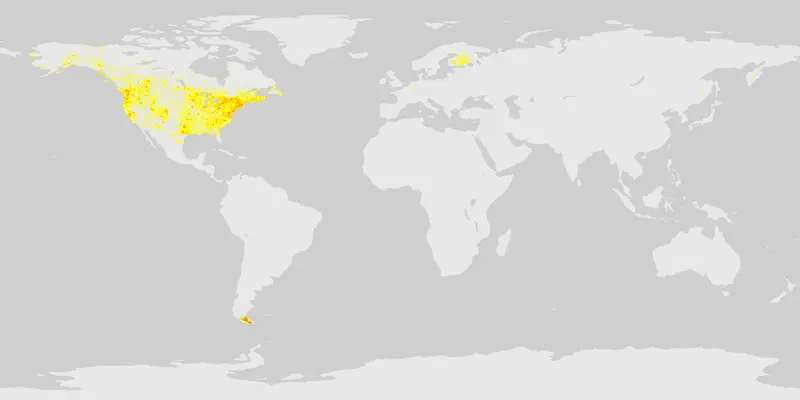
Beavers live throughout nearly all of North America, missing only from the far north of Canada and from the deserts of the southern United States and Mexico. Heavy hunting and trapping for fur, along with pollution and habitat loss, pushed them to the edge: by about the turn of the twentieth century they had nearly vanished from many places where they once lived. Over the last century they have been reintroduced to many of their old haunts with great success. In Yellowstone National Park, the beavers largely escaped the trapping of the eighteen hundreds because the area was so hard to reach, and the number of colonies there has grown in recent decades along with the return of willow. When and where to look: beavers are active mostly at night and in the early morning and evening, so dawn and dusk near water are your best chance. Find an area with fresh signs, such as felled trees, dams and lodges, and wait quietly. You may see one swimming or climbing onto the bank to chew on trees and willows. A loud slap of the tail on the water means you have been noticed. A beaver hunched over its food on the bank can even look like a round rock. Beavers do not seem to shy away from busy places, and some lodges in Yellowstone sit close to popular trails and campsites.
When & where in the US
GBIF holds 50,599 occurrence records of this species from the United States. States with the most records:
- Oregon 3,756
- Texas 3,149
- Washington 2,710
- Massachusetts 2,585
- California 2,450
Occurrence records reflect where and when people look and report (observer effort), not just where the animal is common. Busy birding states and summer months are over-represented; zoo and museum records can appear for non-native species.
Source: GBIF occurrence search for country US.[8]
NPS, number in Yellowstone: colonies estimated in 2024 Where to See Willow Park (between Mammoth and Norris) and the[10]
What it eats
Beavers are plant eaters. Their staple is bark and cambium, the soft growing layer just under the bark. Willow, maple, poplar, beech, birch, alder and aspen are favorites, and in Yellowstone willow and aspen are the preferred winter foods, with cottonwood also used. Where those trees are scarce, beavers will cut conifers and eat underwater plants such as pond lilies. They also eat water plants in general, along with buds and roots. A beaver's skull and teeth are unusually large for its body, which helps it chew through hardwoods such as maple and oak. The upper incisors are bright orange and keep growing throughout life. Most mammals cannot break down cellulose, but beavers carry microbes in a pouch of the gut called the cecum that do the job for them. Beavers will travel a good distance from home to find food, and when they find a rich patch they may dig canals so they can float branches back to the lodge. Logs and twigs are stored underwater as a cache for winter. Their bodies are built for this watery life, with nostrils and ears that close and clear membranes that protect the eyes underwater.
Reproduction and life cycle
Beavers are monogamous, and if one partner dies, the survivor will look for a new mate. In cold climates they mate between January and March; in the South it can be as early as late November or December. After a pregnancy of about three months, the female has one litter a year, usually in spring or early summer. She prepares a soft bed inside the lodge, uses her flat tail as a kind of birthing mat, then licks each kit clean and nurses it. Newborn kits are fully furred, open-eyed, and able to swim within a day. After several days they can follow their parents out of the lodge, and after about a month they spend longer periods outside, swimming and starting on solid food. Both parents bring food and guard the young. A colony is a family group of up to around eight related beavers, and in Yellowstone a colony of about six is typical. The older youngsters stay for up to two years and help raise their younger siblings, gather food and work on the dam. Around their second year, just before a new litter arrives, they are driven out and set off to start a colony of their own, often a few miles away. The lodge is a dome of sticks, grass and moss woven together and plastered with mud, with a central room whose floor sits just above the water and entrances that lead down into the pond. Beavers build dams to hold water deep around the lodge, and in fast water they give the dam a curve so the current does not wash it away.
Threats and conservation
The American beaver is listed as Least Concern today, a striking recovery after being trapped close to disappearing in many places. Humans have been by far the most dangerous predator, through killing beavers for their pelts, changing their habitat and polluting the water, which can infect wounds. An adult's size protects it from most wild predators, but humans, wolves and coyotes are the main killers. Kits are much more vulnerable and fall prey to bears, wolves, wolverines, lynx, fishers and river otters. Parasites and disease also take a toll. Beavers can cause trouble for people: their dams can flood low-lying ground and sometimes destroy a lot of timber, and slowing a fast stream changes which plants and animals live there. Yet beavers are a keystone species with huge benefits. Their wetlands slow floodwaters, prevent erosion and raise the water table, and silt that settles behind dams helps clean the water. Ponds fill with water plants and become homes for many aquatic animals, and when an old dam finally decays, a meadow often takes its place.
How to tell it apart
- Groundhog: Another large brown rodent seen near streams, but the groundhog has a short furry tail and lives in burrows in fields. A beaver's broad, flat, scaly tail and big orange front teeth are unmistakable.
- Raccoon: Also hunts along water at dusk, yet the raccoon has a black mask, a ringed bushy tail and handlike front paws, and it climbs trees instead of cutting them.
- Sea otter: Both are thick-furred and swim with heads up, but sea otters live in Pacific coastal waters, float on their backs and have long, tapered furry tails rather than flat scaly ones.
- Virginia opossum: Has a naked tail too, but the opossum's tail is long and ratlike, its face is white and pointed, and it lives on land rather than in ponds.
- Moose: Both may be seen around northern ponds and willow, but a moose is enormous, long-legged, and wades. A beaver is low-slung, with hind legs longer than its front legs, and swims with only its head showing.
Photo: (c) Rodney Campbell, some rights reserved (CC BY) — CC BY 4.0, source[9]. See all image credits.
Sources
- GBIF Backbone Taxonomy — Castor canadensis (species 2439838), via GBIF API — retrieved 2026-11-21
- GBIF — synonyms of Castor canadensis — retrieved 2026-11-21
- GBIF — vernacular names of Castor canadensis — retrieved 2026-11-21
- ITIS — full hierarchy for TSN 180212 — retrieved 2026-11-21
- IUCN Red List category via GBIF (Castor canadensis) — retrieved 2026-11-21
- Animal Diversity Web (University of Michigan) — Castor canadensis account — retrieved 2026-11-21
- GBIF occurrence density map tile for Castor canadensis — retrieved 2026-11-21
- GBIF occurrence search — Castor canadensis, country US, month and state facets — retrieved 2026-11-21
- iNaturalist taxon 43794 — Castor canadensis (photo source) — retrieved 2026-11-21
- National Park Service — Yellowstone: American beaver — retrieved 2026-11-21

Written under the pen name Maya Reynolds with AI-assisted drafting, then checked against the sources cited on each page. Last reviewed 2026-11-21. Numbers in the fact table come only from the linked sources; all prose is original. See our editorial policy.