Sea otter
Enhydra lutris (Linnaeus, 1758)
The sea otter is a fur-covered, tool-using member of the weasel family that lives along the coasts of the North Pacific, spending nearly its whole life in cold ocean water and relying on the densest fur of any mammal to stay warm.

Quick facts
| Kingdom | Animalia[4] |
|---|---|
| Phylum | Chordata[4] |
| Class | Mammalia[4] |
| Order | Carnivora[4] |
| Family | Mustelidae[4] |
| Genus | Enhydra[4] |
| Species | Enhydra lutris[1] |
| Authority | (Linnaeus, 1758)[1] |
| ITIS TSN | 180547[4] |
| Synonyms | Latax lutris (Linnaeus, 1758); Mustela lutris Linnaeus, 1758; Mustela lutris[2] |
| Other common names | —[3] |
| Length | 1–1.5 m (3.28–4.92 ft)[6] |
| Weight | 14–45 kg (30.9–99.2 lb)[6] |
| Lifespan (max. recorded / range) | 23 years[6] |
| Young per litter or brood | 1 to 2[6] |
| Gestation | 4 to 12 months[6] |
| Diet type | carnivore[6] |
| Habitat | Temperate coastal waters with rocky or soft bottoms, especially kelp forests, usually less than about a hundred feet deep |
| IUCN Red List | Endangered (EN)[5] IUCN page Population trend: not available through GBIF; see the IUCN assessment. |
Where it lives
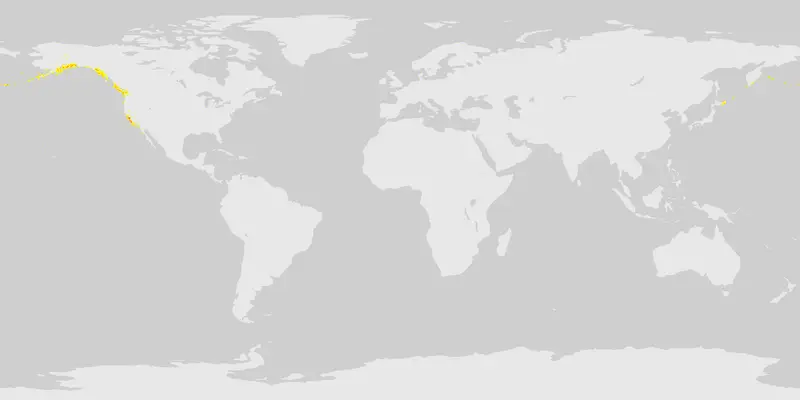
Sea otters live along two separate stretches of the North Pacific coast. One runs from the Kuril and Commander Islands off Russia through the Aleutian Islands and along the Alaska coast to Vancouver Island in Canada. The other is a short strip of central California, from Año Nuevo south to Point Sur. Sea ice limits how far north they can go, and the extent of kelp forests sets the southern limit. Hunting in the eighteenth and nineteenth centuries erased the otters from much of their former range. Today scientists recognize three subspecies: one in the western Pacific around Russia, one along central California, and one in the Aleutians and southern Alaska that has been reintroduced at sites from south of Prince William Sound down to Oregon. In US records gathered by GBIF, California leads by far, followed by Alaska and Washington. Otters feed mostly beneath the kelp canopy and come up to eat, rest and groom at the surface. They prefer water less than about a hundred feet deep, though they can dive deeper than a hundred and forty feet. Look for small brown heads and paws among the kelp, or for a raft of otters resting together, often wrapped in kelp fronds so they do not drift. Binoculars from a seawall or overlook give a far better view than approaching by kayak, which can disturb them.
When & where in the US
GBIF holds 25,753 occurrence records of this species from the United States. States with the most records:
- California 14,096
- Alaska 7,141
- Washington 435
- Oregon 15
- Hawaii 3
Occurrence records reflect where and when people look and report (observer effort), not just where the animal is common. Busy birding states and summer months are over-represented; zoo and museum records can appear for non-native species.
Source: GBIF occurrence search for country US.[8]
What it eats
With no insulating fat, sea otters burn energy fast, and each day they eat about a fifth to a quarter of their own body weight. They will take almost any fish or invertebrate they can find in the kelp. Favorites include sea urchins, sea stars, limpets, mussels, chitons and rock scallops, along with crabs, octopus, squid and fish. Hunting happens on the seafloor, where long, sensitive whiskers help them feel for small animals in crevices and dense kelp. Nimble forepaws grab the prey, and the otter tucks its catch into loose folds of skin under the forearms before swimming up to eat on its back. To get past hard shells, otters use rocks: some rest a rock on the chest and pound the prey against it, others hold the prey on the chest and hit it with the rock, and an otter may keep the same rock for many dives. Individuals tend to specialize, so one may live mostly on urchins and crabs while a neighbor prefers fish. Males will steal a female's catch if they can, so females often forage apart. Otters get most of their water from food but also drink seawater. A meal, including the cleanup grooming afterward, can take a couple of hours, and otters eat three or four times a day. By eating sea urchins, which would otherwise overgraze the kelp, otters let kelp forests thrive and boost the variety of ocean life, which makes the sea otter a classic keystone species.
Reproduction and life cycle
Sea otters can mate in any month, but births cluster in May and June in the Aleutian Islands and in January through March in California. Many males defend territories, usually settling disputes with splashing and calls rather than fights, and they mate with the females living there. A pair stays together for about three days while the female is receptive, and the male grips her nose or head with his teeth, which often leaves scars. Sea otters use delayed implantation, meaning the embryo can pause before it starts growing, so pregnancy lasts anywhere from four months to a year. A female usually has one pup a year or every other year; twins are rare, and only one can be raised. The mother carries the pup on her belly to nurse it, and her milk is very rich in fat. She grooms it constantly for the first few months while its coat develops, and the air trapped in that fluffy fur keeps the pup afloat like a cork. When she dives to forage, she wraps the pup in kelp so it will not drift away, and if a predator appears she grabs it by the neck and dives. Pups begin diving at about two months, start solid food early and are weaned around six months, but stay dependent for six to eight months. Fathers provide no care. Females mature at about four years and males at five or six.
Threats and conservation
Hunting for the fur trade, from the middle of the eighteenth century until early in the twentieth, left only one or two thousand sea otters worldwide. A treaty signed by the United States, Russia, Japan and Great Britain in nineteen eleven banned the hunt, and later the Marine Mammal Protection Act outlawed capturing or harassing sea mammals in US waters. Otters recovered in many areas, but the story is not finished. The IUCN lists the species as Endangered, and in the United States it is federally listed as Threatened. Oil spills are the gravest human-caused danger, because oiled fur loses its insulation; the Exxon Valdez spill in Alaska killed about five thousand otters. Great white sharks are a major predator, bald eagles snatch unattended pups, and coyotes catch otters that come ashore in storms. Orcas were once blamed for declines in Alaska, but the evidence is unclear. Disease also takes a toll. Parasites carried by cats and opossums can wash from storm drains and toilets into the sea and cause brain infections, so California requires cat litter to carry a warning against dumping it down drains or toilets. Visitors can help by staying far enough away that otters do not change their behavior, keeping kayaks and paddleboards back from resting rafts, bagging pet waste instead of flushing cat litter, and never feeding or touching an otter.
How to tell it apart
- American beaver: A beaver lives in fresh water, swims belly down and has a flat, paddle-shaped tail. A sea otter lives in the ocean, floats on its back, and has a short, thick furry tail.
- Common bottlenose dolphin: A dolphin is smooth, gray and streamlined, with a dorsal fin and blowhole. A sea otter has dense brown fur, long whiskers, small front paws and a round, furry face.
- Raccoon: Both use nimble front paws to handle food, but a raccoon is a land animal with a black mask and ringed tail that only dabbles at the water's edge.
- Polar bear: A polar bear is a huge white predator of Arctic sea ice. A sea otter is small by comparison, brown or reddish brown, and rests floating on its back among the kelp.
Photo: (c) Marshal Hedin, some rights reserved (CC BY-SA) — CC BY-SA 4.0, source[9]. See all image credits.
Sources
- GBIF Backbone Taxonomy — Enhydra lutris (species 2433670), via GBIF API — retrieved 2026-11-21
- GBIF — synonyms of Enhydra lutris — retrieved 2026-11-21
- GBIF — vernacular names of Enhydra lutris — retrieved 2026-11-21
- ITIS — full hierarchy for TSN 180547 — retrieved 2026-11-21
- IUCN Red List category via GBIF (Enhydra lutris) — retrieved 2026-11-21
- Animal Diversity Web (University of Michigan) — Enhydra lutris account — retrieved 2026-11-21
- GBIF occurrence density map tile for Enhydra lutris — retrieved 2026-11-21
- GBIF occurrence search — Enhydra lutris, country US, month and state facets — retrieved 2026-11-21
- iNaturalist taxon 41860 — Enhydra lutris (photo source) — retrieved 2026-11-21
- National Park Service — Yellowstone: Sea otter — retrieved 2026-11-21

Written under the pen name Maya Reynolds with AI-assisted drafting, then checked against the sources cited on each page. Last reviewed 2026-11-21. Numbers in the fact table come only from the linked sources; all prose is original. See our editorial policy.