Common bottlenose dolphin
Tursiops truncatus (Montagu, 1821) · also called bottlenose dolphin, Black Porpoise, Black Sea Bottlenose Dolphin, Bottle-nosed Dolphin, Bottle-nosed Dophin, Common Bottle-nosed Dolphin, Bottlenose Dolphin, Tuyiin
The common bottlenose dolphin is a large, gray, highly social dolphin of tropical and warm temperate seas worldwide, known for its tall curved dorsal fin, streamlined body and remarkable intelligence.

Quick facts
| Kingdom | Animalia[4] |
|---|---|
| Phylum | Chordata[4] |
| Class | Mammalia[4] |
| Order | Cetacea[4] |
| Family | Delphinidae[4] |
| Genus | Tursiops[4] |
| Species | Tursiops truncatus[1] |
| Authority | (Montagu, 1821)[1] |
| ITIS TSN | 180426[4] |
| Synonyms | Delphinus compressicauda Lesson, 1828; Delphinus cymodoce Burmeister, 1867; Delphinus erebennus Cope, 1865; Delphinus metis Gray, 1846; Delphinus nesarnack Lacépède, 1804; Delphinus nesarnak Reichenback, 1846; Delphinus parvimanus Lutken, 1887; Delphinus troncatus F.Cuvier, 1836[2] |
| Other common names | bottlenose dolphin, Black Porpoise, Black Sea Bottlenose Dolphin, Bottle-nosed Dolphin, Bottle-nosed Dophin, Common Bottle-nosed Dolphin, Bottlenose Dolphin, Tuyiin[3] |
| Length | 228–381 cm (7.48–12.5 ft)[6] |
| Weight | 260–500 kg (573–1102 lb)[6] |
| Lifespan (max. recorded / range) | 53 years[6] |
| Young per litter or brood (average) | 1[6] |
| Gestation (average) | 12 months[6] |
| Diet type | carnivore[6] |
| Habitat | Bays, estuaries, sounds, open shorelines, large estuarine rivers and deep offshore waters |
| IUCN Red List | Least Concern (LC)[5] IUCN page Population trend: not available through GBIF; see the IUCN assessment. |
Where it lives
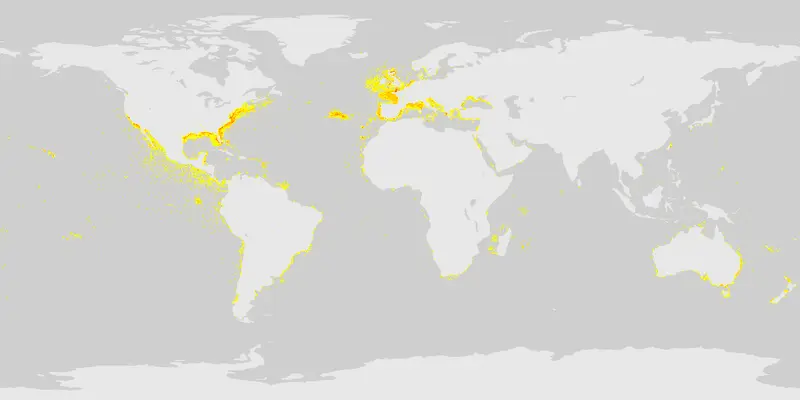
Bottlenose dolphins live in every ocean except the polar seas, usually in tropical, subtropical and warm temperate water where the surface sits between about fifty and ninety degrees Fahrenheit. They are the dolphin Americans are most likely to see, and GBIF records in the United States are led by Florida, Texas, California, North Carolina and Virginia. Some populations, including ones along the Atlantic coast, shift with the seasons, while others stay put. Scientists separate inshore dolphins, which hunt near the coast in bays, sounds, estuaries and big tidal rivers, from deep-water dolphins farther offshore. The two differ in habits: offshore animals come up for air only every minute or two, while inshore dolphins breathe about twice a minute. A group typically uses a home range of around fifty square miles, and group size runs from a handful to more than a hundred animals. Look for a tall, curved dorsal fin set near the middle of the back and a body that is dark to light gray on the sides with a white or faintly pink belly. For a good chance of a sighting, scan calm water from a pier, beach or jetty in the Gulf states or the Carolinas, or join a reputable tour that follows marine mammal viewing guidelines.
When & where in the US
GBIF holds 73,797 occurrence records of this species from the United States. States with the most records:
- Florida 5,470
- Texas 3,799
- California 3,481
- North Carolina 2,761
- Virginia 1,520
Occurrence records reflect where and when people look and report (observer effort), not just where the animal is common. Busy birding states and summer months are over-represented; zoo and museum records can appear for non-native species.
Source: GBIF occurrence search for country US.[8]
What it eats
Dolphins are flexible predators, and their menu changes from place to place. Inshore animals eat fish and invertebrates found close to shore, while offshore dolphins favor squid and open-water fish. Along the US Atlantic coast, common prey includes Atlantic croaker, spot and silver perch. Most prey is a couple of inches to about a foot long, and a dolphin may eat roughly ten to thirty-five pounds of food a day, depending on its size and whether it is nursing. Dolphins find food with echolocation, sending out clicks and listening for echoes that reveal the seafloor, prey and predators. A fatty organ in the forehead called the melon focuses the outgoing sound, and they can even use bursts of sound to stun prey. Some simply listen quietly for prey noises instead. They usually feed alone but sometimes team up to herd a school of fish. Some drive fish onto the shore and briefly strand themselves to grab them, and some shake prey or smack it with their tails to break it up. Their sharp teeth grip, but they swallow prey whole without chewing. In Australia, some dolphins carry a sea sponge on the beak to shield it while they forage along the bottom. Dolphins also follow fishing boats to snatch discarded catch or bait, a habit that can bring them close to hooks and lines.
Reproduction and life cycle
Bottlenose dolphins live in fluid societies in which smaller groups often join and leave the main group. Common groupings include nursery groups of mothers and calves, juvenile groups of young dolphins into their mid-teens, and adult males, which travel alone or, more often, as tightly bonded pairs. Some males work in alliances to separate a receptive female from her home area and keep rival males away, while others stay on their own range and court females that pass through, arching their backs, stroking and nuzzling. Females mature at five to ten years and males at eight to thirteen, though many males do not breed until around twenty. After a pregnancy of about a year, a female has a single calf. Births happen in any month but peak in warmer weather. In its first days the calf learns to ride the pressure wave beside its mother, who keeps it close. Calves nurse for about a year and a half, and females usually conceive again soon after weaning, so a mother has a calf every three to six years. Females in a group help care for one another's young and guard calves from predators. Each dolphin develops a signature whistle within its first month or so and keeps it for life, much like a name. Because each female raises relatively few calves over a long life, protecting adult females is especially important for keeping local populations stable.
Threats and conservation
Worldwide the species is listed as Least Concern, but many local populations face serious pressures. Living in shallow coastal water brings dolphins into constant contact with people. Recreational fishing gear is a major killer, as dolphins get tangled in nets or swallow hooks. One of the gravest threats is pollution from shoreline development, as runoff from farms, homes and industry carries chemicals into coastal waters. Pollutants such as PCBs and the pesticide DDT build up in dolphin tissues, and a mother can pass most of her load to her calf through her milk, weakening its immune system or even killing it. Natural dangers include injury, disease and stingrays, along with large sharks such as bull, tiger and dusky sharks, which mostly target calves, smaller animals and females. Many dolphins carry healed shark-bite scars. In the United States, all dolphins are protected under the Marine Mammal Protection Act, and removing one from the wild without authorization can bring heavy fines or jail. Watch from a respectful distance, slow down and do not chase or encircle dolphins in a boat, never try to swim with or touch wild dolphins, and report stranded or injured animals to a local marine mammal stranding network. Dolphins look after their own kind, too: they have been seen holding injured companions at the surface so they can breathe.
How to tell it apart
- Orca: An orca is a far larger dolphin with bold black and white markings and a white eye patch. Bottlenose dolphins are gray with a pale belly and a curved dorsal fin set mid-back.
- Great white shark: A shark's tail fin stands upright. A dolphin is a mammal with flat tail flukes and a nostril on top of its head, so it must surface to breathe and rolls through the water in arcs.
- Blue whale: A blue whale is enormous and mottled blue-gray, with a tiny dorsal fin set far back. A bottlenose dolphin is far smaller, with a tall, curved fin near the middle of its back.
- Sea otter: A sea otter floats on its back in kelp beds along the Pacific coast and has thick brown fur and paws. A dolphin has no hair at all, only smooth gray skin, and swims with flippers and flukes.
Photo: (c) Benoit NABHOLZ, some rights reserved (CC BY-SA), uploaded by Benoit NABHOLZ — CC BY-SA 4.0, source[9]. See all image credits.
Sources
- GBIF Backbone Taxonomy — Tursiops truncatus (species 2440447), via GBIF API — retrieved 2026-11-21
- GBIF — synonyms of Tursiops truncatus — retrieved 2026-11-21
- GBIF — vernacular names of Tursiops truncatus — retrieved 2026-11-21
- ITIS — full hierarchy for TSN 180426 — retrieved 2026-11-21
- IUCN Red List category via GBIF (Tursiops truncatus) — retrieved 2026-11-21
- Animal Diversity Web (University of Michigan) — Tursiops truncatus account — retrieved 2026-11-21
- GBIF occurrence density map tile for Tursiops truncatus — retrieved 2026-11-21
- GBIF occurrence search — Tursiops truncatus, country US, month and state facets — retrieved 2026-11-21
- iNaturalist taxon 41482 — Tursiops truncatus (photo source) — retrieved 2026-11-21

Written under the pen name Maya Reynolds with AI-assisted drafting, then checked against the sources cited on each page. Last reviewed 2026-11-21. Numbers in the fact table come only from the linked sources; all prose is original. See our editorial policy.