Groundhog
Marmota monax (Linnaeus, 1758) · also called woodchuck, Canada Marmot, Ground-hog, Marmota de Canada, Marmotte commune, Thickwood Badger
The groundhog, also called the woodchuck, is a stocky marmot, the most widespread in North America, that digs roomy burrows and, across most of its range, spends the winter in true hibernation.

Quick facts
| Kingdom | Animalia[4] |
|---|---|
| Phylum | Chordata[4] |
| Class | Mammalia[4] |
| Order | Rodentia[4] |
| Family | Sciuridae[4] |
| Genus | Marmota[4] |
| Species | Marmota monax[1] |
| Authority | (Linnaeus, 1758)[1] |
| ITIS TSN | 180137[4] |
| Synonyms | Arctomys ignavus Bangs, 1899; Arctomys melanopus Kuhl, 1820; Arctomys monax (Linnaeus, 1758); Arctomys sibila Wolf, 1808; Glis canadensis Erxleben, 1777; Hyrax hudsonius (Schreber, 1792); Lipura hudsonia (Schreber, 1792); Marmota ochracea Swarth, 1911[2] |
| Other common names | woodchuck, Canada Marmot, Ground-hog, Marmota de Canada, Marmotte commune, Thickwood Badger[3] |
| Length | 415–675 mm (16.3–26.6 in)[6] |
| Weight | 2–6 kg (4.41–13.2 lb)[6] |
| Lifespan (max. recorded / range) | 2–6 years[6] |
| Young per litter or brood | 1 to 9[6] |
| Gestation | 31 to 32 days[6] |
| Diet type | herbivore[6] |
| Habitat | Low-lying woodlots, fields, pastures, hedgerows, farmland and suburban yards · ADW biomes: savanna or grassland savanna or grassland forest forest[6] |
| IUCN Red List | Least Concern (LC)[5] IUCN page Population trend: not available through GBIF; see the IUCN assessment. |
Where it lives
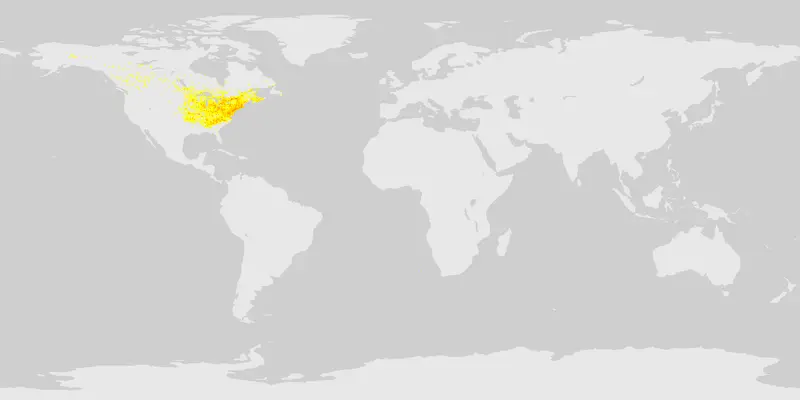
Groundhogs are at home wherever open grass meets some kind of cover. No other marmot on the continent covers so much territory. At the southern end the range runs from eastern Oklahoma and northern Louisiana across Alabama and Georgia to North Carolina. From there it follows the Atlantic side all the way up to Labrador, then swings northwest across Canada as far as southern Alaska. Within that huge area the animal sticks mostly to lower elevations: small woodlots, forest edges, fields, pastures and hedgerows, plus farm country and suburbs. People have done this rodent a big favor. Cutting forests, laying roads and planting crops all opened up more of the leafy food it likes, and the species has prospered as a result. Many groundhogs keep two homes, a summer den close to good feeding and a winter den tucked near protective cover, and they choose well-drained soil for digging. If you want to see one, scan hayfields and grassy roadsides during the day, especially in the morning or afternoon, and look for a grizzled brown animal standing tall on its hind legs. In the north they vanish underground for the cold months, while in the far south some stay active all year.
When & where in the US
GBIF holds 39,461 occurrence records of this species from the United States. States with the most records:
- New York 5,600
- Pennsylvania 4,335
- Ohio 3,272
- Maryland 2,204
- Virginia 2,163
Occurrence records reflect where and when people look and report (observer effort), not just where the animal is common. Busy birding states and summer months are over-represented; zoo and museum records can appear for non-native species.
Source: GBIF occurrence search for country US.[8]
What it eats
A woodchuck is mostly a plant eater, and leaves make up the bulk of what it chews. Its favorite foods are alfalfa, clover and dandelion, the same plants that fill many pastures and lawns. It also nibbles flowers, seeds, stems and even bark, and once in a while it adds a bit of animal food such as insects, snails or a bird egg. Vegetable gardens, pastures and farm crops can suffer real damage, which is the main reason homeowners and groundhogs clash. In summer a typical woodchuck goes out to eat twice a day, once in the morning and again in the afternoon, and each outing lasts less than a couple of hours. In between, it often lounges in the midday sun near its burrow. While it grazes it lifts its head again and again to scan for danger. All of this eating has a purpose: every groundhog builds up fat reserves through the warm months, because that stored energy has to carry it through a long winter sleep without food. Gardeners who want peace usually rely on a sturdy fence, keeping in mind that these animals can dig and even climb trees.
Reproduction and life cycle
Groundhogs lead solitary lives, and the breeding season is about the only time adults seek each other out. Males wake from hibernation ahead of the females so they can claim territories, sort out who is dominant and go looking for mates. Older, stronger males hold ground, while younger ones roam without a fixed home, and a single male may mate with several females. Mating happens shortly after the animals emerge, anywhere from late winter into spring depending on how far north they live. Pregnancy is brief, only about a month. A litter can be as small as one or as large as nine, though three to five pups is most common. The newborns are small and helpless, and the mother handles every bit of the care on her own. The pups nurse for roughly six weeks, hiding in and around the den when she is away, and by about two months old they are ready to leave. Some daughters end up inheriting their mother's den. A burrow usually has several openings, including an escape hatch, plus a network of tunnels and chambers. When the builder moves on, rabbits, skunks, raccoons, opossums, foxes, weasels, chipmunks, snakes and many other creatures move in, so the woodchuck provides housing for half the neighborhood.
Threats and conservation
Because it is so common and so widespread, the groundhog is rated least concern by the IUCN, and it has no special federal protection. Individual animals still face plenty of danger. Gray wolves, coyotes, red and gray foxes, black bears, lynx, bobcats, hawks, snakes and pet dogs all hunt them. A groundhog defends itself with its teeth, and when alarmed it gives a piercing whistle that also warns others nearby, especially youngsters. Fittingly, one of its many nicknames is the whistle pig. In the wild a woodchuck may reach four to six years, yet predators and disease mean many do not survive past age three. People hunt them as game, and farmers often see them as pests, since burrows can hurt livestock, damage machinery and weaken building foundations. Like other mammals they can carry rabies, along with ticks, fleas and other parasites, so a groundhog that acts oddly bold or unsteady should be avoided and reported to local animal control. The name woodchuck likely comes from a Native American word often translated as the digger. The Groundhog Day legend may trace back to the way these animals sometimes come out too early and then return to hibernation.
How to tell it apart
- Eastern gray squirrel: A gray squirrel is far lighter and slimmer, with a long, bushy tail it flicks constantly. It spends much of its life up in trees, while a groundhog is a heavy, stocky animal that mostly stays on the ground near its den.
- American beaver: Both are big brown rodents, but a beaver lives in water, has a flat, scaly paddle tail and webbed hind feet, and is much larger. A groundhog has a short, furry tail and stays on dry land.
- Eastern chipmunk: A chipmunk also lives in burrows, but it is tiny by comparison and carries bold black and white stripes down its back and face. Groundhogs range from gray to cinnamon to dark brown and have no stripes.
- Raccoon: A raccoon has a black mask and a ringed tail, and it is mostly out at night. A groundhog has a plain face, a short tail and feeds in daylight near its burrow.
- Nine-banded armadillo: An armadillo also digs burrows in yards across the Southeast, but it wears a hard, banded shell and a long tail wrapped in rings of scales, while a groundhog is covered in grizzled fur tipped with white.
Photo: (c) Laura Mae, some rights reserved (CC BY), uploaded by Laura Mae — CC BY 4.0, source[9]. See all image credits.
Sources
- GBIF Backbone Taxonomy — Marmota monax (species 2437368), via GBIF API — retrieved 2026-11-21
- GBIF — synonyms of Marmota monax — retrieved 2026-11-21
- GBIF — vernacular names of Marmota monax — retrieved 2026-11-21
- ITIS — full hierarchy for TSN 180137 — retrieved 2026-11-21
- IUCN Red List category via GBIF (Marmota monax) — retrieved 2026-11-21
- Animal Diversity Web (University of Michigan) — Marmota monax account — retrieved 2026-11-21
- GBIF occurrence density map tile for Marmota monax — retrieved 2026-11-21
- GBIF occurrence search — Marmota monax, country US, month and state facets — retrieved 2026-11-21
- iNaturalist taxon 46095 — Marmota monax (photo source) — retrieved 2026-11-21

Written under the pen name Maya Reynolds with AI-assisted drafting, then checked against the sources cited on each page. Last reviewed 2026-11-21. Numbers in the fact table come only from the linked sources; all prose is original. See our editorial policy.