American crow
Corvus brachyrhynchos C.L.Brehm, 1822 · also called American/Northwestern Crow, Common Crow
The American crow is a big, all-black songbird of farmland, woodland edges, suburbs and city parks across southern Canada and the United States, known for loud caws, family groups and resourceful feeding.

Quick facts
| Kingdom | Animalia[4] |
|---|---|
| Phylum | Chordata[4] |
| Class | Aves[4] |
| Order | Passeriformes[4] |
| Family | Corvidae[4] |
| Genus | Corvus[4] |
| Species | Corvus brachyrhynchos[1] |
| Authority | C.L.Brehm, 1822[1] |
| ITIS TSN | 179731[4] |
| Synonyms | None listed[2] |
| Other common names | American/Northwestern Crow, Common Crow[3] |
| Weight | 450 g (15.9 oz)[6] |
| Lifespan (max. recorded / range) | 14 years[6] |
| Eggs per season | 4 to 5[6] |
| Incubation (time to hatching) (average) | 18.0 days[6] |
| Length | Not available from our sources |
| Diet type | omnivore[6] |
| Habitat | Open country with trees, farmland, suburbs, city parks and coasts · ADW biomes: savanna or grassland savanna or grassland forest forest scrub forest scrub forest[6] |
| IUCN Red List | Least Concern (LC)[5] IUCN page Population trend: not available through GBIF; see the IUCN assessment. |
Where it lives
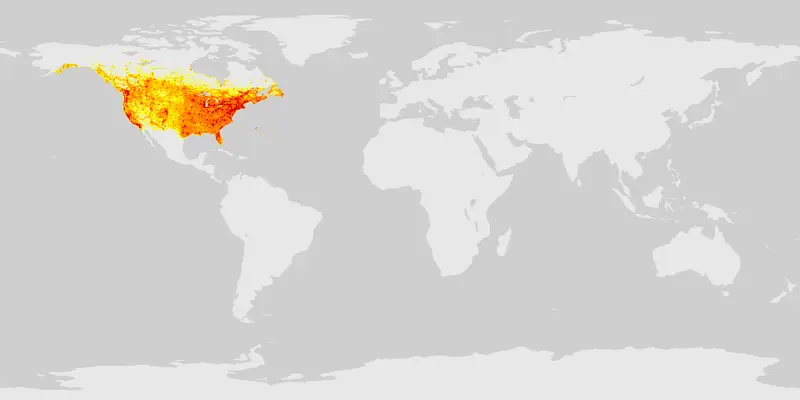
American crows are native to North America, from the southern part of Canada across the continental United States. Their favorite setting is open ground with trees nearby. Farm fields and grassland make good places to search for food, while woodlots and forest edges offer spots to nest and to roost. The birds do very well in suburbs and city parks and along coasts. Some crows migrate. Marked birds from southeastern Michigan have turned up as far south as Tennessee, although most migrants travel shorter distances, and some individuals keep to their home territories all winter. GBIF records from the United States are highest from California, New York, Pennsylvania, Washington and Virginia, with sightings peaking in May. When and where to look: crows are easy to find in any month, but the winter roost is the great spectacle. Starting in autumn and reaching a peak in midwinter, crows gather in the late afternoon in a place with big trees, sometimes in crowds numbering from the tens of thousands into the hundreds of thousands. Often the whole gathering shifts to a final roost as night falls. In summer, watch for clumsy young birds being fed by their families. Youngsters have blue eyes and pink mouth linings, and both darken as they grow up.
When & where in the US
GBIF holds 23,068,185 occurrence records of this species from the United States. States with the most records:
- California 2,407,310
- New York 1,603,136
- Pennsylvania 1,335,797
- Washington 1,138,410
- Virginia 987,244
Occurrence records reflect where and when people look and report (observer effort), not just where the animal is common. Busy birding states and summer months are over-represented; zoo and museum records can appear for non-native species.
Source: GBIF occurrence search for country US.[8]
What it eats
Crows are omnivores that will eat nearly anything. During the nesting season the menu includes insects and their larvae, worms, fruit, grain and nuts. They hunt small animals such as frogs, mice and young rabbits, but they are more likely to scavenge carrion like roadkill. They are also serious nest raiders that eat the eggs and chicks of smaller songbirds. As fall turns to winter, nuts such as acorns and walnuts become more important. Crows make good use of human garbage and only rarely visit backyard feeders. They forage mostly by walking on the ground and picking items up, or by walking along tree branches. Sometimes a few birds feed in a small patch, and at other times groups spread over a wider area. Spare food like meat and nuts goes into short-term caches scattered in many places, such as cracks in trees or spots on the ground hidden under leaves. To open a nut, a crow may pin it under one foot and hammer it with its bill. For something with a very hard shell, like a walnut or a clam, it may carry the item up high and let it fall onto a hard surface. Crows probably help spread seeds when they eat fruit and cache nuts, and by scavenging they speed up the breakdown of carcasses. Studies show that crop losses from crows are smaller than once believed and are offset by the insect pests they eat.
Reproduction and life cycle
American crows are cooperative breeders. Young birds often stay near the place they hatched to help their parents raise later broods and defend the territory, though researchers are not sure why, and pairs with helpers do not seem to fledge more young. Family members preen one another, and the whole family drives predators off its large territory. Breeding may begin as early as February and continue into June. Both members of the pair build the nest, usually well up in a strong evergreen or broadleaf tree. The female lays four or five pale green eggs marked with brown and keeps them warm for about eighteen days. While she sits, she begs for food like a chick and her mate feeds her. The nestlings hatch helpless and are fed by both parents and by older siblings. They leave the nest at roughly five weeks old, but they stay clumsy for several weeks and depend on the family through summer. A pair raises one brood a year and may try again if an early nest fails. Most crows start breeding at two years old. Outside the family, some unmated birds join floater flocks of up to about fifty birds during the breeding season. Crows also practice anting, letting ants swarm through their feathers or rubbing an ant over their plumage.
Threats and conservation
American crows are thriving, especially around suburbs, and their numbers may be rising. The IUCN lists the species as Least Concern. It is protected under the federal migratory bird law, yet crows are also treated as small game, and many states hold hunting seasons, often at times when more prized game birds are out of season. Keeping a young crow as a pet is illegal under that law, even though many people have done it, and pet crows are known to copy human speech. Natural predators include red-tailed hawks, great horned owls, raccoons, snakes and house cats, and people are listed as predators too. Crows respond by mobbing, gathering to scold and chase a threat with harsh calls. Conflicts with people are mostly about crops and mess. Big foraging flocks can hurt orchards and cornfields, and the United States once paid a bounty on crows. Large roosts near busy areas raise worries about noise, droppings and disease, crows scatter garbage, and as nest predators they may reduce game birds such as ducks. Crows are very vocal, and males and females share the same calls. Short, sharp caws seem to be alarms, longer caws help defend territory, and paired double caws may rally the family against intruders. Family members also trade soft coos with bowing, and the birds give several kinds of rattles.
How to tell it apart
- Great horned owl: Crows often mob a roosting owl. The owl has horn-like ear tufts, yellow eyes, a white throat spot and a mottled dark back, while the crow is glossy black from bill to tail.
- Red-tailed hawk: Crows chase hawks too. A red-tailed hawk is auburn to deep brown with a paler belly crossed by a dark band, yellow legs and feet and a brownish red tail. A crow has glossy black feathers all over and a black bill.
- Blue jay: A noisy relative in the same family, but bright blue above and whitish below, with a crest and a black collar. The crow shows no blue and no crest.
- Wild turkey: Dark birds walking across a field can puzzle you at a distance. A turkey is far larger, with long legs, a long neck, a big fan-shaped tail and, in males, a red wattle. A crow is compact and glossy black with a black bill.
Photo: (c) Gordon Leggett, some rights reserved (CC BY-SA) — CC BY-SA 4.0, source[9]. See all image credits.
Sources
- GBIF Backbone Taxonomy — Corvus brachyrhynchos (species 2482507), via GBIF API — retrieved 2026-11-21
- GBIF — synonyms of Corvus brachyrhynchos — retrieved 2026-11-21
- GBIF — vernacular names of Corvus brachyrhynchos — retrieved 2026-11-21
- ITIS — full hierarchy for TSN 179731 — retrieved 2026-11-21
- IUCN Red List category via GBIF (Corvus brachyrhynchos) — retrieved 2026-11-21
- Animal Diversity Web (University of Michigan) — Corvus brachyrhynchos account — retrieved 2026-11-21
- GBIF occurrence density map tile for Corvus brachyrhynchos — retrieved 2026-11-21
- GBIF occurrence search — Corvus brachyrhynchos, country US, month and state facets — retrieved 2026-11-21
- iNaturalist taxon 8021 — Corvus brachyrhynchos (photo source) — retrieved 2026-11-21

Written under the pen name Maya Reynolds with AI-assisted drafting, then checked against the sources cited on each page. Last reviewed 2026-11-21. Numbers in the fact table come only from the linked sources; all prose is original. See our editorial policy.