Wild turkey
Meleagris gallopavo Linnaeus, 1758 · also called American turkey, Common Turkey, Domestic Turkey, Great American Cock, Great American Fowl, Great American Hen
The wild turkey is a large, ground-dwelling bird of North American woods and fields, whose dark, shimmering males fan their tails and gobble each spring to attract hens.

Quick facts
| Kingdom | Animalia[4] |
|---|---|
| Phylum | Chordata[4] |
| Class | Aves[4] |
| Order | Galliformes[4] |
| Family | Phasianidae[4] |
| Genus | Meleagris[4] |
| Species | Meleagris gallopavo[1] |
| Authority | Linnaeus, 1758[1] |
| ITIS TSN | 176136[4] |
| Synonyms | Ardea sellardsi Shufeldt, 1917[2] |
| Other common names | American turkey, Common Turkey, Domestic Turkey, Great American Cock, Great American Fowl, Great American Hen[3] |
| Weight | 3.6–11 kg (7.94–24.3 lb)[6] |
| Lifespan (max. recorded / range) | 13 years[6] |
| Eggs per season | 4 to 17[6] |
| Incubation (time to hatching) | 25 to 31 days[6] |
| Length | Not available from our sources |
| Diet type | omnivore[6] |
| Habitat | Hardwood and mixed forests with openings, pastures, fields, orchards and streamside woods · ADW biomes: forest[6] |
| IUCN Red List | Least Concern (LC)[5] IUCN page Population trend: not available through GBIF; see the IUCN assessment. |
Where it lives
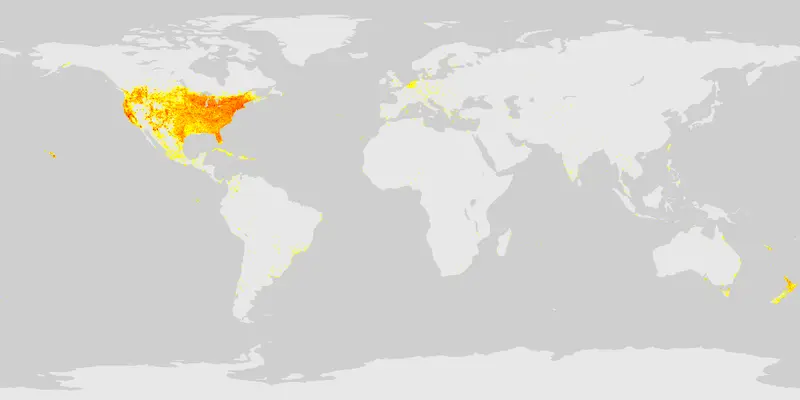
The wild turkey is one of the most widespread game birds in North America. It lives across most of the eastern United States, in scattered pockets throughout the West, and in parts of northern Mexico, especially in the mountains. It has also been introduced to Germany and New Zealand. Turkeys do best in hardwood forests or mixed forests of hardwoods and conifers broken up by openings such as pastures, fields, orchards and seasonal marshes. The birds are plentiful today, and many states have been releasing them into areas where they did not live before, so the range keeps growing. Hunting groups and other organizations work to keep populations healthy across the country. There are six subspecies, which differ in size, plumage and where they live. When and where to look: turkeys do most of their feeding in the first two or three hours after dawn and again in the hours before dusk, so early morning and late afternoon at the edge of woods and fields are best. Spring is the noisy season, when males gobble and strut. In summer, look for hens leading their young, called poults. In winter, turkeys gather in bands, and at night they fly up to roost in trees.
When & where in the US
GBIF holds 2,451,541 occurrence records of this species from the United States. States with the most records:
- California 227,265
- Wisconsin 194,690
- Massachusetts 152,096
- Michigan 151,778
- New York 151,140
Occurrence records reflect where and when people look and report (observer effort), not just where the animal is common. Busy birding states and summer months are over-represented; zoo and museum records can appear for non-native species.
Source: GBIF occurrence search for country US.[8]
What it eats
Turkeys are omnivores, but most of what they eat is plant material. Acorns and other nuts, seeds, buds, leaves, fern fronds, fruits and roots are all important. Insects that live on the ground, along with salamanders, make up roughly a tenth of the diet. Nearly all foraging happens on the ground as the birds walk along, though a turkey will sometimes hop up into a shrub or low tree to pluck fruit or buds. Watching a flock work slowly across a woodland floor or a field edge is a good way to see this in action. Feeding peaks early and late in the day, in the few hours after sunrise and before sunset. Because they eat so many nuts and seeds, turkeys affect the plants of the forests they live in, and in turn they are an important food for many predators. Wild turkeys are wary birds with sharp eyes and good hearing, so you will usually see more if you stay still and quiet at a distance.
Reproduction and life cycle
Wild turkeys are polygynous, meaning one male mates with several females. Courtship starts in late January in the South and late February in the North. Adult males, called gobblers, gobble and strut, fanning the tail, dropping the wings until they drag on the ground, raising the back feathers, pulling the head back and puffing up the crop. A gobble can carry for more than a mile. A male's head turns red, blue or white depending on the season, and he has a red wattle hanging from the throat and a fleshy knob on the forehead. Males provide no care for the young. The hen scratches out a shallow dip in the ground, usually hidden in thick brush, vines, tangles, tall grass or a fallen treetop. She lays a large clutch, often around a dozen eggs, and sits on them for about four weeks. The chicks are precocial, able to walk and feed themselves within a day of hatching. For the first two weeks she broods them at night, and she defends them fiercely, sometimes chasing hawks. Young males stay with her through the fall and young females into the next spring. Turkeys can breed at about ten months, but young males rarely beat older rivals in their first spring. Hens often lay eggs in each other's nests, and turkeys sometimes even lay in ruffed grouse nests. Ring-necked pheasants, in turn, may lay in turkey nests.
Threats and conservation
Wild turkeys are plentiful and widespread, with a North American population once estimated at around four million, and they are listed as Least Concern. They are not legally protected the way most songbirds are and are hunted in many states. Turkey hunting brings in large sums for state natural resource agencies and conservation groups, and some of that money pays for habitat improvement. Life is short for most turkeys: average life expectancy is only about a year and a half, though one wild bird lived at least thirteen years. Eggs and young chicks are eaten by raccoons, opossums, striped and spotted skunks, gray foxes, woodchucks, rodents, birds, bobcats, rat snakes and bull snakes. Humans are the main predator of adults, followed by coyotes, bobcats, raccoons, mountain lions, golden eagles and great horned owls. Turkeys also carry at least sixty kinds of parasites, from protozoans and worms to arthropods. Their best defenses are caution, keen senses, fast running and powerful flight, and they have been clocked flying at highway speed.
How to tell it apart
- Canada goose: Both are large birds that graze fields, but the goose has a black neck, white chinstrap and webbed feet, and it swims. A turkey has a red, blue or white head with a red wattle, long legs and dark, shimmering plumage.
- American crow: Dark birds walking a field can look alike at a distance, but crows are much smaller and glossy black, while a turkey is a huge, long-necked bird that runs fast or bursts into strong flight.
- Bald eagle: Young eagles can look dark and turkey-sized on the ground, yet an eagle has a powerful hooked beak, feathered head and big talons. A turkey has a small head, a fleshy wattle and a large fan-shaped tail.
- Great horned owl: Both roost in trees at night, and the owl is one of the hunters that kills adult turkeys. The owl sits upright with ear tufts and big yellow eyes; a turkey is far bigger, with long legs and a long neck.
Photo: (c) Judy Gallagher, some rights reserved (CC BY) — CC BY 4.0, source[9]. See all image credits.
Sources
- GBIF Backbone Taxonomy — Meleagris gallopavo (species 9606290), via GBIF API — retrieved 2026-11-21
- GBIF — synonyms of Meleagris gallopavo — retrieved 2026-11-21
- GBIF — vernacular names of Meleagris gallopavo — retrieved 2026-11-21
- ITIS — full hierarchy for TSN 176136 — retrieved 2026-11-21
- IUCN Red List category via GBIF (Meleagris gallopavo) — retrieved 2026-11-21
- Animal Diversity Web (University of Michigan) — Meleagris gallopavo account — retrieved 2026-11-21
- GBIF occurrence density map tile for Meleagris gallopavo — retrieved 2026-11-21
- GBIF occurrence search — Meleagris gallopavo, country US, month and state facets — retrieved 2026-11-21
- iNaturalist taxon 906 — Meleagris gallopavo (photo source) — retrieved 2026-11-21

Written under the pen name Maya Reynolds with AI-assisted drafting, then checked against the sources cited on each page. Last reviewed 2026-11-21. Numbers in the fact table come only from the linked sources; all prose is original. See our editorial policy.