Great horned owl
Bubo virginianus (J.F.Gmelin, 1788) · also called American Eagle-Owl, American Horned Owl, Big Hoot Owl, Cat Owl, Great Horned Owl (Great Horned), Hoot Owl
The great horned owl is a large owl with horn-like feather tufts, yellow eyes and a white throat spot, found from Alaska into South America in woods, deserts, wetlands and even cities.

Quick facts
| Kingdom | Animalia[4] |
|---|---|
| Phylum | Chordata[4] |
| Class | Aves[4] |
| Order | Strigiformes[4] |
| Family | Strigidae[4] |
| Genus | Bubo[4] |
| Species | Bubo virginianus[1] |
| Authority | (J.F.Gmelin, 1788)[1] |
| ITIS TSN | 177884[4] |
| Synonyms | Strix virginiana[2] |
| Other common names | American Eagle-Owl, American Horned Owl, Big Hoot Owl, Cat Owl, Great Horned Owl (Great Horned), Hoot Owl[3] |
| Length | 45.7–63.5 cm (18–25 in)[6] |
| Weight | 1450 g (3.2 lb)[6] |
| Lifespan (max. recorded / range) | 28 years[6] |
| Eggs per season | 1 to 6[6] |
| Incubation (time to hatching) | 30 to 37 days[6] |
| Diet type | is[6] |
| Habitat | Woodland mixed with open fields, deserts, swamps, marshes, farmland and towns · ADW biomes: tundra tundra taiga taiga desert or dune desert or dune savanna or grassland savanna or grassland chaparral chaparral forest forest rainforest rainforest scrub forest scrub forest mountains mountains[6] |
| IUCN Red List | Least Concern (LC)[5] IUCN page Population trend: not available through GBIF; see the IUCN assessment. |
Where it lives
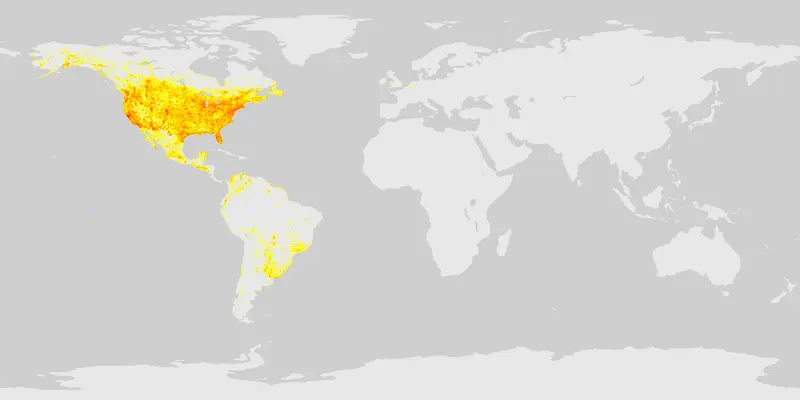
The great horned owl covers a huge area. Its range takes in most of North America and continues south through Central America into South America, stretching from around the northern tip of Alaska far into the Southern Hemisphere. It lives anywhere from sea level to mountain heights of roughly eleven thousand feet. The best places are patchworks of woodland and open fields, but the list of habitats is long: grasslands, deserts, swamps, marshes, mangroves, farmland and both rural and urban settlements. These owls do not migrate; they stay in the same general area. Size and color change across the range. Northern owls tend to be bigger with longer wings, matching a pattern called Bergmann's rule, while a woodland subspecies can be darker and browner and a desert form in Baja California paler and grayer. In United States records gathered by GBIF, the most sightings come from California, Texas, Colorado, Arizona and Florida, and reports peak in April. When and where to look: woods next to open fields, parks and farmland with big trees. Listen at dusk or after dark for the deep territorial hoots, a pattern like hoo-hoo hoooo hoo-hoo that can carry for miles. Nesting comes in the colder months, since breeding runs from about November to April, and owls farther north tend to nest later in the year.
When & where in the US
GBIF holds 1,366,380 occurrence records of this species from the United States. States with the most records:
- California 241,090
- Texas 92,301
- Colorado 83,843
- Arizona 74,903
- Florida 66,603
Occurrence records reflect where and when people look and report (observer effort), not just where the animal is common. Busy birding states and summer months are over-represented; zoo and museum records can appear for non-native species.
Source: GBIF occurrence search for country US.[8]
What it eats
Great horned owls are carnivores that mostly hunt land animals with backbones. What they eat depends on what is around. In older, mature forests, rabbits, hares and voles are key prey. In the southwestern United States, where the owls run smaller, they often take young rabbits, small rodents and insects. Out in fields and deserts, rodents and insects are probably the main meal. Near water, the owls can catch fish, frogs and other amphibians, crustaceans and reptiles, and birds are also on the menu. A typical hunt starts from a perch. The owl scans for prey, drops down on it and will snatch it in midair if needed, and it screeches loudly as it attacks. Its eyes face forward, giving binocular vision that is sharp straight ahead though weaker to the sides, and it uses sight to find prey and to move through dark, dense forest. Because they eat many rodents and insects that people count as pests, the owls can help keep those animals in check near homes and farms. On the other hand, they sometimes take chickens and other poultry. Owl numbers rise and fall with prey: when snowshoe hares are abundant, owl populations climb, and when hares crash, owls decline.
Reproduction and life cycle
Great horned owls are monogamous, and the pair raises the young together. Mates find each other through hooting, which grows more intense as the breeding season nears; males hoot all year, while females hoot only around mating time. Courtship involves vigorous nodding and bowing, followed by a calmer phase of billing and cooing. The owls do not build their own nests. They move into nests left by squirrels or other birds, including other great horned owls. In mature forest they may use sites as high as about a hundred feet, while in prairies and younger habitats nests may sit in bushes, cliff nooks or even on the ground. A clutch holds one to six eggs, and brood size follows the food supply; along the East Coast more than two young is unusual, but three or four is fairly common farther west. Eggs hatch in about a month or a little longer. While nesting, the male does most of the hunting and the female guards the brood, though she will leave to hunt when food is scarce. Young owls fledge at six to nine weeks and reach maturity within one to three years. Pairs defend the area near the nest from other breeding owls, and some owls without territories, called floaters, roam between the home ranges of others. Territory fights can be deadly. In summer, when biting blackflies are active, owls roost on or near the ground and return to the treetops in winter.
Threats and conservation
This is one of the most widespread and successful birds in the United States, and it is neither threatened nor endangered. The IUCN lists it as Least Concern. At the top of many food chains, it has no regular predators, though crows and raccoons sometimes eat its eggs, and fights between owls over territory can kill. Disease is another risk. Avian malaria, spread by infected blackflies, is not always fatal but can afflict the birds, and owls can lose their sight through injury, infection and possibly inherited disorders. Habitat degradation and other human activities are expected to shorten lifespans. The average wild owl lives about thirteen years, and the wild record is twenty-eight; in captivity owls average twenty years, with a record of thirty-five. Females are larger than males, averaging about three and three-quarter pounds against close to three for males. Recordings of hooting are sometimes used to estimate how many owls live in an area. To keep owls nearby, protect mixed woods and fields and secure poultry at night.
How to tell it apart
- Red-tailed hawk: A daytime hunter of the same farm country. The hawk lacks ear tufts and has a paler belly crossed by a dark band, yellow legs and a brownish red tail. The owl has tufts, forward-facing yellow eyes and a barred white belly.
- American crow: The crow is glossy black and noisy, while the owl is mottled black and brown on the back with a white throat spot. Crows mob predators, and they sometimes eat owl eggs.
- Bald eagle: Both are large birds at the top of the food chain, but an adult eagle has a mostly white head and tail on a dark body and no ear tufts.
- Peregrine falcon: A falcon has long tapered wings, a slim short tail, a white face with a black cheek stripe and large dark eyes. The owl is bulkier, with ear tufts and yellow eyes set in a round face.
Photo: no rights reserved — CC0 1.0, source[9]. See all image credits.
Sources
- GBIF Backbone Taxonomy — Bubo virginianus (species 5959118), via GBIF API — retrieved 2026-11-21
- GBIF — synonyms of Bubo virginianus — retrieved 2026-11-21
- GBIF — vernacular names of Bubo virginianus — retrieved 2026-11-21
- ITIS — full hierarchy for TSN 177884 — retrieved 2026-11-21
- IUCN Red List category via GBIF (Bubo virginianus) — retrieved 2026-11-21
- Animal Diversity Web (University of Michigan) — Bubo virginianus account — retrieved 2026-11-21
- GBIF occurrence density map tile for Bubo virginianus — retrieved 2026-11-21
- GBIF occurrence search — Bubo virginianus, country US, month and state facets — retrieved 2026-11-21
- iNaturalist taxon 20044 — Bubo virginianus (photo source) — retrieved 2026-11-21

Written under the pen name Maya Reynolds with AI-assisted drafting, then checked against the sources cited on each page. Last reviewed 2026-11-21. Numbers in the fact table come only from the linked sources; all prose is original. See our editorial policy.