Canada goose
Branta canadensis (Linnaeus, 1758) · also called Canada Goose (canadensis Group), Canada Goose, Greater Canada Goose, Greater Canada Goose
The Canada goose is a large North American goose with a long black head and neck, a white chin mark and a brown-gray back, famous for honking flocks that fly in a V.

Quick facts
| Kingdom | Animalia[4] |
|---|---|
| Phylum | Chordata[4] |
| Class | Aves[4] |
| Order | Anseriformes[4] |
| Family | Anatidae[4] |
| Genus | Branta[4] |
| Species | Branta canadensis[1] |
| Authority | (Linnaeus, 1758)[1] |
| ITIS TSN | 174999[4] |
| Synonyms | None listed[2] |
| Other common names | Canada Goose (canadensis Group), Canada Goose, Greater Canada Goose, Greater Canada Goose[3] |
| Length | 76–110 cm (2.49–3.61 ft)[6] |
| Weight | 3–10.9 kg (6.61–24 lb)[6] |
| Lifespan (max. recorded / range) | 30 years[6] |
| Eggs per season | 2 to 10[6] |
| Incubation (time to hatching) | 28 to 30 days[6] |
| Diet type | herbivore[6] |
| Habitat | Grassy places near ponds, marshes, rivers, coasts, parks and farm fields · ADW biomes: tundra tundra savanna or grassland savanna or grassland forest forest[6] |
| IUCN Red List | Least Concern (LC)[5] IUCN page Population trend: not available through GBIF; see the IUCN assessment. |
Where it lives
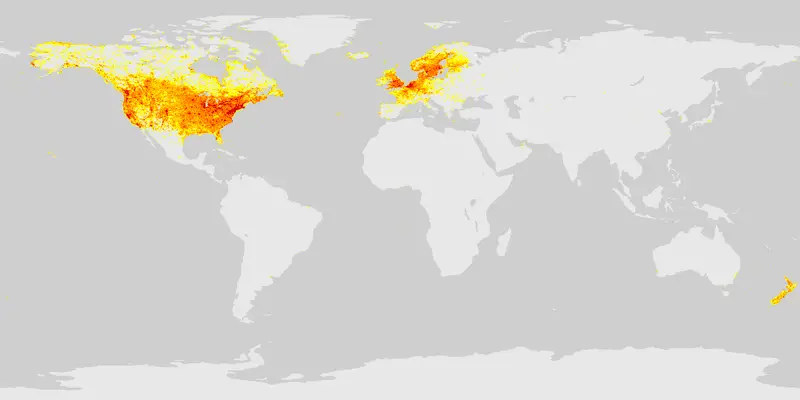
Canada geese are native to Canada, the United States and Mexico. Much of North America falls within their range, and most birds spend the winter in the southern part of the continent. Deliberate releases and wandering birds have also brought the species to much of Europe, to Australia and to parts of Asia, including Japan, Korea and Russia. They like open, grassy ground near water, such as ponds, marshes, rivers and coastlines, and they tend to avoid tall grass and shrubs that could hide a predator. They manage at almost any elevation, from the seashore to alpine country. Many flocks have settled into towns and suburbs with mowed lawns, and farm fields draw grazing birds too. Not every goose migrates. Resident town geese have smaller home ranges than migrants, helped by year-round lawn food and few predators. Because young geese learn migration from their parents, the offspring of a pair that stays put will stay put too. GBIF records in the United States are most numerous from New York, Ohio, California, Illinois and Pennsylvania, with reports peaking in April. When and where to look: open water bordered by short grass. Listen for honking overhead as V-shaped flocks pass. The wedge saves energy, and the lead bird changes because the front spot is the most tiring. In spring and summer, look for pairs with goslings and for groups of families together.
When & where in the US
GBIF holds 18,659,196 occurrence records of this species from the United States. States with the most records:
- New York 1,594,252
- Ohio 1,163,806
- California 1,113,273
- Illinois 1,100,231
- Pennsylvania 981,224
Occurrence records reflect where and when people look and report (observer effort), not just where the animal is common. Busy birding states and summer months are over-represented; zoo and museum records can appear for non-native species.
Source: GBIF occurrence search for country US.[8]
What it eats
A Canada goose is mainly a plant eater. Its diet is mostly leaves, grass, seeds, berries, algae and roots, and the birds need food rich in protein and energy. Along the edge of the bill run comb-like ridges called lamellae, which help the goose grip grass; it then pulls the blades free with a quick jerk of the head. Geese steer clear of plants loaded with chemical defenses, which protects them from upset stomachs and poisoning. Animal food is a small extra. Insects, small fish, crustaceans, mollusks and other water invertebrates are eaten now and then, mostly by growing goslings, by parents raising young and during breeding, when extra nutrients matter. If weather or other conditions keep them from feeding, adults can go as long as about a month without eating. Geese also help plants by spreading the seeds of what they eat. Grazing flocks on lawns can be a nuisance, since they leave droppings, damage turf and pack down the soil, and keeping them off golf courses, lawns and farms can be costly.
Reproduction and life cycle
Males are called ganders and females are called geese. Birds tend to choose partners of a similar size, and pairs are monogamous, often for life. If one partner dies, the survivor finds a new mate. Nesting usually happens in April and May, sometimes stretching into June in colder places. The female builds the nest, often returning to a favorite site each year. She looks for a place close to water with a good view, gathers twigs and grass and lines the nest with feathers or down. Geese can mature at two years, but most do not breed until they are at least three. She lays from two to ten eggs, roughly a day and a half apart, and incubation starts after the last one. The eggs hatch in about four weeks, and the goslings use a hard egg tooth on the bill to break out. Both adults guard the nest before and during incubation, and after hatching the gander takes over defense, ready to charge predators and other geese. Goslings are well developed and can leave the nest as soon as a day after hatching, when the parents lead them to food and water. Families often band together in groups called crèches. The young fledge at about six weeks and can fly and feed themselves within roughly two months, but they stay with their parents until after the next spring migration. At some point in the breeding season the adults molt and cannot fly for about a month, which leaves them more open to predators.
Threats and conservation
Canada geese are of little or no conservation concern, and the IUCN lists them as Least Concern. The population is very large and seems to be growing, even though some places try to control it. Since the federal migratory bird law took effect in nineteen eighteen, these geese can be hunted only during open season or with a special permit, but in towns where they are seen as pests some are killed without permits. People cause the great majority of goose deaths, mostly through hunting. Adults are big enough to have few predators, and they honk, hiss and lunge when threatened. Eggs and goslings left alone are at much greater risk from gulls, ravens and crows, as well as foxes, wolves, coyotes, bears, dogs, skunks and raccoons. Geese carry parasites such as gizzard worms and can suffer avian cholera, botulism, salmonella, aspergillosis and duck virus enteritis, and they can also carry avian influenza. Germs in droppings can spread to people or animals, which makes geese a concern for water supplies. Near airports, flocks delay takeoffs and landings, and geese pulled into an engine can bring down a plane. One wild goose was reported to live more than thirty years, though most live about twelve. Seven subspecies are recognized, the giant Canada goose being the largest, and in two thousand four the cackling goose was split off as a separate species.
How to tell it apart
- Mallard: Often in the same pond, but a mallard is a much smaller duck. The male has an iridescent green head and neck and both sexes show a blue wing patch, while the goose has a long black neck with a white chin mark.
- Wild turkey: A turkey at a field edge can be as bulky as a goose, but it has long legs, a big fan-shaped tail and, in males, a red wattle and a red, blue or white head. It lacks the black neck and white chin mark of the goose.
- Bald eagle: Both are big birds near water, but an adult eagle has a mostly white head and tail on a dark body, not a black neck with a white chin patch.
- American crow: From afar a dark bird on a lawn could be either. A crow is entirely glossy black, while a goose has a brown-gray back, a pale belly and rump and a white mark on its black head.
Photo: no rights reserved — CC0 1.0, source[9]. See all image credits.
Sources
- GBIF Backbone Taxonomy — Branta canadensis (species 5232437), via GBIF API — retrieved 2026-11-21
- GBIF — synonyms of Branta canadensis — retrieved 2026-11-21
- GBIF — vernacular names of Branta canadensis — retrieved 2026-11-21
- ITIS — full hierarchy for TSN 174999 — retrieved 2026-11-21
- IUCN Red List category via GBIF (Branta canadensis) — retrieved 2026-11-21
- Animal Diversity Web (University of Michigan) — Branta canadensis account — retrieved 2026-11-21
- GBIF occurrence density map tile for Branta canadensis — retrieved 2026-11-21
- GBIF occurrence search — Branta canadensis, country US, month and state facets — retrieved 2026-11-21
- iNaturalist taxon 7089 — Branta canadensis (photo source) — retrieved 2026-11-21

Written under the pen name Maya Reynolds with AI-assisted drafting, then checked against the sources cited on each page. Last reviewed 2026-11-21. Numbers in the fact table come only from the linked sources; all prose is original. See our editorial policy.